The Time Traveller’s Almanac – The Ultimate Treasury of Time Travel Fiction – Brought to You from the Future
Edited by Ann and Jeff Vandermeer
Published by Head of Zeus (UK), November 2013
ISBN: 978-1781853900
800 pages
Review by Mark Yon
As we approach the end of the year, we get another behemoth collection from the Vandermeers and Head of Zeus. After 2011’s The Weird, which deservedly won awards, and last year’s Zombies! in 2013 we get The Time Traveller’s Almanac. (Or at least we do here in the UK: US readers will have to travel a little further in time until March 2014 for their copies.)
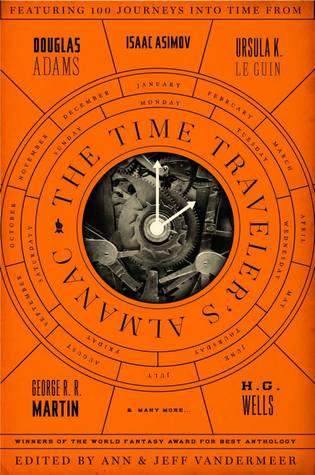
There are many collections of time travel stories out there. This one is claimed to be the biggest, and, as I’m sure many reviews will say, this is a huge book. 800+ pages of fairly small print, with over sixty authors and over one hundred stories. There’s certainly a range here.
This size is both a blessing and a curse. As a result of its size I found that it’s a book that has to be dipped into in stages, rather than try and read in one go. To help – and as the subtitle above will tell you- there is an overall connecting theme, which I liked – that this is a book brought to us from time-travellers in the future, from 2150. To further help the reader gain a grasp of this nebulous ‘timey-wimey’ concept (to paraphrase Doctor Who), the book is divided into broad sections – Experiments, Reactionaries and Revolutionaries, Mazes and Traps, and Communiques.
The first section, Experiments, features stories in which people are experimenting with time travel or are subjects of experimentation, Reactionaries and Revolutionaries is stories where people try to protect the past, Mazes and Traps are tales where time paradoxes are prevalent, and Communiques are stories about people trying to get a message to someone/somewhen out of their own time, either in the past or the future.
There are also non-fictional interludes along the way summarising key points of travel: Top Ten Tips for Time Travellers, Time Travel in Theory and Practice, Fashion for Time Travellers, Music for Time Travellers. (Some may be pleased to note that David Bowie is not mentioned in any of those.)
It is difficult to summarise such a tome, and it would perhaps be wrong of me to try. However, like the previous Vandermeer collection, I found old personal favourites (Ray Bradbury, HG Wells, Asimov, Kuttner and Moore, Connie Willis) as well as ones totally new to me (Vandana Singh, Dean Francis Alfar, Rosaleen Love, Karen Haber, Rjurik Davidson). I found stories from authors I liked, but hadn’t read (George RR Martin, Kristine Kathryn Rusch, Adrian Tchaikovsky, Kim Newman, Eric Frank Russell) and stories I know others will like but left me cold (Ursula K leGuin, Adam Roberts). There are some old ones (Edward Page Mitchell’s The Clock that went Backward, 1881, regarded here as one of the earliest time-travel tales, Max Beerbohn’s Enoch Soames, 1916, EF Benson’s In the Tube 1923), and some relatively new ones (John Chu’s Thirty Seconds from Now, 2011, Adrian Tchaikovsky’s The Mouse Ran Down, 2012). There were some that I forgot nearly as soon as I had finished reading them, even some I disliked. But that is the nature of such an eclectic assemblage: if you don’t like one, there’ll be another along in a minute that you probably will.
With such an enormous collection, there are bound to be gaps and lapses – or, as the book’s Preface put it, ‘wormholes and rifts’, although any book claiming to be ‘The Ultimate’ something is just asking for trouble. I was surprised not to find some of the ‘old timer’ tales here, even if just to show how far such tales have developed.
Such matters usually lead to that great debate over what has been included and what’s not: why has Mike Moorcock’s Pale Rose been included rather than the much more famous short story Behold the Man? (The Vandermeers do actually explain that one themselves in their introduction to Mike’s story.) Why is there an extract from HG Wells’ short novel, The Time Machine, rather than his earlier short story, The Chronic Argonauts (which inspired him to write The Time Machine)? Why no Poul Anderson (Time Patrol), no H Beam Piper (Paratime stories), no Jack Finney (Time and Time Again) or L. Sprague de Camp (Lest Darkness Fall)?*
This highlights an issue with this and other such collections, as to whether as an editor you try and cover the range and show the evolution of such tales by giving stories that are (ironically) endemic of their time, or go for what you see as ‘the best’, bearing in mind that such statements are qualitative anyway. Here the Vandermeers seem to have gone for the latter, even when some may be disappointed by the choices made, and other authors have the privilege of being included more than once – Kage Baker twice, Gene Wolfe twice (though this one has good reason, being connected tales), for example, although the quality of the stories is more good than bad. Such discussions are the basis of many an Internet forum/social media site.
One minor quibble, but the sort of thing I pick up on quickly, and others may be put off by it – I was a little dismayed to find that the first thing read in the Vandermeer’s Preface was a quote, with the person’s name spelt wrong – Stephen Hawking, not Hawkings! – which made me worry that the rest of the book would be as sloppy – it’s easy to mess up in a book of this size. Thankfully, after that things calmed down a little.
Such points may make you feel that this collection is a disappointment. It’s really not, but its choices may not be to everyone’s taste. There’s enough here to generate debate, a big enough range to give the reader an idea of just how big the topic is, and enough relative quality to offset the dingbats. This is how any collection should be.
For me, if I’m brutally honest, I liked this book, more than Zombies! (which was itself very good), although it must be said not as much as The Weird. It is, for all my quibbles, a very good collection and I would go so far as to say that it is an essential read. As an accumulation of time travel tales, it is hard to beat. Recommended.
Mark Yon, October – November 2013 (but possibly also 2113, and 1963.)
*(These are the first I thought of. I’m sure that there will be others that can be mentioned.)