A brother and sister separated at a very young age. A rebellious uprising against a strong-armed government. A post-apocalyptic world. Ancient magic and science, plus a blending of the two. These are all familiar ingredients in speculative fiction, which all come together in Ashes of the Sun, the first installment of Django Wexler’s Burningblade and Silvereye.
Long ago, a magical war destroyed an empire, and a new one was built in its ashes. But still the old grudges simmer, and two siblings will fight on opposite sides to save their world in the start of Django Wexler’s new epic fantasy trilogy.
Gyre hasn’t seen his beloved sister since their parents sold her to the mysterious Twilight Order. Now, twelve years after her disappearance, Gyre’s sole focus is revenge, and he’s willing to risk anything and anyone to claim enough power to destroy the Order.
Chasing rumors of a fabled city protecting a powerful artifact, Gyre comes face-to-face with his lost sister. But she isn’t who she once was. Trained to be a warrior, Maya wields magic for the Twilight Order’s cause. Standing on opposite sides of a looming civil war, the two siblings will learn that not even the ties of blood will keep them from splitting the world in two.
Gyre and his younger sister Maya, live rather peaceably with their family on a farm, except that Maya has a strange illness. When the Twilight Order arrives promising to keep Maya’s affliction under control on the condition that she is taken away and indoctrinated in the order, Gyre protests and suffers the consequences. Jump a dozen years and Wexler keeps the narrative focused on Maya and Gyre as their separation at 5 and 8 years old respectively, has irrevocably affected the course of their lives.
Maya is training to be a warrior-knight so she can help the Twilight Order continue their protection of humanity. She forms a very close bond with her mentor, Jaedia who trains Maya how to manipulate a mysterious, magical power source known as deiat which is essentially channeled into her sword-like weapon called a Haken. Part of this “protection of humanity” involves hunting and destroying plaguespawn, monstrous creatures that prey on humanity and can take on many different and frightening shapes. As Maya “levels” up in her training to achieve the title of Centarch, thus becoming an official member of the order, she learns more about the political machinations within the Order and how that has come to directly affect her mentor.
Meanwhile, Gyre has become a member of a rebel group obsessed with tearing down the Order, understandably seeing them as the reason for the ruin of his idyllic life and the essential destruction of his family. As a result of his various actions against the Order, he’s earned a reputation and is a wanted man. The course he finds himself on leads back to his sister Maya, but not in ways that he expected.
Let’s get the obvious out of the way – there are intentional echoes of Star Wars in this novel and story. One of Django Wexler’s ideas with this story/world is playing with the idea that Jedi simply grab kids at a young age, uproot them from their families, stick what is essentially a magic sword in their hand, and teach them to become wizard-knights to maintain peace and order. I’ve read plenty of genre novels that play with some of those Star Wars themes and the writer(s) don’t always have the skill and storytelling ability to leave the shadow of that inspiration. Nothing could be further from the truth with Ashes of the Sun, because Wexler takes that conceit of kids taken at a young age and brings very logical ramifications to bear. In addition to Star Wars, there were elements of the world that I found to be resonant with the “Age of Legends” era of history in The Wheel of Time, with the way the past technology was depicted as more of a techno-magic than technology or magic.
Maya’s storyline could conceivably be enough for one novel/storyline, but one of Django Wexler’s strengths is his ability to give his stories a flair for the Epic. He also tells an equally compelling story about Gyre and his efforts. Their parallel narrative (another storytelling trick I really enjoy when done right like it is done in Ashes of the Sun), provides for a fascinating look into the world and also a briskly-paced narrative.
Wexler has proven in his Shadow Campaigns saga that he follows a “no boundaries” approach with respect to keeping his story within the many subsets of Speculative Fiction. You could say he “kitchen-sinked” the milieu by throwing elements from many of those subsets into the world, but that would detract from the precision with which Wexler built everything about it. I got a sense that all the craziness in the current state of the world of the novels came about for very specific reasons.
The world is immersive and wondrous and one book into the series, it ranks pretty high on my list of secondary worlds. I’ve always been fascinated with Post-Apocalyptic stories and this one is very much in that vein, but the apocalypse here was magical in nature rather than scientific (i.e. nuclear war or plague). This allows for remnants of ancient techno-magic from the lost civilizations of the Chosen and the ghouls who fought in the Plague War 400 years earlier to pepper the landscape and world. Remnants like the aforementioned plaguespawn, which are essentially creatures like Frankenstein’s monster, but with non-human body parts added to the mix, all held together by the magic the ghouls wielded. Another example are skyfortresses which were utilized by the precursor society before and during the Plague War. There are many other hints at the past of the world, both before the cataclysmic Plague War and the Plague War itself. I also get hints of Steampunk/Clockwork elements that only enhance the world. In short, Wexler imbues a deep history to this milieu and I am 100% on board for anything he does in this world.
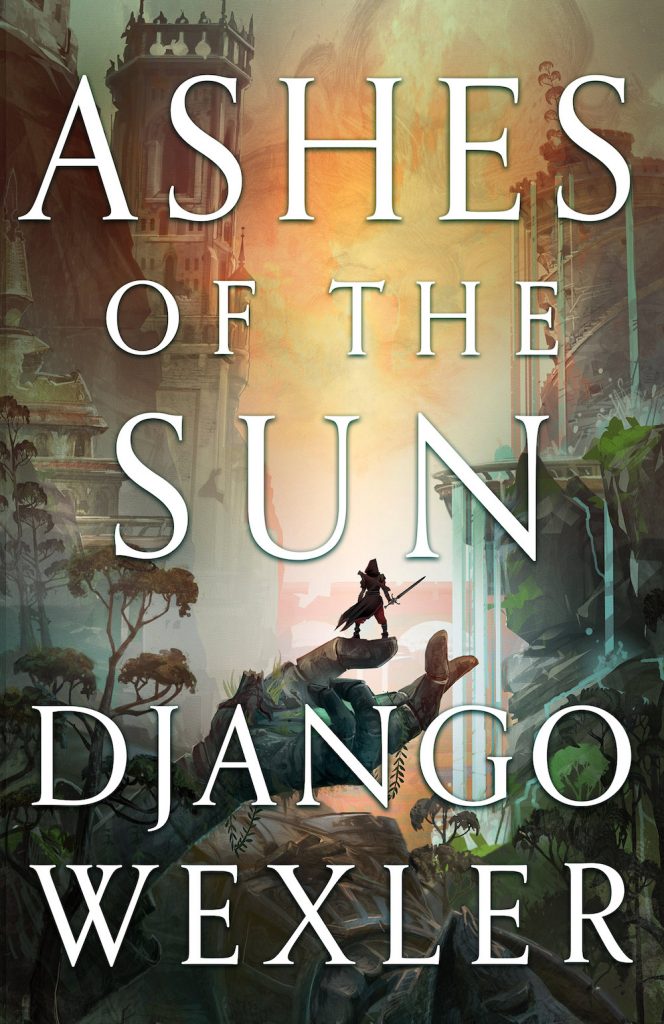
I also want to call out the amazing cover by Scott M. Fischer for this novel, which practically tells a story in itself as it draws the eye to the center. Great balance of character and landscape wonderfully evoke the world that Django Wexler’s words bring to life.
Ashes of the Sun is an enormously fun, thought-provoking novel that is an outstanding launch novel for a series.
Highly, highly recommended. It will take a great deal for any fantasy novel in 2020 to knock Ashes of the Sun off my top fantasy spot for the year.
© 2020 Rob H. Bedford
Trade Paperback | Orbit Books
July 2020 | 550 Pages (includes glossary)
https://djangowexler.com/