 Things are changing in sf writing, and (to paraphrase Doctor Who) some would say that it’s about time. Many of you reading this will know that the last few years have seen a greater prominence of stories that gender-flip or deal with gender-fluid characters in sf-nal situations, which have been greeted either with a collective sigh or just a feeling that the genre is growing up and dealing with issues that have tended to be underrepresented or just ignored in the past.
Watching from the sidelines (as I usually do), I am aware that these things often happen in cycles, become noticeable for a while and then either blend into the mainstream or disappear. Some may see this current trend as ‘a phase’, whilst others will welcome it. Personally, I think that such issues of race and sexuality have been part of the sf field since the New Wave of the 1960s with authors such as Samuel Delany, Octavia Butler and Ursula K le Guin, and whilst undeniably less noticeable in recent years, for lots of reasons for a long while, the new writers of today have been aware of their under-representation and grasped the issues with both hands.
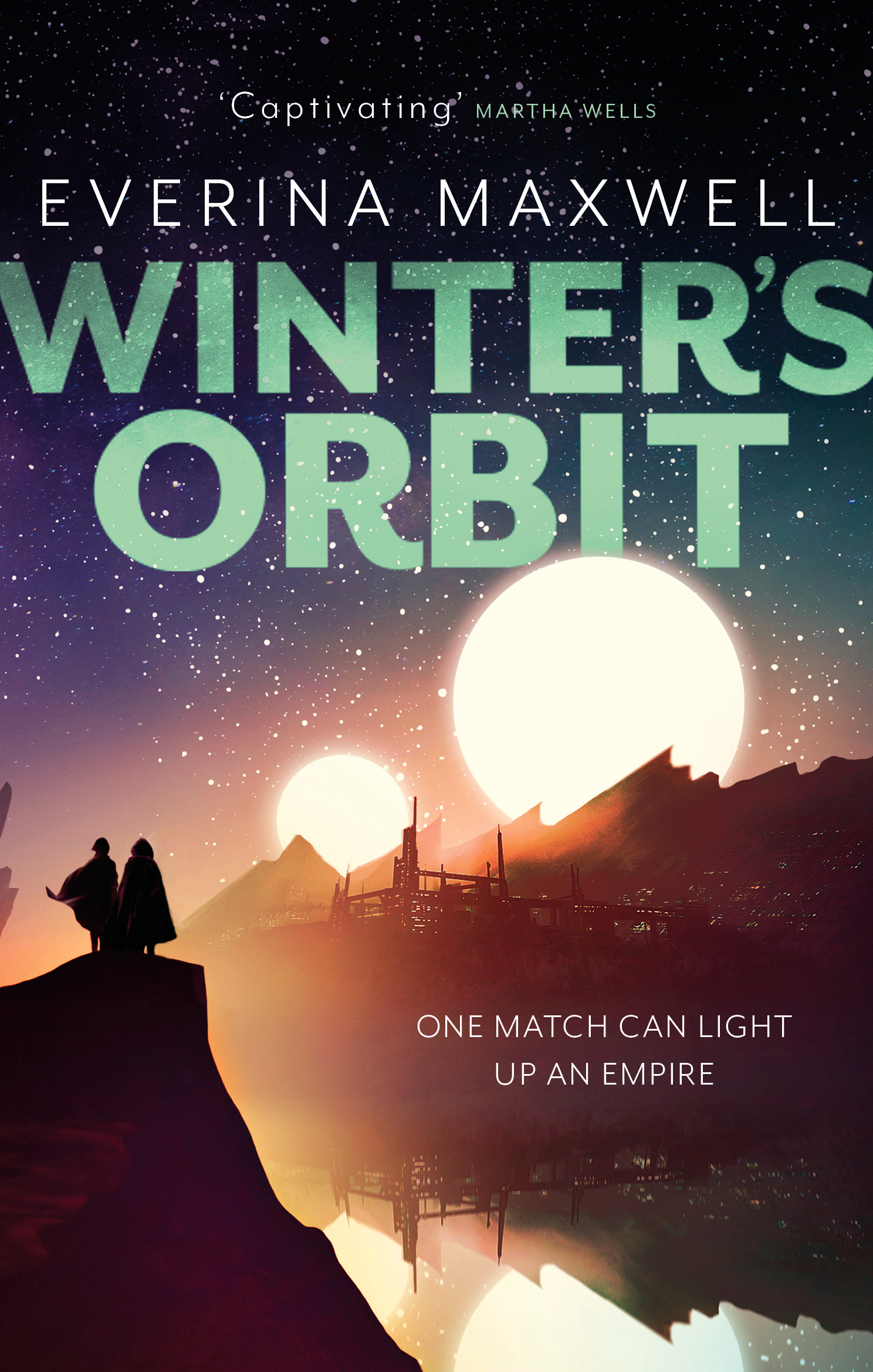
Winter’s Orbit is one of those books of the new generation. It takes fairly traditional sf tropes but uses them in a way that will be greeted with pleasure by those who have accepted the new.
It is basically a planetary romance, in more than one sense of the word, for it not only shows the development of a new relationship but also shows us the landscape and culture of the planet of Iskat. It nails its colours firmly to the mast of this new ship. At the beginning of the book Prince Kiem, Prince Royal of Iskat, and Count Jainan of Feria are to be married, and indeed are expected to be so as part of a planetary alliance that is political as well as cultural. Even whilst Jainan is grieving for his previous male partner, Prince Taam, he is expected to do the right thing and remarry in about one month after Taam’s death.
What we also have here is a political drama set against these characters. The Iskat Empire and Thea are due to renew their alliance by the signing of a treaty on Unification Day in just over a month’s time. Kiem, and Count Jainan are the designated representatives of the two factions and their marriage is meant to reflect the successful signing of the treaties. Continued trade with the other Galaxies is dependent upon this agreement and so this is overseen by the mysterious Adjudicator who has the final say-so on behalf of the Resolution, who run the rest of the Galaxies and whose role is to decide whether the treaty has been successfully renewed or not.
It is a strangely harsh environment. Thea is clearly a subjugated planet dependent on the Iskat Empire for its continued well-being, something which both planets clearly know. Jainan is forced to remarry on behalf of the planet Thea even though it is only a month since Taam’s death. Much of the early part of the book is about how the two main characters deal with that, having to start a new yet forced relationship, whilst Jainan is clearly still in mourning. Despite Kiem’s reputation as a flighty and rather disreputable playboy, he is quite keen to make the relationship work at a personal level as well as a practical one. In contrast Jainan is traumatised, and clearly reticent about the situation, afraid to do anything wrong and both upset his new partner and halt the political process. The reasons for this become clearer through the novel.
As if this didn’t give it away, the book’s strongest point is that it is, for all of its political trappings, a character-based Space Opera. We see how the characters, put in a difficult situation, learn to live with the state of affairs, learn and even love. By the end you may care about them and what happens to them.
And I guess that leads to the “elephant in the room” for some readers, in that the relationship is a homosexual one. Does it matter? Not really. One of the refreshing aspects of the story is actually about how much it actually doesn’t matter that they are the same sex. No big deal is made of the situation, and although there are sex scenes, they are not gratuitous – as it should be in any novel in my opinion.
The book very much reminds me of Lois McMaster Bujold’s Vorkosigan series, with the same level of respect and character development. It is no big surprise that Everina points out in her Acknowledgements that she is a fan of Bujold’s work.
On the negative side, it is not perfect. There’s some too-convenient conveniences along the way and one too many jeopardy plot devices being juggled for me near the end. The reticence of both characters to communicate with each other may be a little over-done at the start. But overall this was a gripping read of how lovers can overcome challenges together, written with heart and a lot of affection. I think it will do very well and I am sure that there will be more books after this one – the ending is deliberately open for them.
In short, Winter’s Orbit is a definite crowd-pleaser that breaks the traditional genre stereotypes and shows those (who didn’t know already) how the genre is changing. We’ve come a long way from a time when, as Douglas Adams described, “Men were men, women were women and furry creatures from Alpha Centauri were furry creatures from Alpha Centauri”. Here you can revel in how much things have changed.
Winter’s Orbit by Everina Maxwell
Published by Orbit, February 2021
448 pages
ISBN: 978-0356515885
Review by Mark Yon