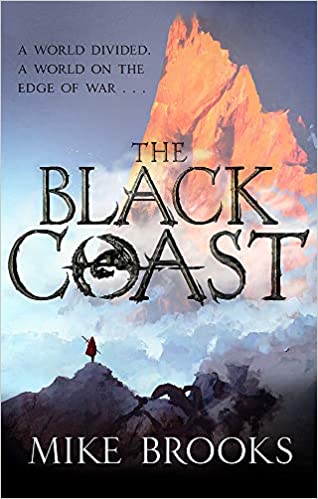
 There’s something great about reading an immersive fantasy, isn’t there? A book that you can wallow in, breathe in, live in, at least for a little while. Mike’s latest book, his debut Fantasy, I found to be one of those books.
There’s a lot of aspects that regular readers will like – a range of characters in different settings, fights of a small scale as well as epic, swords, god-like beings, not to mention dragons.
The story begins in the land of Narida, where the peaceful people of Black Keep suddenly find that a group of raiders from Tjakorsha arrive on their shores. Fearing attack, they rally to arms, to find that the Brown Eagle clan, led by Saana Sattistutuar, are actually there to settle peaceably, not invade.
It made me think of what it might have been like when the Vikings settled in Saxon lands 1600 years ago. There is suspicion, misunderstandings, hatred, old scores to be settled and betrayal and division as a result. The young Daimon Blackcreek, adopted son of Lord Asrel, finds himself having to negotiate a difficult line of diplomacy between the two often discordant groups. It also doesn’t help that he has gone against his father and his brother in order to create a fragile peace. He knows that the ruler of Narida will not take lightly the arrival of these heathens to his shores and once the news has got back to the ruler will no doubt lead to retribution on Daimon, not to mention the arrival of an army from The God King to reclaim ‘his’ authority.
Whilst the groups appear to adjust to this new reality, we then find the reason for the arrival of the raiders. Sanaa and her clan have moved to the Black Coast lands because of trouble in their original territory of Tjakorsha. There are stories of a god-like being (or draug) known as The Golden who has taken it upon himself to subjugate tribes like the Brown Eagles and rule them with some sort of demonic magic. It is not a kind rule, nor a just one, and according to prophesy preludes the end of the world, so Sanaa and her clan make the tough decision to move or be conquered.
Things are also unsettled elsewhere. From the Prologue we find that Natan, The God King of Narida is without an heir and therefore faces being usurped by the Splinter King as a viable alternative from neighbouring Alaba. His sister, Tila, is determined to remove the threat before it becomes a problem.
And then there’s dragons, used by the people of Black Keep and Narida in battle. Whilst these seem more like Tyrannosaurus Rex than the dragons of Game of Thrones, they are impressive. The battle scenes are quite visceral and show that the dragons are worth the wait.
So far, this sounds like a typical Fantasy story. Mike sets up a great world with a variety of memorable characters and a situation that seems on the cusp of change. But there are elements that make this more than the usual. Not only is this a Fantasy which covers many of the expected tropes, but The Black Coast is a story that is partly about peace and defending that peace rather than going to war. I liked the fact that it was in part about two disparate cultures attempting to overcome their various challenges and prejudices in order to work, live and survive together.
What Mike also does that is interesting is use diacritics (where symbols such as hé/shé etc are used) to denote gender. In Narida there’s also a difference shown in class, which leads to characters referring to themselves in the third person as “This lord” or “This man” as well as the first person. It’s a nicely unusual touch which allows the differences between the groups to be subtly shown without labouring the idea too much.
The Black Coast starts fairly slow but builds into an engaging solid piece of Fantasy that kept me turning those nearly 700 pages. Some nice characterisation and unusual touches turn this story into a superior piece of immersive fiction. For those looking at something to disappear into, it’s a great read.
The Black Coast by Mike Brooks
The God-King Chronicles Book 1
Published by Orbit Books, February 2021
672 pages
ISBN: 978-0356513911
Review by Mark Yon