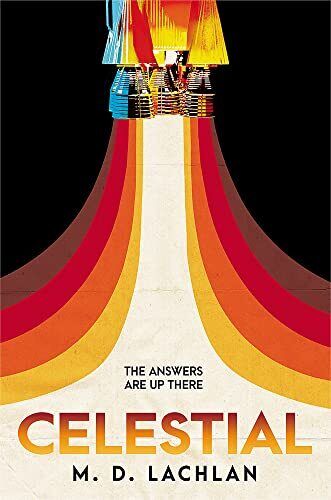
 Ziggy Da Luca is not an astronaut – she’s a Buddhist linguist. And yet she quickly finds herself as an additional extra on board a US spaceship heading to the Moon. The reason? A recently intercepted communication shows that the Russians have discovered a mysterious hatch on the Moon. The discoverers of this mysterious hatch have now disappeared. There is now, in this alternative 1977, a race between the Russians and the Americans to get to the Moon and find out what has happened. Ziggy’s skills may be needed to decipher the alien symbols.
However, Ziggy feels that she is out of her depth. Relatively untrained in space operations, with little experience of even using a gun, she is seen by at least one of the crew as necessary but unwanted excess cargo. Ziggy has to put up with Griffin’s antagonistic behaviour for the good of the mission, even though he knows that it is wrong and does little to moderate it.
The team arrive on the Moon to see their Luna-orbiting command module destroyed whilst they are on the way down to the Moon surface. With little alternative choice, Ziggy and the rest of the surviving astronauts (which unfortunately still includes Griffin) have to enter the alien artifact to survive.
Once inside, things get very strange, and not necessarily what they appear to be. The Americans meet the Russians who are as bemused as they are. This strange world inside the alien artifact feels a little like Fantastic Voyage (1966) as the group travel inside a world of expanding and contacting spaces, surrounded by pipes with strange fluids and symbols drifting inside. Ziggy and Kovacs, her Russian counterpart, find that they can speak to each other by telepathy and can see inside other’s minds. The story is then filled with images and flashbacks of their individual memories. But to what purpose?
The rest of the book is about how (and if) Ziggy and the team survive with the Russian cosmonauts to return home, as well as try together to uncover the mystery of the alien artifact in changed circumstances. Needless to say, revelations about human past history and the reasons for their vivid imagery mean that the future of humankind could be changed for ever.
An alien first-contact story, Celestial shows that M. D. knows his science fiction. There’s the alien artefact like the monolith in Arthur C. Clarke’s 2001: A Space Odyssey (1968) or even his Rendezvous with Rama (1973). The idea of first contact and the process of trying to decipher alien languages reminded me of Ted Chang’s Arrival. In other places, the Cold War standoff between the Russians and the Americans reminded me of the ending of the movie Ice Station Zebra (1968). There’s even a nice nod to Gerry Anderson’s Space: 1999.
This is not necessarily a bad thing. Lachlan takes all these familiar aspects and does what a writer should do – turns them into a story that is not what you expect, nor can you predict.
Celestial is deliberately quite different in style to Lachlan’s usual Fantasy writing, although it does feel more like soft-styled ‘New Wave’ Science Fiction rather than anything particularly hard-SF based. What happens inside of the artifact reads a little like a contemporary version of Stanislaw Lem’s Solaris (1961), or perhaps Tarkovsky’s movie of it (1972), or the biggest psychedelic trip since the 1960’s (see also 2001: A Space Odyssey.)
Expect lots of introverted navel-gazing and fractured visions, dreamlike flashbacks as the human presence inside the alien ‘thing’ causes changes to happen, both to the humans and the environment they are in. Each person seems to get different responses. Is what happens due to the aliens trying to make contact, to create a means of communication with the humans, or is it something more? Is it just the impact of psychological stress, of being there, with the strange environment amplifying the group’s emotions and relaying them back?
Things are initially unclear, and Lachlan does well to keep all options open and all the plates spinning as the plot develops. What Ziggy and her colleagues see as visions take up most of the book, which keeps the reader guessing, until by the end world religions, mythology and self-enlightenment are all involved.
On the downside, I can see that this book may not be for everyone. What feels like a typical Analog-style story to start with ends up being rather esoteric towards the end. As the alien contact seems to amplify human emotion, feelings of love, hate, revenge and everything in-between are on display and ramped up to eleven, which some readers may find annoying. In particular, Griffin seems to be particularly unsubtle, although the reasons for his attitude are explained along the way.
Overall, I thought that Celestial was pleasantly surprising.
This one may not be for everyone, but its elegant unravelling of an unusual plot and imaginative use of science fictional tropes made Celestial an enjoyable read for me.
Celestial by M D Lachlan
Published by Gollancz, November 2022
336 pages
ISBN: 978 057 5115 255
Review by Mark Yon