 Must admit that I approached this book knowing nothing about it, although the book comes with a high degree of provenance, as author Hays has a background of working in real museums and with art. It certainly shows in the elements that infuse this book. This is an author who gives the impression that her characters know what they’re talking about, whether it be Tarot cards or Renaissance artifacts.
The setting is wonderful. The Cloisters – whether real or not, I didn’t know – gave a real feeling of a safe haven in the middle of New York City in the Summer. The book begins in July and ends in September with all of the sweltering conditions and noise that this busy metropolis seems to offer. By contrast, The Cloisters are quiet, serene, and filled with quiet alcoves and shady retreats that must be a balm for anyone uncomfortable with the climate or the noise.
It is certainly something that our main character, Ann Stillwell seems to appreciate. Coming from the remote backwater of Walla Walla, she soon revels in the wealth of material and the atmosphere therein. Hays tells this story from her perspective, a person in need of escape from her troubled family background, who is desperately keen to make a new and fresh start in New York, working in an area of expertise that she loves. Ann is someone who doesn’t makes friends easily, nor does she usually make much of an impression. In fact, at the beginning of the story she is on the verge of being told that, despite expectations, there is not a Summer position for her at the Metropolitan Museum of Art.
Luckily for her she is taken under the wing of Patrick Roland, the curator of The Cloisters, although the reasons for this are initially unclear. Ann leaps at the chance to work at The Cloisters for not only is it a job opportunity, albeit just for the Summer, but also that The Cloisters is a museum quietly famous for its medieval and Renaissance collections, Ann’s area of expertise.
At the Cloisters Ann meets the outwardly confident Rachel, who seems to be the opposite of Ann in most things – personality, status and wealth. Working together, Ann finds herself desperate for Rachael’s attention but also to emulate her wealthy lifestyle. We come to realise that this means that the story then becomes not just a story of “What Ann did next”, but also a story about ambition, social climbing and power games, especially when Ann realises how the other people around her interact. It seems that Patrick and Rachel have a thing going – or have had in the past – but also Ann finds herself attracted to Leo, the Cloister’s full-time gardener, responsible for producing ancient herbs, plants and poisons at the Cloisters.
The plot thickens when Ann discovers a deck of 15th century Tarot cards that seem to suggest that during the Renaissance Tarot divination was much more important than has previously been proved. Like others around her she begins to question their power – can the cards define her own future? Are they steering events towards something that is not happenstance but ordained? Or is it just coincidence?
The development of these complicated relationships and the toxic friendships that may result are much of the middle part of this novel. The last part of the book becomes a murder-mystery when a death at the Cloisters puts all of them and their complicated histories under suspicion. One of them just might be a murderer – but why? And how?
Whilst there are elements that seem to be remarkably convenient or coincidental for convenience, it must be said that these didn’t detract too much from the overall feel of the novel. I did find plot points were left unresolved, though – this is not a story for those who like tidy endings. Most of all, at the end I was left wondering whether what was told was entirely true. The Cloisters does work on that aspect of “unreliable narrator” quite well.
The importance of the Tarot cards is also intriguing, as the reader is left to decide whether they shape our destinies, can be used to determine future actions or are simply a relic from an ancient age. It is perhaps this occult aspect of the story that genre readers may appreciate most, although in the end it is less important than it may at first appear to be. Like a lot of things in this novel, things are rarely what they seem to be.
This also applies to the characters. I think it would be fair to say that I can see that some readers may find them unappealing, even unpleasant, and yet at the same time they have a draw that is undeniable. As the story progresses, the point of interest seems to be whether Ann is drawn into their world or whether she is an instigator of events, something the reader is left pondering up to the end. And it is this aspect of toxic relationships that kept me reading until the end. It all felt rather Hitchcock-ian at the end, which is no bad thing in my book.
In short, The Cloisters is a modern book set in an ancient setting for a literate and informed readership who relish moral ambiguity and complexity. It reads very well and kept me guessing to the end. The Cloisters lures you in, with its talk of books, ancient artifacts and shady nooks and keeps you reading until you can’t put it down. Not my usual kind of reading perhaps, but I’m glad I did. This is what Peng Shepherd’s The Cartographers should have been like, but sadly wasn’t.
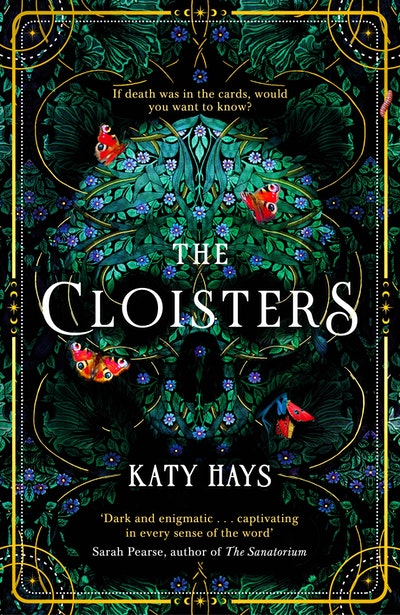
The Cloisters by Katy Hays
Published by Bantam Press, January 2023
320 pages
ISBN: 978-1787636392
Review by Mark Yon