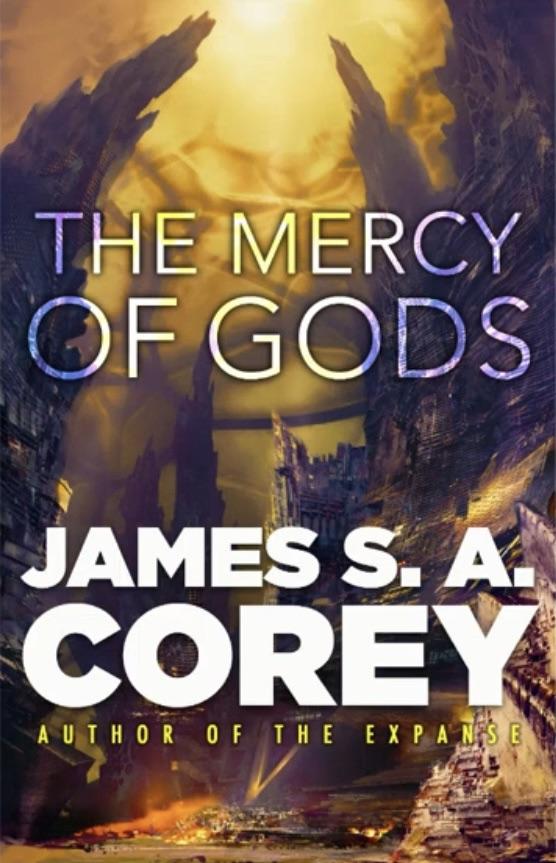
 I think it is safe to say that The Mercy of Gods is one of the most eagerly anticipated science fiction novels of the year. This is the first in a new series by Daniel Abraham and Ty Franck, the writers of The Expanse, one of the most popular series of SF novels and TV programmes of recent years. Part of the excitement being generated might be because The Mercy of Gods appears not to be set in The Expanse universe, but is the start of a new space opera series.
Although the story is about humans, it is not about earthlings. The Mercy of Gods is set initially on a different planet, that of Anjiin. Despite not being on Earth, the main characters have similar human traits and emotions – love, hate, jealousy, and so on, which the first part of the book does well to emulate. In fact, the beginning of the book begins almost like an Asimov-type academia story, with groups of scientists circulating interminable cheese and wine parties whilst jockeying for career advancement and future finance. This also allows us to meet our main characters. Tonner Freis is the leader of a group of scientists involved in research but looking for further finance. Dafyd Alkhor is in a rival group, an outsider partly there because of his family’s finances. Llaren Morse identifies a strange signal from outer space.
The book only really steps up a notch when the source of Llaren’s signal is discovered as alien, who then attack Anjiin. Immediately one in every eight people are killed. After five days the world is defeated. Tonnen, Dafyd, Llaren and a number of their colleagues are selected by the alien invaders and unceremoniously transported to a new world.
And it’s here where the book really gets interesting. The aliens, known as the Carryx, are really alien. Their motives are different to humans, their reasoning is different than ours, even their general demeanour unclear. Their actions are unexplained to the humans. The Carryx are assisted by a number of other alien species – the Soft Lothark, who seem to be some sort of soldier-servant, and Rak-Hunds, amongst others – although whether these aliens are there by choice or under duress is never quite clear.
The journey our human prisoners take to wherever they go (which is never really disclosed), is a long one. Though they are given basics of food and water, the conditions are harsh and their future unclear. The group of scientists are divided. What is interesting here is that the story is not a typical one of heroism and keeping a stiff upper lip under stress, but a story of survival, where the worst elements of human nature are exposed whilst the majority become passive and docile in defeat. Attempts at escape are futile and dealt with harshly.
At this point the book becomes less about an adventure and more about how humans perform under stress. Much of this is grim reading. Generally, the mood is of ennui, despair and depression. It isn’t a surprise to find that some of our characters with mental issues struggle in this situation.
“They have different assumptions and axioms. Different ways of understanding things like free will and what it means to be a person.”
When our humans arrive in their new environment, they are separated into groups. They find that they are just one alien race of many, all working for the Carryx. The alien overlords give the human groups tasks, the reason why and for what purpose are unclear initially. The science groups involving Torren and Dafyd find that their task involves them using their scientific skills to create a means of turning one species into food for another. Despite initial revulsion, the group find their work is challenging and engaging.
As the story widens scope, the humans find that they are but one species amongst many, all governed by the Carryx, performing different tasks for an unknown purpose. The humans soon realise that they are to the Carryx like animals in a pandemonic zoo – inmates in a prison separated by enormous gulfs of language.
Events transpire to show that they’re actually competing against other alien groups to complete their task and so stay in favour with the Carryx – in other words, their purpose is to find a way of staying alive and produce something of value to the Carryx. However, one of the Anjiin group has been infiltrated by another mysterious entity, that has its own agenda.
The Mercy of Gods is a dark novel of alien invasion and its aftermath. It takes on the idea that there are creatures out there in space who are truly alien, whose purpose is unclear and who regard us like we would insects. (I was at this point rather reminded of the enigmatic aliens in Arthur C Clarke’s Rendezvous with Rama.) Our needs are dealt with only because we can help the Carryx, our concerns, worries and desires unimportant. Humans exist here only because the god-like Carryx allow it. It is a sobering thought – what if future aliens are not benevolent, but like the Carryx instead? And is there anything they are afraid of?
The range of aliens the humans encounter is impressive – Elmrath, Phylarchs of Astrdeim, and Night Drinkers amongst others. Many are briefly described and mentioned, but rather like those in James White’s Sector General stories, they are varied and complex. It is clear that there’s a lot of them, and I suspect that we will find out more about them in later novels in this series.
For it is also clear that this is the first in a series. Much of the groundwork is done here, there are foretellings of possible future events and hints of bigger things afoot, whilst the ending is the inevitable cliffhanger to lead us to the next book.
However, The Mercy of Gods is a pleasingly complex start. It does not always go the way you might expect, which I liked. I was also pleased that the characters we get to know are also complicated and not always likable, or change as a consequence of what happens here.
In summary, The Mercy of Gods is an impressive start to a thoughtful and intelligent series which does not let the authors rest on their laurels. Challenging, provocative and absorbing – it may be worth the hype.
THE MERCY OF GODS by James S. A. Corey
Published by Orbit, August 2024
ISBN: 978 035 651 7797
424 pages
Review by Mark Yon