
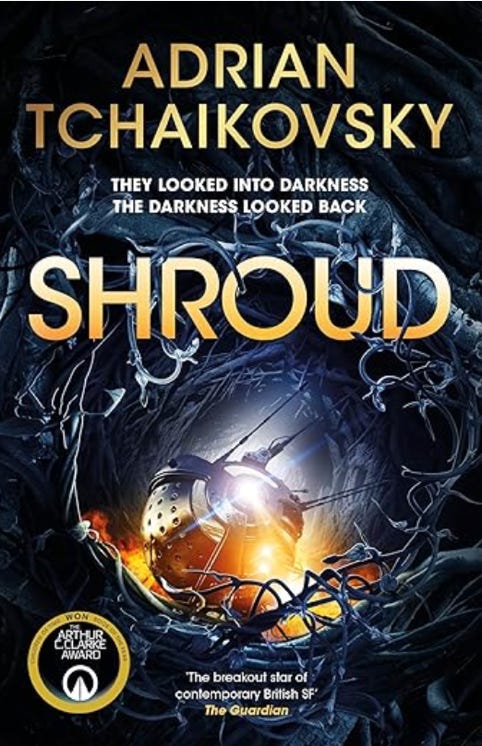
 To me, it seems that Adrian Tchaikovsky has been developing a reputation of late. He has in the last few years produced an enormous amount of genre material, year on year. Last year (2024) I think there were three alone.
What impresses me even more is that these books are usually different from each other (unless they’re in a series) and they do not decline in quality. There has been science fiction and fantasy, serious and humorous SF, for example. I was very impressed with his last science fiction effort, Alien Clay, which I reviewed (but not at SFFWorld) and said “it is familiar enough and yet strange enough to build on science-fictional tropes and take them to new and unusual places. It has clever plotting and imaginative world-building, whilst at the same time allowing the discussion of big and complex ideas in science and politics. It is seriously impressive.”.
With Shroud Adrian returns to SF – I was intrigued to see if he could keep up his current high hit-rate.
On the face of it, Shroud is a story of human/alien – really alien – first contact. The story is narrated by Juna Ceelander, one of a group of humans working for The Concerns, a commercial exploitation fleet. Their spaceship, the Garvaneer, discovers a pitch-black moon alive with radio activity. Its high-gravity, high-pressure, zero-oxygen environment is deadly to human life, but ripe for exploitation.
When an accident forces Juna and her colleague Mai Ste Etienne to land on the moon, they find themselves in a barely adequate escape vehicle, embarking on a gruelling journey across land, sea and air in search of salvation. This also means that they are at considerable risk from the alien creatures on the moon’s surface.
It could therefore be said that at its basic core Shroud is an updating of the old Analog staple story – how humans meet strange aliens and battle treacherous landscapes to survive through human ingenuity. What Adrian also does is tell a story of communication, and how two very different species attempt to understand each other. Because they are so different, this seems impossible, and yet over the course of the book both are sufficiently intelligent enough to work out a means of doing this, albeit initially limited. Shroud is an attempt to understand very different minds, as well as highlight the consequences of a rigid economic and social structure and its inability to change. I couldn’t help feeling that this was an updating of the sort of story beloved by John W. Campbell in vintage Analog magazine, where much of the plot is about solving one problem at a time, in order to survive.
Of course, this takes considerable skill for a writer. It’s not easy to write a 400-page novel that for much of it only involves two drugged-up humans, filled full of pharmaceuticals in order to survive on a world where you cannot see around you, and keep it interesting. (I was reminded of the challenges Sandra Bullock faced in Gravity, for example, although that was pretty much a solo performance.)
Admittedly, there is considerable tension built up over the pages by using limited and finite resources to try and reach a point where they can contact the spacecraft still orbiting the planet. Furthermore, a place where one of your main senses is redundant and where light is a relative unknown can only ratchet-up the tension. It also doesn’t help that the extremes of pressure on the moon’s surface means that getting off their padded couches is near impossible.
Perhaps most importantly, and something which I suspect Campbell would most definitely not have liked, is the fact that the framing story tells us that the human world away from Shroud is not particularly nice.
As told by Ceelander’s cynical and snarky monologue, humans survive by being a commodity – “eating up food and breathing air”, one character points out. They are nothing more than part of the societal machinery created by corporations, based on economic targets, efficiency ratings and spreadsheets, designed to optimise the exploration of new planets, the extraction of resources, the development of colonies and survival. Being prepared to perform more than one function and thinking outside the box is not something that is widely encouraged, although Juna’s role seems to be that of a go-between who smooths things over and get things working.
It doesn’t help that in this future society has worn the workforce down. This is no place where people are working for the greater good, but instead they are submissive to the corporations, who want people to accept the way it has to be, concerned with exploration for profits and survival. As Earth has collapsed it seems that the workers have little/no choice to accept the awful conditions they work in. For example, once a person has completed a task they are often put back into hibernation, with no knowing whether they will be resurrected at a future date.
With this in mind, I found that like in Children of Time, the aliens are also often more likeable than the majority of humans. You may find yourself, like me, rooting more for the aliens than the humans at some points, because, after all, in such a human society the aliens are seen as a mere nuisance, in the way of profit.
It doesn’t help that the last part of the book seems somewhat cynical and bleak, although it is a logical consequence of the species’ previous interactions. To lighten it a little, the enigmatic ending gives an intriguing glimmer of hope for the future, although it could also be seen as a tad creepy!
In short, Adrian has done it again. He’s taken some traditional science-fictional ideas and given them his own unique spin to create an arresting story that raises questions, introduces some unusual exobiology and holds your attention until the end. Another success, that I can see being on the Awards lists of 2025. How does he keep doing it?
© 2025 Mark Yon
Hardback | Tor Books
SHROUD by Adrian Tchaikovsky
February 2025 | 438 pages
ISBN: 978 1035 013 791
Review copy courtesy of the publisher, Tor Books


If this novel doesn’t sweep all the awards this year, then science fiction has lost its way.