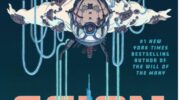
Alien invasion stories are often the sole purvey… or rather primarily categorized in the science fiction section of your bookstores and libraries. When you think about them for a moment, they really can be considered horror stories as well. You’ve got the sense of a large force threatening your life (and the entire planet for that matter). It shouldn’t be a surprise that Mira Grant (the name Seanan McGuire uses when her stories lean more science fictional) has published a novel at that intersection of horror and science fiction. Her Newsflesh series is a landmark set of Zombie novels, the Parasitology novels terrifyingly posit a world with genetically engineered tapeworms, and Into the Drowning Deep is the most horrific mermaid novel I’ve ever read. In this novel, the Earth is invaded by alien, sentient plant life. With Overgrowth, she visits the alien invasion scenario, but one not explored too often outside of a couple very notable examples (Day of the Triffids and Invasion of the Body Snatchers). While comparisons are made between Overgrowth and those stories, they are only superficial.

Since she was three years old, Anastasia Miller has been telling anyone who would listen that she’s an alien disguised as a human being, and that the armada that left her on Earth is coming for her. Since she was three years old, no one has been willing to listen.
Now, with an alien signal from the stars being broadcast around the world, humanity is finally starting to realize that it’s already been warned, and it may be too late. The invasion is coming, Stasia’s biological family is on the way to bring her home, and very few family reunions are willing to cross the gulf of space for just one misplaced child.
What happens when you know what’s coming, and just refuse to listen?
The novel is told through the first-person perspective of Anastasia “Stasia” Miller who always informs people upon first meeting them that she’s an alien and her people are coming. The thing is, she’s telling the truth, except the character whose story we follow through the novel isn’t the real Stasia. When Stasia was three-years old, she was replaced by an alien plant. This isn’t a spoiler since it occurs within the 25 pages of the novel. Fast foreword about twenty years to the year 2031, Stasia has a job and she has friends. One could say she lives the life of a decently-well adjusted neurodivergent adult or a young woman with some quirks. While she has her friends, her co-workers aren’t very fond of her, but her friends love and accept her. Her whole “alien invasion” thing is sort of hand-waived as a personality quirk.
It turns out, her “people” send a signal warning the world of their looming invasion in 2031. Because Stasia has been so vocal throughout her life about being an alien, she isn’t exactly an unknown entity. When she and her boyfriend Graham make a journey to find the scientist who received then distributed the signal to America, the trip doesn’t exactly go easily for them. Stasia and Graham pick up some companions along the way as the invasion looms over the whole world. Each chapter is effectively a countdown to the invasion, which does help to ratchet up the tension of an already tense story.
I mentioned neurodivergent as a possible descriptor for Stasia and I didn’t think of that initially. The more I consider the story, the more resonance I find between Stasia and Rose Darling from Chuck Tingle’s Camp Damascus. Not exactly a 1 for 1 comparison, but the idiosyncratic thought process and view we see through the protagonists of each novel of the world is similar enough.
Overgrowth is a novel that forced me to wrestle with some big thoughts. Because Stasia is the protagonist of the novel, I as the reader naturally built up a great deal of empathy for her. She is largely a likeable character and cares about her friends. Good start for a person. But she’s also, very much admittedly, part of an alien invasion so that makes her difficult to “like” in many ways and as a member of the human race, I both empathized with the difficult situation she was in, but also didn’t want her and her “people” to succeed. Grant plays a tricky game here with the character, but she does such a great job of putting the reader in the head of Stasia, which makes for a compulsive read. Because Stasia is protagonist who generates empathy, I wanted her to succeed. But as the “early warning party” of an alien invasion on Earth, I didn’t want her to succeed, I wanted to see her be diverted from her goals. I found it difficult to find a true way I wanted to lean: did I want her to “go native” and reject her alien heritage and side with humanity, or did I want to see her be true to her biological origins? That internal question helped to keep me reading (in addition to the tight character work).
If I can balance this review with any “slights,” there were times where I felt scenes didn’t connect with each other with 100% fluidity. In other words, “a thing happened” then “another thing happened” without a strong connection between them, but those disconnected scenes weren’t very prevalent.
The natural comparisons are The Day of the Triffids and Invasion of the Body Snatchers. I think a more apt comparison, or a comparison my mind kept making was to Octavia Butler’s masterwork Xenogenesis/Lilith’s Brood which begins with the novel Dawn. While humanity is in a slightly different situation (Butler’s saga imagines a humanity largely destroyed by nuclear war), there’s a resonant assimilation of humanity in both Butler’s work (which does have some horrific passages and scenes) and Grant’s novel here.
In the end, Overgrowth is a novel that elicits more questions than answers, which is what good speculative fiction should do. I enjoyed it a great deal and appreciated the level to which Grant forced me to confront some of the challenging themes presented in the novel. There are some horrific scenes depicting how the alien plants can overpower humanity, while some equally beautiful scenes depicting the alien plant life. In the end, while Overgrowth has many science-fictional elements and trappings, the tone is very much horror, especially how the novel is bookended.
Recommended
© 2025 Rob H. Bedford
Publisher: Tor Nightfire | May 2025
Hardcover 381 pages
Excerpt: https://us.macmillan.com/books/9781250401748/overgrowth/