 Ray’s book, The Mountain in the Sea, was one of my favourite reads of 2023; an ecological story that combined science fiction with fiercely intelligent, detailed and literate prose, it made me relate to octopi in a way I’d not considered before. At the time I said that “For its thoughtful depth, its dealing with big ideas such as the manner and matter of intelligence and communication and its education about the oceans, it is very, very good.” Understandably it was a Nebula Award, Ray Bradbury Prize and Arthur C. Clarke Award finalist and a Locus Award winner.
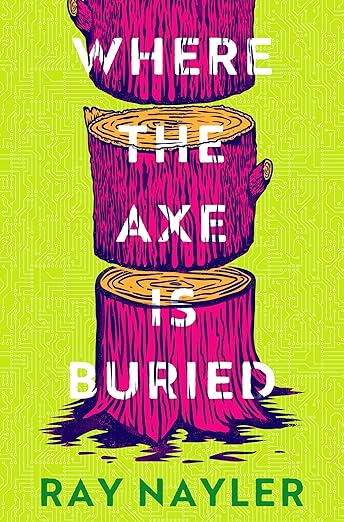
Where the Axe is Buried is a near future political technothriller, involving AI and a number of different characters giving varying perspectives on a future governmental situation.
The story is told through short chapters, each with different viewpoints. We have the autocratic Federation, a small Eastern European run by a Prime Minister whose longevity in autocratic power is maintained by being downloaded into a new body once his present one begins to fail. Nikolai is the medical physician in charge of maintaining the President through all his changes, reporting to Krotov, the head of the government’s secret services. (For those who may remember, Krotov reminded me a great deal of Colonel Stok, the Soviet intelligence officer in the 1960’s Harry Palmer movies, starring Michael Caine!)
To this we also have Nurlan, an official working for the government, whose presence in Parliament has been unremarkable up to this point but who is unwittingly involved in revolution. In contrast, Zoya is an old revolutionary who was exiled for her resistance actions in the past, but also for writing a book, The Forever Argument, which carries a death penalty in the Federation. (Readers of The Man in the High Castle may also recognise this aspect of the novel), who becomes an important part of an assassination plot.
Lilia is a student scientist who is originally from the Federation, but who has been given permission to study in The Union – parts of Western Europe and the USA. However, she is placed under conditional release whilst visiting Vitaly, her infirm father, on a return to the Federation and cannot return to her studies in Western Europe. When Lilia does manage to escape to the West, her boyfriend Palmer (perhaps another Michael Caine movie reference – coincidence?) also becomes a person of interest in the Union and has to go into hiding as well. Elmira is an assassin entrusted in hunting them down.
Whilst the countries involved here are in the main deliberately vague, it is clear that there are deliberate parallels between Where the Axe is Buried and our own world environment. It’s not for nothing that the book is dedicated “For anyone who has lost a country.” This means not only in the past, but also the present, and even what could happen in the future.
Ray makes it clear in his Acknowledgements that this book is about the effects of “authoritarianism… in its many forms”, going on to say that “Some oppressions are easy to see. It is easy to identify the malevolent dictator clinging to power for decades, bleeding his country of its resources, killing and imprisoning anyone who stands in his way, maintaining as much personal power as he can. He always wears a dollar-store mask of religion or patriotism, but nothing about him is really hidden. The question is not who he is— it is how to dislodge him.
Other oppressions are more subtle, as countries succumb to increasing limits on personal choices and watch the value of their citizenship eroded by invasive algorithms, decreasing access to basic services, and by a raft of bland technocratic pseudo-efficiencies that habituate the population to massive income disparities, political gridlock, and a bleaker, more precarious, more limited future in which the “gig economy” is just another name for piecework, and economic survival demands monetizing every element of one’s life and identity.”
At a basic level then, the book is a techno-thriller set in a grim future with corporations and governments doing their best to hold onto power. However, one of the strengths of this book is that the book goes beyond this surface level, and shows us something deeper, more complex and perhaps more important. Ray manages to avoid simplistic, facile generalisations and point out that the situation is complicated and that the solutions are not easy.
In spite of this, and in the end, Where the Axe is Buried gives a degree of hope, that even if things are bad, they can get better. Whilst all systems fail, the results can be catastrophic, generative or even both, and although things may fail, there are those who resist, who should, could and do. As Ray points out that the book was inspired by the birth of his daughter: “I want her to live in a better world than the present one— a world where authoritarian government is the rarest aberration, and the future is something her generation thinks of with excitement and optimism, not dread.” And in 2025 that’s a good thing to want, I feel.
Where the Axe is Buried is a different kind of book in many ways to Mountain in the Sea, but continues to show shows that Ray is definitely an author to watch. It is a book that warns and makes you think, that makes you observe and relate to the situations uncovered. It is quite an intense read – there’s not a lot of humour here to lighten the mood – but it has things to say and does so extremely well. Another memorable read that I can see doing very well; I’m definitely thinking that this is one of my best reads of 2025.
© 2025 Mark Yon
Hardback | W&N
WHERE THE AXE IS BURIED by Ray Nayler
August 2025 | 368 pages
ISBN: 978 139 9627 887