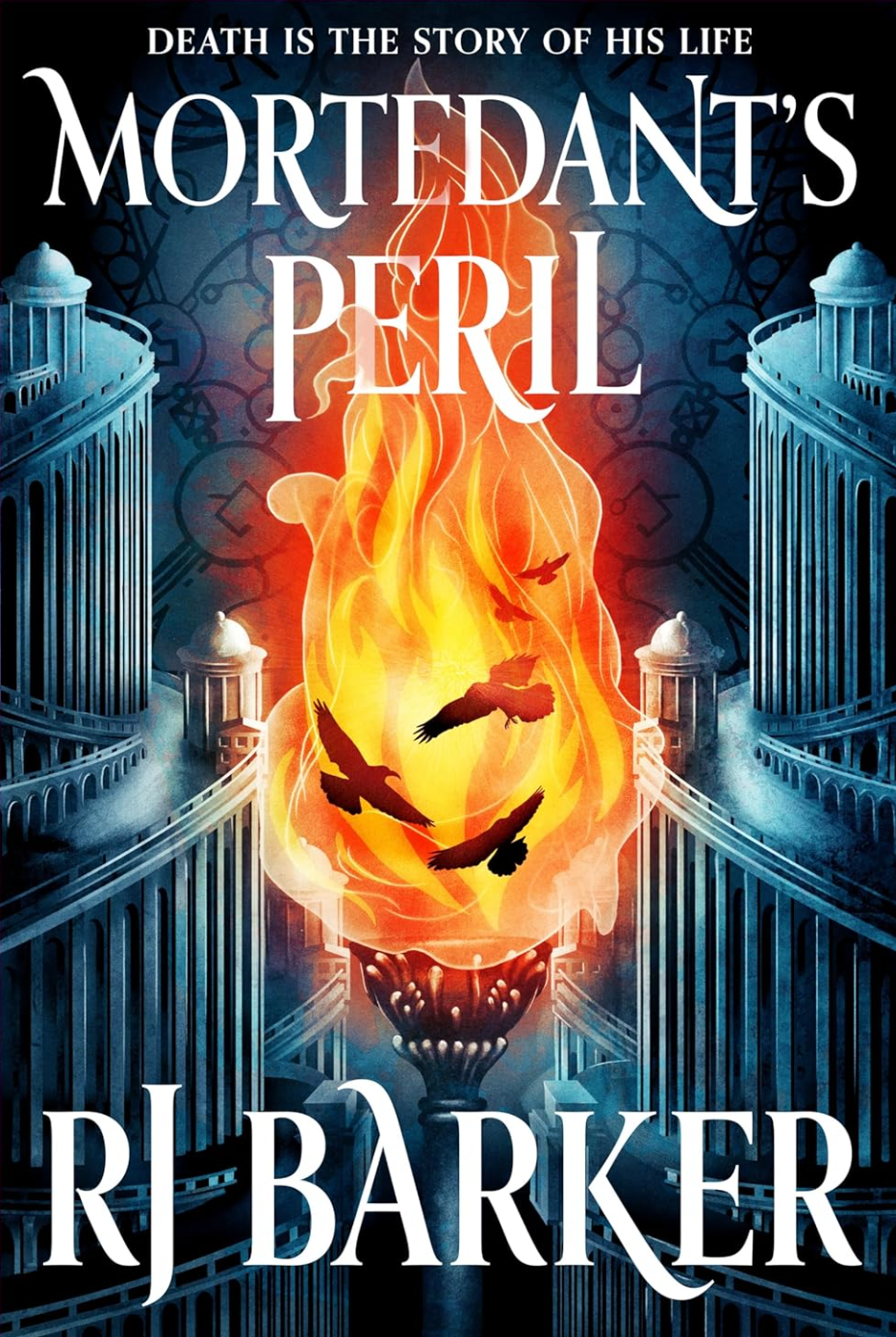
 R J Barker’s latest fantasy novel goes into the Grimdark – a murder mystery story of steampunkish machinery, death, political manoeuvrings and corruption in a grimy, unpleasant world.
Irody Hasp is a Mortedant, a cleric tasked with reading the last thoughts of the dead—though no one thanks him for it. No Mortedant is popular – generally Mortedants are feared and disliked – but Irody is scarcely tolerated even by the other members of his own guild, and rarely selected for anything but the lowliest of jobs.
This impoverished existence would be dismal enough—but after reading the corpse of Durrivan Murser, a low-level records keeper, Irody’s troubles quickly multiply when Malkin, his own neophyte apprentice, is murdered, and all fingers point to him as a suspect. He has only been given four days to find the real killer of his apprentice or be executed himself.
The only way to save his own skin is to find the real culprit himself, an investigation that quickly attracts powerful enemies with few scruples, and draws him into a plot that threatens the entire corrupt yet wondrous city he calls home.
You do get the feeling pretty much from the off that Irody is being set up to fail. Somebody doesn’t want Malkin’s killer found, and Irody’s bosses pile on the pressure to make him struggle.
Barker manages to take many of the Grimdark tropes – snarky main character, a dark, grimy city with widespread poverty, arcane magic – but then add to it some ideas of his own. The city of Elbay (far too often read as ‘Ebay’!) is tiered (which reminded me a little of Robert Silverberg’s Castle Mount in Lord Valentine’s Castle) – each tier is a tier of society, with -guess what? – the lowlifes on the bottom tier and the elite on the highest.
And then there’s Hasp’s magic skills – there’s a touch of occultist steampunk in there too, with Irody performing arcane rituals in order to see a dying person’s last thoughts. This might be useful in what appears to be a murder at the beginning of the novel, when Hasp and his mentor are called to see the dead body, a nondescript bookkeeper.
At night the spirits of dead people seem to float around Elbay at will. They are however often captured by the Sperriers, who use the captured ghosts energy to power weaponry and construct magic carriages to transport the elite around the city.
There are gods – the city is said to be built on top of the Howling Lord, a sleeping god – and this leads to various religious factions competing for attention. The book takes place as the city approaches The Festival of the Last Siren, which puts the religious groups into a heightened state of fervour. This makes Hasp’s task more difficult as the city fills with visitors. It also creates a tension as it seems important that the case is solved before the Festival begins. There’s a little of the Joe Abercrombie-like grimness here, although I don’t think that it is quite as grim.
To this fantasy setting we also have added elements of steampunk – lots of mysterious machinery with enigmatic purposes. The city itself has arcane energy which is regularly discharged around Elbay through pylons that surround its summit like prongs on a crown. Everything the ring touches is obliterated.
A book like this lives or dies on the strength of its characters. What is good news is the fact that Barker does this very well. Irody is rude, cantankerous and rather snobbish. He often puts people’s backs up, and as an unreliable narrator, Irody is not a character to immediately like, but over time you come to appreciate his situation and the reasons for his irritability.
Part of the reason for this is Irody’s found family, who temper his surly actions: Mirial, the sister of his recently departed apprentice, is determined to find out the truth about Malkin murder. Whisper is a strange Oster, an outsider with remarkable strength and build, who has been given the task of protecting Irody until his trial. Together their varying characteristics make an engaging team, which reminded me a little of the ‘buddy’ relationship that James Logan created between Lukan Gordova and Flea in his Last Legacy series. All of this is good.
On the downside, I worked out the plot twists pretty easily. I also felt that the pace of the novel overall is a little uneven. There is a steady build to the plot at the beginning of the book, which I liked. However, what I thought would be a major event in the novel is then sorted very quickly, after having spent about three-quarters of the book building to that point. The rest of the book is then about resolving bigger issues, but I did feel that that had a different tone, although I am happy that by the end all seems pretty much sorted.
Reading the afterword, it is clear that RJ would like to write more about these characters – indeed, as he writes at the end, a second book is already written. I for one am pleased with this. Summing up, Mortedant’s Peril is a superior fantasy that drags you in, managing to use old tropes but then adding something new to the mix. Although the plot twists were a little obvious to me, the characterisation is a particular strength that won me over.
© 2026 Mark Yon
Hardback | TOR Books
MORTEDANT’S PERIL by R J Barker
May 2026 | 432 pages
ISBN: 978 1250 398 802