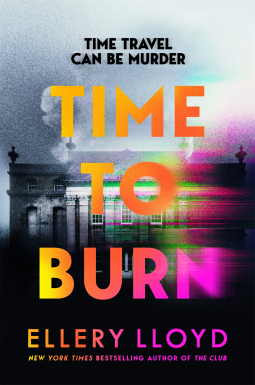
 One of my favourite tropes of science fiction is the ability to time-travel and the consequences of such activities. I think that it is because it gives us access to that idea of “what-if?” and offers a variety of different possible futures. It may be because I was brought up on Doctor Who and one of the first adult science fiction novels I read was H G Wells’ The Time Machine. It has clearly had a life-long effect on me – I still watch George Pal’s film version (although very different!) every year, over the Christmas season.
The saying goes that you can’t keep a good idea down – and so I have read many versions of that idea over the past 50 years or so. Some are better than others – I still have a great fondness for Connie Willis’ time travel tales from The Doomsday Book to Blackout and All Clear, which I tend to use as my benchmark to compare all modern time travel stories to. (And if you haven’t read any, I thoroughly recommend you do.) But you can add work by Harry Turtledove (Crosstime Traffic series), Stephen King (22/11/63), Audrey Nifenegger (The Time Traveller’s Wife), Brandon Sanderson (The Frugal Wizard’s Handbook for Surviving Medieval England, even Diana Gabaldon’s Outlander and many, many more.
Ellery Lloyd (actually two writers) takes those ideas of time travel, that must be pretty well known to even mainstream readers, and combines them with an egocentric inventor/ entrepreneur Inigo Frank, who has invented time travel and turned travel into a pastime for the very, very, VERY rich. (Feel free to add your own egomaniacal entrepreneur here for comparison.) The power needed to make the time travel work is so much that it limits the number of times people can travel, although Frank hopes to make it more commercial in the future with his company Tempus Tours, who offer the wealthy a chance to witness pivotal moments in history.
To immortalise his achievement, Frank enlists award-winning filmmaker Phoebe Hunt to create a fly-on-the-wall documentary. About him and the work the company does. On her first day shadowing Inigo, she is set to witness the return of Harry Allen, a billionaire property developer and his family from their trip to London in 1941. But instead of their awe-filled return, she captures the group arriving bloodied and traumatized, with one of their number missing.
Not only that, but Phoebe recognizes the missing woman. She knows not only that she’s not who she claims to be, but that the woman has every reason to harbour a grudge against her. And as events begin to unravel in the present day, it seems increasingly clear that the woman had sinister motives for returning to the past – and that people close to Phoebe are in danger.
So: in essence, this is a murder mystery wrapped around a time travel setting. As you might therefore expect, all is not what it seems. The good news for people who rarely read such stories is that the science element takes pretty much a back seat to the crime element. Time to Burn is not a story of science but of the consequences of people travelling through time. Told from the focus of Phoebe, we read of the consequences of this crime on the characters we meet.
Some of the characters are fairly stereotypical, with not a great deal of depth. Inigo Frank fits the mould of your typical corporate businessperson. Similarly, Harry Allen is a typical blustery self-made millionaire with the grumpy berating attitude to boot; his son Luke is that young adult desperate for his father’s attention, whilst his wife Sasha is an influencer, married perhaps all-too-quickly. Phoebe and her fellow-journalist partner David are as nice as you want them to be.
As the book progresses though much of the book is about the point that not all is entirely what it seems to be. Phoebe, for example, has a secret connection to the Allen family through her past. There’s a degree of setting past grievances to rest here, as we discover through the book.
Of course, one of the key elements of the novel for me is how much time travel is an important component of the plot. And there I found the results a little muddled. For much of the book the science fiction element takes a back seat, the plot mainly focussing on the back story and flashbacks of the main characters. The book’s strength is more about the main characters and less so about the science-fictional element – perhaps unsurprising, as that is what I understand Lloyd’s previous work has tended to focus on.
I should add that the paradox of knowing about the future and using that knowledge to change things was important to the plot, although it all seemed rather convenient and incidental in the main. I did wonder what would happen if hundreds, if not thousands, of journeys back in time would change things, although ideas seem to have been glossed over. (See Fritz Leiber’s The Big Time from 1958, for example.) The author here has dealt with this a little by limiting such excursions to the exclusively rich, but even so there were things that I thought could become big issues – much of this story could have been solved by time-travelling and resetting things back to basics, before the life-changing events happened, for example – but would we even know?
On the positive side, many (but not all) of the much-expected plot twists seemed possible and not just there for effect.
Thinking about the book when finished, I must admit that this one didn’t set things alight for me (pun intended.) However, I also get the feeling that this is going to be one of those books that will be popular with people who don’t read much science fiction. (I’m imagining all the “I don’t read science fiction/time travel stories, but I liked this one!” comments now….)
For me, Time To Burn was a good, solid, entertaining read, but it wasn’t a book that made me want to think about it too much, nor was it particularly complex. Whilst it was good to see a new(ish) writer tackle some of the science-fictional ideas, I couldn’t help feeling that I’d read better, although not as contemporary.
Having said that, I think that crime readers in particular will appreciate it – the science fiction element is not too intimidating, and as is usual in a crime drama most elements are tied up conveniently and all is resolved at the end. (There is one twist that could be taken further, should the author wish it, I think.)
For me Time to Burn was a story that I enjoyed whilst I read it, but once read I suspect will be fairly quickly forgotten – or is that the effect of time travel, I wonder?
© 2026 Mark Yon
Hardback | Macmillan
TIME TO BURN by Ellery Lloyd
July 2026 | 320 pages
ISBN: 978 1035 020 997