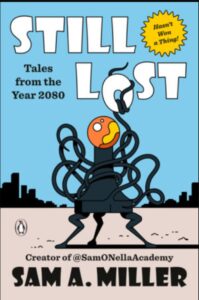
 From the beloved creator of the wildly popular Sam O’Nella Academy YouTube channel, an irreverent and timely science fiction collection that offers a wry look at the not-so-distant future.
A hyper advanced alien race seemingly solves all existential threats—no climate change, no nuclear weapons, no singularity crisis…and yet, in crisis we remain. Because humans are their own existential threat in the not dys- or u-topian, but simply “topian” world of this interconnected collection.
I’ll be honest, from the moment I saw the “Hasn’t won a thing” sticker on the front of this cover, along with the suggestion that it’s similar to the writings of Douglas Adams and Matt Dinniman’s, I immediately had some preconceived ideas about the book’s tone, assuming it was going to be a very funny, silly read. I do think lovers of those two authors will likely enjoy this book, but such comparisons may be a disservice to what this book has to say. And, boy, does it have a lot to say about the nature of humans.
Firstly, this is a collection of short stories and, while they all take place on Earth in the year 2080 after an alien invasion, this is where the stories’ similarities end. The first story lays a very solid foundation of world building: Earth has been invaded by these black, gloopy aliens that no one quite understands. No, they aren’t evil, but they aren’t benevolent either. In fact, this story has a surprisingly violent start, featuring an army general’s perspective and justification for how his troops responded to the invasion. It’s an unsurprisingly “shoot first and ask questions later” mentality that brings about violent ends to aggressors. The general tells his story in a way that conveys a lot of dark, absurdist humour, and it does a great job at setting the tone of the book, along with piquing your curiosity about the aliens (later named Xeno). We find out the aliens will only use violence to protect themselves, they are completely ambivalent and sarcastic towards pretty much everything, and they’re also going to eradicate all of humanity’s main issues such as climate change. So, all that’s left is human nature to take its course, setting up an interesting premise for the stories that follow.
It’s tricky to talk in-depth about each individual story without spoiling them, so instead I’ll give a rough overview of a few. Xenos is when we skip ahead to 2080 and get more insight into how society has changed. We meet a biologist who has an interesting relationship with a Xeno sex worker; this was perhaps one of the funniest and strongest stories, continuing the scene-setting by offering insights into how society is functioning alongside these aliens.
We then start to get more abstract. The weakest of the stories for me was Agency, a story about an American footballer who gets a brain implant to enhance his performance at great cost. While I understood this to be a pretty scathing look at how athletes are commodified, it did struggle to keep my interest. There’s no real reference to the Xeno or much else of society, so for me this story felt a little out of place and disjointed from the rest.
Eggs for Roman is from the perspective of a baboon named Roman who is enhanced to become smarter, eventually leading to him being cyberbullied (trust me, the plotline makes sense when you read it). While I did enjoy this story, it was slower-paced, and the areas that it shone and interested me most were touched on the least; the focus was strong around the increased intelligence aspect and it was hard for me to look past how overdone this trope has been done, but maybe I am particularly sensitive to it having not long read Flowers for Algernon.
Beat was a favourite of mine in terms of the writing and storytelling. It follows a boy who, in short, gets addicted to music. These beats invoke very visceral emotional reactions similar to drugs, and there were some really interesting ideas here and great writing around how this works and visualises it very well, as well as being a story I hadn’t seen done before.
Four Little Words is about a group of scientists making a shocking discovery about the nature of grass, sending them into spiralling existential crisis. While not that deep of a story, it did bring back a lot of the absurdist humour about human nature that initially reeled me into this book, and it was a very fun read.
Overall, I found Still Lost to be an enjoyable read, featuring very strong writing, great storytelling, and world-building. Miller clearly has a good sense of how far to push dark humour without losing the main morals behind the plot. Like any collection of short stories though, there’s always a risk that they will be a mixed bag, where some stories will connect with the reader more than others, and this book is no exception. Some of these short stories did feel like Miller had wanted to write them for some time, and to get them into this book they were loosely threaded back into the overall world rather than having stronger plots linked to the world. I thought this was a shame, as I wanted to know more about the Xeno and Earth in 2080 as a whole as it was such a strong premise.
However, if you want a book with strong moral lessons and takes on human nature with a sci-fi twist, along with some truly bonkers themes, you’ll have a good time with this book.
© 2026 Lydia Harris
Hardback | Del Rey
STILL LOST: Tales from 2080 by Sam A. Miller
September 2026 |336 pages
ISBN: 978-180 7842 499