What is an unhaunting? Is it a reverse haunting? Isn’t that what the Maitlands did in Beetlejuice? None of the above, I was just trying to be clever with the opening of this review. Micaiah Johnson suggests in her novel The Unhaunting that a haunted house wants you to stay, scare you into its comfort rather than scare you away from its confines.
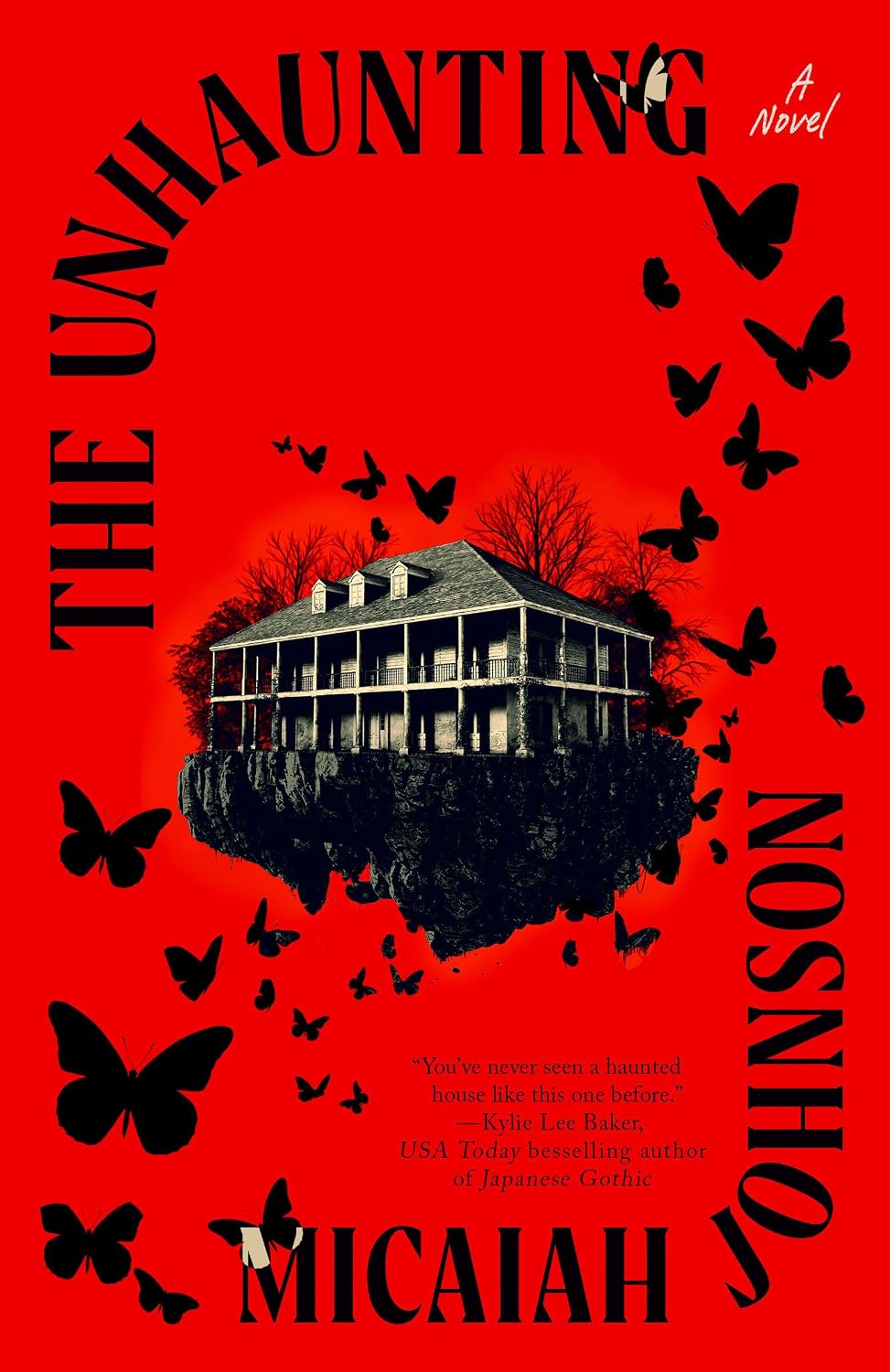
A house, itself, is nothing. It’s not a shelter until it is sheltering someone. A house is a housefire, waiting for its match. A house is a ghost story, waiting for its death.
At the end of the Civil War, a daughter of the Confederacy made what she thought was an innocent wish: to build a house where nothing bad could happen. But peace came at a price, and one hundred and seventy years later Shantell and her friends are about to discover where all that darkness ended up.
When Shantell’s best friend, Avery, tells her he has inherited a house big enough to make their dreams of a sanctuary come true, she’s too cautious to be optimistic. A lifetime of loss — her father to the Iraq war, her brother to police violence, and her mother to suicide — has taught her cynicism, and even though Avery swears the house has never experienced a tragedy, she goes along expecting everything from black mold to evil spirits.
But not only is the house in better shape than they’d expected, it makes them better too: Shantell’s anxiety stops flaring up; terminally shallow Avery is suddenly capable of deeper emotions; and Tobias, Avery’s older brother and the contractor for the job, even quits chain smoking.
There’s an eeriness to the calm, and it’s almost a relief when they realize they do not walk alone in Abernathy House. If nothing bad has ever happened here, where are all these ghosts coming from? As they dig into the house’s history, Shantell, Avery, and Tobias discover that there’s only one thing worse than a house that’s haunted: a house that desperately wants to be.
Abernathy House has been standing for a over 150 years going back to the Civil War in the deep south, so it definitely has history. What kind of history? Well, a history that Avery Abernathy isn’t fully aware of when he inherits it from his family and tries to convince his best friend Shantell to move in with him. Avery is rich and white, Shantell is black, neurodivergent and with very limited familial connections. Avery’s brother Tobias is helping Avery renovate the old home, which is a potential stressor for Shantell who has a long-standing fear of the seemingly always angry Tobias.
Shantall is our main character and what a gem she is. On top of her neurodivergent nature, she’s suffered a lot of loss prior to her introduction in the novel. Her father served in Iraq, but didn’t make it home. Her brother was shot and killed by the police, and her mother’s suicide only compounded Shantall’s grief. Despite that, she moves forward in life, building something for herself. The only constant in her life, the one who was there for her was Avery.
Back to the history of Abernathy House… the neighbors and local history of the town bring to light that nothing bad ever happened to the people and family who lived in Abernathy House. Tobias, who has a smoking habit, doesn’t feel compelled to light up while at Abernathy House. The long-held anxieties and pain Shantal has been suffering don’t seem to bother her within its walls.
But Shantall, who has lived a life of pain, knows everything has some kind of cost and starts to question Abernathy house. Its history, its affect on Avery and Tobias, the strange figures seen from outside, and an inaccessible attic all add up to something strange. Something, unsettling.
I found Johnson’s writing to be extremely effective, laying out these characters, allowing me as the reader to get a sense of who they are while building an undercurrent of distrust and tension. Based on Shantall’s history with Tobias, there was always a “tingling” (for lack of a better term) when they shared the page. Their time away from each other helped to make things better as they had a shared focus on trying to help Avery.
Sometimes the things that seem warm, inviting, and pleasant at the outset only to turn dark, selfish and sinister are the scariest of all. That duplicity can cut deeper to the bone and make the sinister nature even more sinister because of the emotional distance it forces characters and people to traverse. That’s an additional element Johnson captured effectively and excellently in The Unhaunting.
As I often say when I’m writing about Haunted House/Haunting stories, the characters often bring their haunted personalities to whatever locale in which the story is set. That’s certainly true for Shantall, as I’ve mentioned, but Avery has had far less stress and anxiety in his life. He just tries to bury the things that could get to him, ignoring the obvious nature of Abernathy House’s connection to slavery. But with that haunting, the house / domicile / locale, is often seen by the characters as a solution. Of course this is before these characters realize the place is haunted. The question that emerges, and here Johnson does a great job navigating these characters to a resolution – will they survive the haunting? Will their relationship overcome the strange nature of where they’ve decided to place themselves?
The novel has a gothic feel and the racism of the South and Slavery serve as foundational elements that drive much of the tension. That embedded darkness is itself an unseen ghost over the proceedings of the novel.
The Unhaunting is a rather slim novel (267 pages), but Johnson packs a wallop of emotion, grief, tension, and pervading fear.
Highly recommended.
© 2026 Rob H. Bedford
Hardcover | G.P. Putnam and Sons
September 2026 | 272 Pages
https://www.micaiahjohnson.com/
Review copy courtesy of the publisher