Fear is the driving emotion of many a horror novel, but what form does that fear take? Christina Henry has explored the many forms of fear in her horror novels, but Pinfeathers explores a fear so acute, so sharp, a fear that nearly half the population deals with it in some form – the fear of motherhood or that something is wrong with your baby. Sure, your baby may have been born happy and healthy, but so much development occurs during those formative first months and year, your baby may be a completely different child as they change from week to week or even day to day. Especially when that child begins to sprout feathers. Which is what happens to Nora’s daughter Olivia and starts the story rolling.
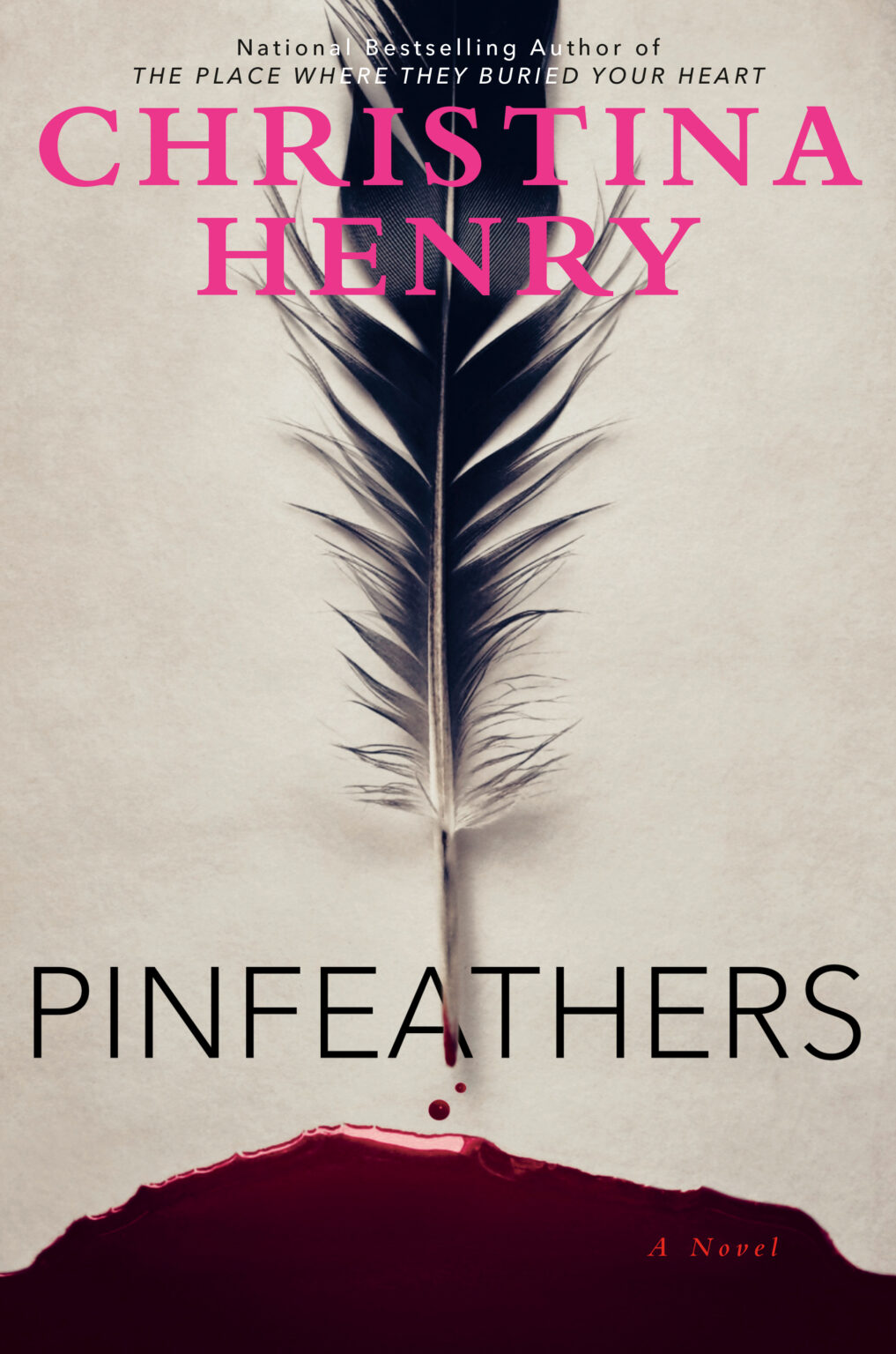
Nora Pacetti is a new stay-at-home mother—she’s tired but coping while caring for her happy, healthy baby, Olivia. But then one morning, something that looks like a feather starts growing out of Olivia’s arm. Or at least, that’s what Nora’s mother, Giulia, thinks. Nora thinks her mother has probably spent too much time watching conspiracy videos on YouTube.
Nora’s husband thinks Olivia needs tests, specialists, hospitals. But Nora senses that whatever is happening to her daughter needs to be concealed—and a mother’s intuition is never wrong. Soon sinister people begin asking questions about Olivia, and Nora starts to wonder if there really is something wrong with her baby. But she’s determined to discover the truth about her daughter . . . no matter the cost.
Nora is a stay-at-home mom, caring for little Olivia whose cries cannot be quelled. Nora discovers something poking through the skin on her daughter’s arm, with a matching poker on the other arm. Nora’s husband, Adam, urges Nora to take Oliva to a doctor and Nora’s mother Guilia eventually arrives (unannounced as she often does), so now we have three adults trying to solve an impossible situation. Guilia wants to keep Olivia hidden, but Nora’s mother has become something of a conspiracy theorist, reddit contributor on top of being a bit of a know-it-all. I know I didn’t exactly paint a favorable picture of Guilia right there, but she is a very well-drawn character and one whose presence in the story I very much welcomed. Especially as the story advanced and Guilia’s own motherly instincts kicked in for her daughter and granddaughter.
Nora relents… she and Adam take Olivia to the doctor only to have more questions once they leave. Adam then asks his friend from fantasy football – who happens to be some kind of doctor – for advice, but he starts taking pictures of Olivia, who now has even more feathers. When Adam chases his friend out of the apartment, an intruder attacks Nora and when Adam returns, he is severely wounded. The three adults finally agree on one thing – staying in Nora and Adam’s condo is not the answer because now they are targeted and hunted. But by whom?
This all happens very early in the book… in other words, Christina Henry wastes almost no time in putting the plot into high gear. It goes to unexpected places, some wild places, and is kind of gonzo crazy in the best way. The narrative is extremely potent, I felt pulled along its wake unable to set the book aside. Some novels with that kind of pacing make looking back upon the story, or reflecting on earlier scenes a head-shake. What I mean is that you might just accept a thing on a brisk plot without blinking, but these kinds of elements in Henry’s hands mostly hold up under re-examination.
But the glue, the heart of this novel is Nora. She is a vulnerable, believable character in so many ways. She feels (rightly) that her husband dismisses her and even takes her for granted. She feels her mother is often looking down upon her as a child. In other words, she is a worn-out, stressed-out mother… and this is before her daughter starts growing feathers. The fear, astonishment, and eventual horror Nora feels about her daughter as Oliva continues to change… came across as all too real, as did the love Nora feels for Olivia.
This is novel in two parts… the initial revelation of the horror and then how Nora and her family deal with that horror’s implications by running. The emotional potency of the novel is maintained throughout despite the two somewhat separate kinds of stories this novel is. Because of that, and how Henry maintained the strong characterization and character interplay throughout the entirety of the novel, I found the resulting whole of the novel to work and to be extremely effective. (I also tapped out of another book that was NOT working for me just before starting Pinfeathers so this novel was just what the doctor ordered). Some of the explanations could have had a little more weight, a little bit more about Guilia would have been a nice addition, too. The absence of those elements don’t take away from the effectiveness of what Henry seemingly tried to accomplish with the novel, nor did it detract from my overall enjoyment of the novel.
I also want to reiterate again very plainly the over-the-top awesome concept I’ve touched upon in this review – a baby starts growing feathers and becomes more birdlike. It is a batshit crazy concept of body horror, but Henry commits to it fully and that is the only way something like this could work and work as successfully as it does. Horror is very much a metaphor and the metaphor here is very effective, through the unexpected turns the narrative takes as well as the emotional beats Henry hits with these characters.
I don’t have children so I can only imagine how near the bone* this novel might hit for parents, whether their children are just going through their natural development or their child turns out to be autistic or some other thig. The message Henry ultimately lands on by the end of the novel… well, it worked for me. Go into this one and just let Henry take you on a harrowing, exciting, and emotional ride.
*Near the Bone is the title of another fantastic Christina Henry novel.
Recommended
© 2026 Rob H. Bedford
Berkley | Hardcover
November 2026 | 305 Pages
https://www.christinahenry.net/
Excerpt: https://prhcomics.com/book/?isbn=9780593954010#book-excerpt
Review copy courtesy of the publisher