
Musa Publishing recently released Andrew Leon Husdon’s The Glass Sealing, a steampunk tale of a city on the brink of drastic change. This book is part of a shared world project spearheaded by Musa Publishing. Today, Mr. Hudson gives us a few insights into this story world and tells us how his first steps into publishing are going.
 Can you tell us a bit about The Glass Sealing?
The Glass Sealing is a steampunk adventure set in a fictional story world centred on the city of Southwatch, where social status is determined by altitude and the sharpest divide between the haves and have-nots is the Dark Cloud: a free-floating toxic smog that casts everything beneath it into barely-breathable gloom.
The city is gripped by industrial conflict, with unappreciated workers struggling for their rights against brutal enforcers hired by the factory owners – but when one of the city’s celebrated figures takes the workers’ side he is cast out of polite society. He becomes a figurehead of a protest movement that could become a revolution, placing him in opposition to his former peers – including one of the few female pioneers of the business world, who has plans for her city that no-one, wealthy or poor, can even imagine…
The story was partly inspired by the global protests sparked by the Occupy Wall Street movement, which came to my doorstep in Spain in 2011. Though the occupation of central Madrid was a mostly peaceful affair, there was also aggression on both sides across the nation. I decided to relocate these motives to something like the industrial revolution (only with steam-powered robots), but I was interested in telling a story in which neither side has truly pure motives – and it’s hard to side with the global financial industry these days!
This story is part of a codex? What’s that all about?
“Darkside Codex” is the umbrella name of a shared-world project developed by Musa Publishing. Mine is the third title, and a forth was published just a short while ago. All the stories to date are by different authors, so one of the trickier editorial roles has been coordinating the crossovers between each new story and what has come before. There is an ever expanding world bible, which all the participating writers can consult to help them toe the line and which each now book adds to. I’m hoping to write more stories in the Codex, but I fear for how big that bible will be the next time I see it!
What is with the steampunk genre that is so fascinating?
I would say there are two core advantages: it’s stylistically rich, but also relatively easy. There’s a hugely recognisible hook in the period trappings (bustles and top hats, brass fittings, steampower) and the anachronistic technology is really just a variation on what readers of science fiction look for generally – the only difference is that the black boxes that do amazing things are from the past, more or less, instead of the future. I shoot myself in the foot saying so, but it’s easier to look back at what was and speculate than to look forward at what might be.
Beyond the surface level though, I feel that steampunk attracts a certain kind of story: the adventure. This is partly because we associate it with the kind of stories told by Jules Verne, in which what was then contemporary tech was used amazingly – and the popular adventure fiction of the recent past also gave us characters like H. Rider Haggard’s Allan Quartermaine, or Edgar Rice Burroughs’s John Carter and Tarzan. That’s right, readers of yesteryear enjoyed lots of derring do from white males of imperialist societies… hmm.
So, having said all that: steampunk also gives authors the opportunity to cast off the constraints of the past, both factual and fictional. The patriarchal and colonial past (to the extent that it is past) makes for an excellent backdrop against which characters can shrug off restrictive cultural practices. Female protagonists tend to flourish in steampunk, and I believe that there is lots of interesting genre writing coming from further-flung parts of the world – the potential for fascinating, and different, perspectives is unbounded.
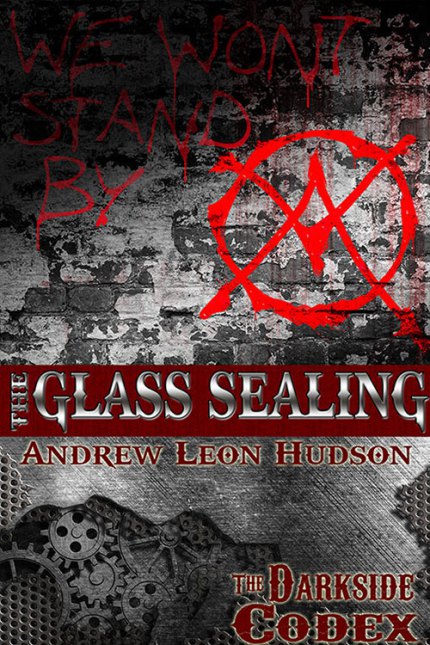
Tell us a little bit about the cover art for your books. Who designs it? What makes you choose a particular cover?
The cover for my novel was a learning process, literally to an extent. I found it challenging to communicate what I wanted with the publisher’s artist – my idea was quite different to how the other books in the series appeared, so after a while I started tinkering with Photoshop in order to demonstrate what I was after. I had little experience of using Photoshop creatively, but I learned a lot. My work ended up being used in the final piece, and what people always say about authors doing their own cover art makes me think of the old Hollywood adage about working with children and animals – don’t.
Do you think that the cover plays an important part in the buying process?
I do… and as far as my future work is concerned, I hope not to be directly responsible! I know from my own buying habits that I judge books by covers. I deliberately avoided two of what eventually came to be my favourite reads because I didn’t like how they looked when I first came across them (my shame: I’m thinking specifically of Good Omens by Neil Gaiman and Terry Pratchett, and The Player of Games, by Iain M. Banks).
I’m planning some small publishing projects at the moment, and my hope for these is to collaborate with a different artist on each one for cover art and illustrations. I’ll give them suggestions, but that’s all they will be – I’ll let the artists read the texts, and if they are inspired to produce something different then that inspiration is what I’m looking for.
How do you market your books?
Mahr…keht?
Which social networks have worked best for you?
After being an inactive member of Goodreads for far longer than I imagined, I made the effort to actually complete my account as soon as I had an actual purchasable title under my belt. I did some research of reviewers and approached a select group with an enthusiasm for sci-fi or steampunk, and whose reviews I appreciated (even if I didn’t always agree with their opinions). I’ve had a few balanced reviews as a result – 100% more than I have via just random readers stumbling across me, of whom… zero!
However, I’m not a rabid social-networker, so to say any of them have worked well for me would be a stretch! That’s my own failing though, and it’s one I mean to fix. My blogging activity filters out through Twitter, but that’s only a dribble added to a waterfall – so I’m planning more SF/F/H community-based activities in the future. And I’ll dribble that too.
What’s the hardest thing about writing?
For me, it’s committing to one project long enough to finish it. Not because I’ll lie around idle, not necessarily, but because there’s always a new idea screaming for attention, and what’s new is also exciting. The fact that I’ve substituted a string of unfinished screaming ideas for a string of unstarted screaming ideas is, I maintain, evidence of my Spectacular Growth As An Artist.
What are your thoughts on good/bad reviews?
Well, I’ve written both myself, so it’d be hypocritical to kick up a fuss if someone doesn’t like what I write. I’m certainly not interested in attracting attention through a digital tantrum, but I confess that it’s frustrating to see a comment that feels mistaken or unfair and know that I should just take a deep breath and click onward. So far, I always do!
How do you define success as an author?
Not having to do anything else.
For your own reading, do you prefer ebooks or traditional paper/hard back books?
I have shelves stuffed with books, but I’m a near total convert to digital formats. Part of that comes from living in Madrid and being a pathetic speaker of Spanish – buying English language books here costs a lot and the selection is limited, whereas I can have anything I want from Amazon (there, I said it) at a very reasonable price and without delay (fine, unless it’s from Hachette but let’s not go there…).
What kind of books do you read, any favourite authors?
All sorts. I just love reading, always have. A lot of my focus is on spec-fic in its various guises, but I also like a good thriller, crime and mystery writing, and science non-fiction. I read a lot of short stories too. Also general fiction (I don’t accept the genre literary fiction, that’s a judgement call to be made by readers, not self-applied by writers) and historical fiction: one of my favourite novels is Q, by Luther Blissett. If you ever want to read a seat-of-the-pants thriller set in reformation Europe written by four Italian anarchists under the pseudonym of a Jamaican-born English footballer from the 1980s, make it this one.
At the moment, I’m reading some current release spec-fic for the first time in quite a while. I enjoyed Ann Leckie’s Ancillary Justice a lot – it helped fill the hole left by Iain M. Banks, as much as that is possible – and by the time this interview appears I’ll likely have finished Jeff Vandermeer’s Annihilation, which is great so far. But I’m on general fiction after that – I’ll be breaking my Roberto Bolaño duck with 2666, which should see me through to 2019…
Q: What’s next?
I’ve got two more stories for the Darkside Codex ready to write, and I’ve been sitting on an original fantasy yarn or three since before I started The Glass Sealing, but right now I’m interested in testing the waters of self-publishing. I want to do it with something smaller than novel-length, so I’m planning to release a series of short ebooks over a twelve-month period, hopefully a new one every two months. More than anything else I’ve read or been told, the key to success as a writer is to Write More Books. So I’m going to.
* * * * * * * * * *
Interview by N. E. White and Andrew Leon Hudson – SFFWorld.com © 2014





Care to explain that ‘duck’ reference for our US audience?
I had to read back as I had no idea what you were talking about… “Breaking your duck” is a cricket term, so it’s understandable that you didn’t know what I was talking about either! Allow me to provide a practical example of how interesting a sport cricket can be:
When a batsman is dismissed in cricket, he is “out”. If you go out without scoring, it’s called being “out for a duck”. If you are batting but fail to score for some time, you are in constant danger of going out for a duck, so when such a batsman finally scores he is said to have “broken” his duck (for some reason). And the phrase has come to mean “doing something for the first time after a long opportunity”.
I’ve no idea why it’s called that though – to Wikipedia! [checks] …it’s because a zero looks like a duck’s egg. So “breaking your duck(‘s egg)” suddenly makes a lot more sense.
Now perhaps Nila can reciprocate by explaining why baseball needs something called a “designated hitter” in order not to bore the pants of the fans… 🙂