

Alix Black is a swordswoman, a soldier of the country of Alden in King Erik White’s army at a time of great chaos and war. Her King’s brother has broken away from him in an act of civil war while Alden is at war with Oridian, a nation powered by dark magic. The Bloodbound is the first of a new series by Erin Lindsey, pen name for Burundi-writer E.L. Tettensor, author of the Nicholas Lenoir supernatural mysteries.
The majority of the novel is told from Alix’s point of view, with some scenes through her King’s eyes. Alix comes across as an honest, almost-too-good-for-her-own-good protagonist torn between duty and passion. She finds her passion and romantic feelings for her closest companion Liam growing, so she acts upon it. The thing that throws a monkey-wrench into their relationship is the king himself. Rather, Alix acting as headstrong as ever; she goes against the orders of her superior Allan Green and breaks formation to save the King’s life. He wakes to find Alix draped over her. That physical interaction leads to more emotional interaction between the two.
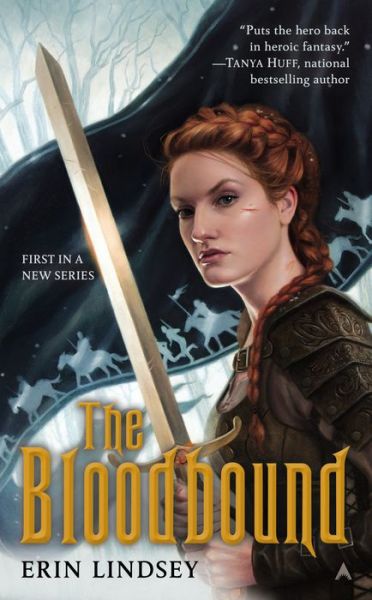
The dueling romances of Alix and Erik vs Alix and Liam provided a great amount of tension. It was a believable thing for the characters involved and added to the already heightened tension of the continuing war. As such, The Bloodbound is a very character driven story, and as much as I liked Alix for her ability to generate empathy in me, I think Erik was just as much as a stand out. Here we have a King fighting for his kingdom who willing to listen to others and striving for what is best for his kingdom. Lindsey plays out his actions in such a way that he comes across as very genuine and very human.
One of the only hollow aspects of the novel was the Priest pulling the strings of Alden and King Erik’s enemy. We are told about what he is doing, we see the results of the magic our heroes deduce he is practicing, but we never truly see the Priest himself. His threat is a bit abstract and part of me would have liked to see more story focus on the character. On the other hand, in times of war the enemy can be a target at which to aim without knowing very much about the enemy so in that sense, Lindsey’s minimal depiction of the Priest was effective for The Bloodbound. It isn’t clear where she intends to go with the second book, but it would be fun to get a bit more background on him or more depth of what he represents.
On the other side of the conflict, in terms of magic, we have the bloodblades utilized by many of the soldiers. The bloodblades are forged with – you guessed it, blood from its intended wielder – and once forged becomes more of a singular unit with the wielder. This magic weapon helps to make more elite soldiers. Like the Priest’s magic, Lindsey shows us only what we need to know at this time and in that respect, I found the magic she did show us quite effective.
The world-building is a bit light at this point in the series, the kingdom of Alden doesn’t particularly stand out compared to other medieval-esque fantasy nations and the magic is only hinted. This is all well and good because in the case of this novel, I was more interested in getting to know the characters. Again, with a second novel coming, there’s an opportunity to see a little more of the world and its magic.
As much as The Bloodbound is about a kingdom at war which naturally involves physical conflict, Lindsey shines in her depiction of conflict on a human, interpersonal level. This is, in part, as I called out earlier in the review because Lindsey has crafted some empathetic, plausible, and engaging characters. But mixing them together provides good results, too. They react in ways that aren’t dramatic just for the sake of the novel’s plot; rather, they behave in ways I could see myself behaving or ways I can forsee people I know behaving.
I liked this one a great deal. Lindsey does a fine job of building tension as in the narrative and while I was hooked into the novel early on, I felt much more invested and glued to the page as the novel progressed. I genuinely liked the characters and want to read more about them. In a genre landscape where darkness in characters and grimdark tone seem to be rather prevalent, The Bloodbound was a refreshing change from that. There’s a great sense of hopefulness and positivity in the characters and paths through which the plot drives. I felt Lindsey did a fine job of keeping that hopeful and rather upbeat tone even when things for the characters took some less than positive twists without coming across as too saccharine. As a couple of reviewers pointed out, there’s a strong similarity to Elizabeth Moon’s Paksenarrion novels. One, this is a good thing because I enjoy Elizabeth Moon’s writing very much. Two, this shouldn’t be a surprise when one realizes they share the same agent.*
So, as I succinctly stated on Twitter just after finishing the novel, more please.
© 2014 Rob H. Bedford
(*I’ve remarked before that genre readers could do a lot worse than using that JABberwocky client list I linked as a recommended reading list)
http://www.erin-lindsey.com
Ace, Mass Market Paperback October 2014
Review copy courtesy of the publisher, Ace




Glad you liked it. You appreciated Bloodbound in the same way I did. I touched upon many of the same things you noticed in the quick review I posted in the October reading thread in the fantasy forum. And I felt the same way at the end as well. I want more.
Davis
Sounds like a book to add to the pile. 🙂