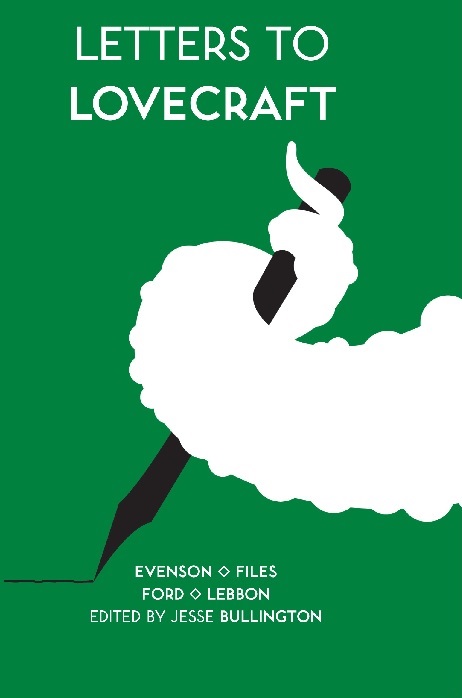
 So the premise is this: Letters to Lovecraft is eighteen tales, from a number of authors in a variety of styles, that approach Howard Phillips Lovecraft’s work through his essay, ‘Supernatural Horror in Literature.’ By doing so, the writers and its editor hope to ‘compile a collection of responses to Lovecraft’s ethos, in the form of original fiction.’ (page 7).
As you might therefore expect, the results are diverse.
Jesse’s Introduction is a great start to the book. It summarises the point of the anthology (quoted above) as well as pointing out for the uninitiated what the attraction of Lovecraft’s writing was, even whilst acknowledging that some aspects of the man’s personality were not what we would like. It manages that tricky job of being both erudite and yet accessible, of being reasoned and balanced when others might descend into outrage or obsequious fawning.
Of the stories, I most liked Tim Lebbon’s The Lonely Wood, which created a lovely ambience of creeping menace in a great setting from the perspective of an atheist in St. Paul’s Cathedral, London whilst reading it. Nadia Bulkin’s tale (Only Unity Saves the Damned) is a contemporary tale of elemental Horror that works well. Livia Llewellyn’s Allochthon was a tale showing the importance of landscape in horror and the always-present land, which I really appreciated. Stephen Graham Jones’ tale (Doc’s Tale) is a werewolf story – it says so in its first line! – which is not entirely part of HPL’s remit. It was also wryly humorous, something Lovecraft’s not usually known for. Reading rather like an episode of The Addams Family, its wry humour lightened the mood of the collection enormously.
I also quite liked Orrin Grey’s and Asamatsu Ken’s efforts, whereby they break the literary wall and use Lovecraft as a character in their stories. As Jesse points out in the Introduction, this could be a recipe for disaster, yet both authors, both authors new to me, seem to have managed it. In particular Asamatu’s Glimmer in the Darkness, a combination of Lovecraft and the UFO phenomenon was an inspired one. Orrin Grey’s Lovecrafting is written mainly in film script format, something that will pretty much have been after ol’ Howard’s time. It made me wonder what HPL would have made of movies, especially those inspired by his written work.
Less successful for me were Paul Tremblay’s enigmatically titled ‘_________’, which looks at a horror that is familial in origin. This starts well and has a lot of aspects that I liked but fell apart a little at the end. Jeffrey Ford’s tale of cult groups, The Order of the Haunted Wood was, as I rather expected, clever, but in the end said little to me. Chesya Burke’s The Horror at the Castle of the Cumberland bravely tackles race issues as an allegory in society for ‘The Other’, but seemed to hammer its valid point home rather inelegantly for me.
Nevertheless, for all my minor gripes, I liked the range of ideas at play here, even when they didn’t all quite work for me. In summary, this is an unusual anthology worthy of your attention. There is a lot of Lovecraftian ephemera out there and sometimes it can be difficult to separate the wheat from the chaff. Letters to Lovecraft strikes me as an intelligent attempt to do something different and as such should be applauded.
It is the first time that I have come across Stone Skin Press, but based on the evidence presented here, it is not going to be my last.
Letters to Lovecraft
Edited by Jesse Bullington
From Stone Skin Press, December 2014
280 pages
ISBN: 978 1 908983 10 7
Mark Yon, November/December 2014