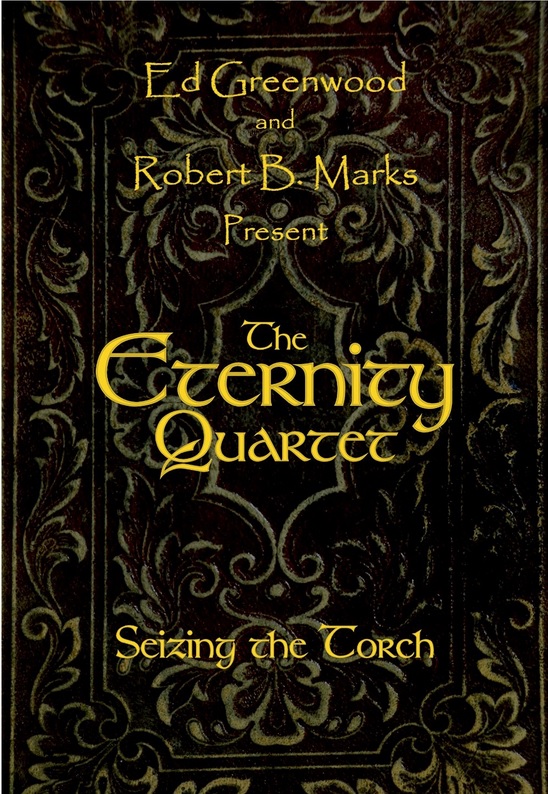
Robert B. Marks and Ed Greenwood has just launched The Eternity Quartet. Consisting of 16 separate yet linked stories, The Eternity Quartet tells the tale of a fantasy world from one ice age to the next.
The Eternity Quartet tells the tale of a fantasy world from one ice age to the next, covering around 25,000 years. Can you tell us a bit it?
Certainly. It’s pretty much as you say, the tale of a world from one ice age to the next. We’ve got four “movements” named “Spring,” “Summer,” “Autumn,” and “Winter,” and each one has four stories. The first movement takes place in the pre-history to the ancient world, the second in what would be the equivalent of the Middle Ages and the Renaissance, the third in the Enlightenment and the modern day, and the fourth in the next ice age.
You start it all off with mammoth hunting and people with strange pointy ears in Seizing the Torch. Can you tell us a bit about it?
I like to think it’s very much a look at how things get started. Kevvik and the tribe are the seed of civilization – they’re the ones who get together and take the first steps on the road away from being simple hunter-gatherers to something greater. That said, they’re a seed, and they’re only taking the first steps – it will be millennia before that seed grows into something that can be called civilization.
Survival and sacrifice stands out as a common thread after reading the two first stories besides some more obvious ones with characters and related to magic. What will the common thread be?
For me, it’s the sweep and scope of history, and the cycle of fall and redemption that accompanies human nature. So, for example, the tribe makes a certain decision that is definitely a fall with massive repercussions, while the main character, Kevvik, makes a decision that provides some level of personal redemption – although, in a lot of ways, irreparable harm is already done.
Also, one of the things I’m enjoying playing with is looking at just how people are remembered over the centuries, if they get remembered at all. So, Kevvik and the tribe at this moment do get remembered in the second story, but by the time that story takes place, little actually remains except their names – the memory of them is so distorted that it bears little resemblance to reality.
 You are writing The Eternity Quartet together with Ed Greenwood. How has that been and what would you say is his strengths compared to yours?
It’s been a joy. Ed is an incredible writer. So, we’re editing each other’s stories, and there’s a lot of back and forth. Ed’s also a very good editor, which is important – any given author is at best a competent editor of their own work, just because they’re too close to it to see the flaws. Having Ed give each story a couple of editing passes really helps to maintain the quality.
How have you worked together, from the ideas to the final story?
I think a really good image would be of two artists grabbing paintbrushes and painting a blank canvas at the same time. I originally got the idea for the Eternity Quartet from a combination of watching Cloud Atlas and reading the Bible – Cloud Atlas in particular made neurons fire about storytelling in new ways that I just had to explore, and it was a perfect project to bring Ed into. So, I’ve outlined how it starts and how it ends, and there are, I think, two stories towards the end that have specific plot points that must be hit, but otherwise we both have complete creative freedom with our part of the canvas.
That said, there is a decent amount of communication between us – each story uses a recognizable object or place of some sort from the last to provide continuity (we call them “McGuffins”), and so if one of us needs a particular McGuffin, or something to happen to the last one, the other provides it. And, if one of us needs something set up for a future story, the other makes sure that happens.
You’ve said that it’s a dream come true working with Ed. Can you tell us what you mean by that?
Ed and I have been trying to work together on a project for about 12 years. We first met at a convention, back when I was a young, hungry writer who had just gotten his first professional book sale (an e-book called Demonsbane), and we just hit it off. At the time, I remember thinking that I could learn so much from him, and wanting to write a book together, as well as pick his brain. And then things just kept falling through – we outlined a novel, but we both kept getting too busy to get started on writing it. This was the status quo for over a decade.
So, this was something we could do, we both had the time at last, and it came together. The interesting thing is that today the playing field is a lot more even between us – Ed’s still the more experienced fiction writer, but I’ve now got 15 years of professional writing under my belt.
What sort of research, if any, did you do as part of this project?
Well, I’m a trained historian with an interest in ancient myth and religion, so for the most part I’m usually drawing upon research I’ve already done. That said, Ed does have a talent for throwing me something new – for story number 3, which I’m working on right now, I’ve had to look up some words in ancient Akkadian, which I did not expect to have to do.
How did you start writing? Was there a particular book or moment in your life that spurned you on?
The Eye of the Hunter, by Dennis L. McKiernan – that was the book that got me started writing. The great thing is that Dennis helped edit my first published book, Demonsbane. So I actually had the opportunity to work with my inspiration.
Have you ever struggled between what you would like to happen to a character and what you considered more sensible to occur? Can you tell us when and what did you do at last?
Not really. What I have had happen is for a character on the page be the polar opposite of who I had planned him or her to be in the outline. And when that happens, there is no question about what to do – you go with it, wherever it takes you. It means your character has come to life and for a writer that is a best-case scenario.
Can you tell us a bit about how you choose to publish The Eternity Quartet and why?
Well, it’s a bit of a strange but ambitious project. On one hand, we’re telling a massive story through snapshots, but on the other hand, we’re frequently going to be doing it with stories that are a bit on the unconventional side. So, releasing the stories as short e-books gives us the ability to build an audience while also having the freedom to go wherever our imagination takes us, no matter how out-of-the-box we get.
For your own reading, do you prefer ebooks or traditional paper/hard back books?
Paper, definitely. I’m actually a bit of a Luddite in that regard. I’m also a bibliophile, so I love books, new and old.
What kind of books do you read, any favourite authors?
I’m fairly eclectic, really. My favourite authors right now are George R.R. Martin, Bernard Cornwell, and Terry Pratchett. And, of course, Ed Greenwood.
What do you do when you’re not writing, any hobbies?
My main active hobby right now is magic (as in slight of hand), but I also play Magic (the card game), and I’ve done German Longsword and played the violin (badly).
What’s next? Do you also have other projects besides the Eternity Quartet you are working on now?
On the writing side, I’m not sure yet. Ed and I have already started talking about doing another project together after The Eternity Quartet, though.
On the publishing side, there’s always some exciting stuff coming. The first print book in the Legacy Books Press fiction line is coming out on September 15th, and it’s an incredible alternate history about a fascist takeover of the United States in the 1930s.
* * * * * * *
Interview by Dag Rambraut – SFFWorld.com © 2015