The Just City by Jo Walton is a typically unique novel by an author who has become one of the major names in genre writing, combining science fiction with elements from Classical Greek literature and mythology. Walton is a Welsh-Canadian writer who has worked across both science fiction and fantasy genres, garnering multiple awards. Her 2011 novel Among Others was widely praised and won both the Nebula Award and the Hugo Award. The Just City, her eleventh and latest novel published earlier this year, tells a cerebral and metaphysical tale that might stand as too idiosyncratic within the science fiction genre to find wide appreciation amongst fans, but continues to confirm Walton’s reputation as one of the most interesting and eclectic writers in the field.
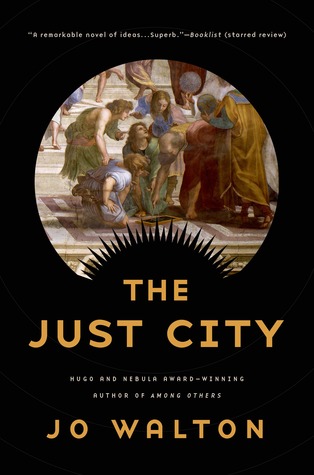
The Greek Gods Pallas Athene and Apollo are introduced as major characters in the first few pages of the book. At the beginning of the novel, a bewildered Apollo is left wondering why the nymph Daphne preferred to be transformed into a tree by his sister goddess Artemis, rather than submitting herself to him to be raped. Apollo seeks advice from his sister Athene who discusses the human notions of volition and equal significance with him, and Apollo decides he would like to live a human life to gain a better understanding of these concepts. When he expresses uncertainty about which era of history he should be born into, Athene tells him about an experiment she is planning, in which she will create a city in the mould of the Just City described in Plato’s Republic. Apollo decides he would like to live his human life as part of this experiment, becoming a citizen of the city.
Athene begins her experiment by taking three hundred scholars from all eras in history out of time and revealing her intentions to them. This cast of characters is comprised of a number of historical figures, such as real-life Plato scholars and philosophers. With a few exceptions, who are promptly returned to their own timelines, the scholars agree to help Athene in her experiment, accepting the role of teachers in the city. They adopt appropriate names from either Socratic Dialogues or Greek mythology, and set about forming a number of committees to govern the city. They are assisted this endeavour by manual labourers known as “workers” – robots snatched by Athene from a timeframe in the future to our present day. Athene decides that the city is to be constructed on the Mediterranean island of Atlantis, next to an active volcano, at a time before the fall of Troy. In this way, when the volcano erupts and Atlantis sinks, the city will eventually be destroyed and forgotten by history. With Athene’s assistance, the teachers collect exactly ten thousand children, again from other eras of history, to populate the city. All the children are bought as slaves and are roughly ten years of age, though some of them lie in order to be chosen. The children are educated and raised by the teachers in the city built by the workers in accordance with the principles set out by Plato in the Republic.
The book is told in chapters that alternate between three first person points of view. The first is Maia, a woman born as Ethel in Yorkshire in 1841. At an early age, Ethel was encouraged by her liberal father into intellectual pursuits, but but was suffocated by the sexism of the Victorian era. Maia is chosen by Athene to become a teacher in the city. The second is Simmea, one of the more gifted children of the city, the daughter of Coptic Christians in Egypt sometime during the first century AD. The last point of view character is Apollo himself, who has been born into the life of one of the children in city, and is calling himself Pyreas. The book follows these characters over a period of about ten years as they live in the Just City. Simmea and Pyreas become friends of Sokrates, who is brought to the city by Athene five years after it is established, not as a teacher, but against his will, almost as a trophy. It is the brilliantly evoked character of Sokrates who creates the drama in the novel, as he questions and rebels against Athene and her vision of the Just City.
Despite its scholarly subject matter, I found The Just City to be approachable and readable. The story moves slowly, but elegantly, and Walton’s prose is crystal clear, shimmering like the Agean sea on a summer’s day. While Simmea and Maia are immediately sympathetic and likeable narrators, it is impressive that Walton does such an excellent job of making the personification of the Greek god Apollo relatable to readers. Walton also makes her erudite subject matter accessible and even those readers, like me, not familiar with Greek classical literature and philosophy will find the books approachable. Walton weaves her disparate science fictional, historical and mythological elements together well to into something that feels logically coherent and seamless. In a genre built on a long tradition of imagining utopias and dystopias, Walton’s speculation about the rational implications of such societies, with a particular focus on the impact on the individual, is intriguing and echoes themes similar to Ursula Le Guin’s classic story “The Ones Who Walk Away from Omelas”. This novel’s ideas about power, compulsion and consent are handled deftly, with story elements that could be easily fumbled in the hands of as a lesser writer, such as scenes depicting rape, dealt with respectfully and intelligently.
Undoubtedly, some readers will be frustrated by the lack of narrative drive in the novel. There is very little in the way of action and the conflict in the novel is not overt. The Just City is an understated novel, and though there are events in the plot that are both absorbing and surprising, the book is more a novel about ideas and social dynamics between characters than of big plot points. While the prose is clear and sharp, there is often an analytical tone to the writing that, I felt, could be emotionally distancing from Walton’s storytelling. At times some of the secondary players feel like vessels for the ideas that Walton wants to explore, rather than fully fleshed out characters. It should also be noted that the novel not only extensively references the work of Plato, but also other pieces of Classical and Renaissance literature and art, and though, as I have already stated, a familiarity with this source material is not essential to the enjoy the novel, those familiar with the references will undoubtedly appreciate what Walton is doing at a level of sophistication that I, and other readers equally naive about this subject matter, could not.
During my reading of The Just City the comfortable narrative pace put me in mind of some of Connie Willis’ prose, while the combination of Greek mythological and science fictional elements were reminiscent of Dan Simmons’ Ilium and Olympos duology. I have no doubt that The Just City will appeal to fans of previous works by Jo Walton who enjoy this writer’s intelligence and clarity of prose. The book is also likely to find an appreciative audience in those interested in a science fiction novel that intersects with Classical Greek literature and mythology in a narrative about utopia, power, justice and consent. The Just City is being followed later this year by a sequel called The Philosopher Kings scheduled for publication in June, which I will be looking forward to.
The Just City by Jo Walton
Published by Tor, February 2015
368 pages
ISBN: 978-0-7653-3266-0
Review by Luke Brown, March 2015