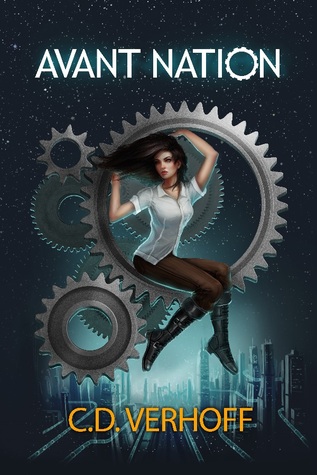
 “Like all Avants, Clara Spinner’s genetic code, future occupation and date of death have been predetermined by the government.” We have talked to C.D. Verhoff, author of Avant Nation.
First of all can you tell us a bit about your new novel, Avant Nation?
The story opens after the Second Civil War has dissolved the United States. The south is now Avantica, a nation built on genetic engineering. In the north there’s the Liberty Union Democracy, a nation violently opposed to Avantica’s ideologies. Clara, the protagonist, is a young medic caught in the middle. The questions she finds herself asking are issues we face today. How much influence should the government have over healthcare and education? How will genetic engineering shape the future? Who will control the gene pool? In exchange for comfort and security, what freedoms are we willing to give away? However, the novel’s focus isn’t on politics or science. In a nutshell, it’s a suspenseful coming-of-age story with lots of action and a touch of romance.
Can you give us some insight into your main character, Clara Spinner?
Clara is an Avant. Her genetic code, occupation and expiration date have been predetermined by the government. She is studious, compliant and compassionate by design. Her adventurous streak and sense of humor are aberrations that could get her exiled. Suppressing her true nature is a constant struggle. Nonetheless, she takes the view that no system is perfect. Despite a few negatives, Avantica is still the best country in the world.
Guided by the philosophy that the good of the nation outweighs the good of the individual, Avantica has grown wealthy and strong. Clara doesn’t question the rhetoric until she enters the workforce as a medical technician, specializing in the field of memory retrieval. Seeing the government’s heartless policies applied to the sick and injured is a wakeup call. She loves her country, but comes to doubt the motives of its leadership. Clara keeps her concerns to herself and works hard to impress her superiors. Eventually, her memory extraction skills capture the attention of the military and she’s recruited for a mission into the Liberty Union Democracy.
Undercover behind enemy lines, Clara’s convictions begin to falter. Not knowing who to trust anymore, all she wants is the truth, and the freedom to act accordingly. Can she overcome her hardwired disposition to fight for a cause she believes in?
What goals might you have set for yourself when writing Avant Nation?
My goal was to entertain people. Period. Dot. The End.
And how do you feel about the end result?
In my view, the reader’s reaction is the end result, so I’ll let them weigh-in:
“This is by far the best book I’ve read in a LONG time! I did not want to put it down until I got to the end and then when I got to the end I was sad that I was finished.” ~Nick Turner
“I was enraptured the whole time. I am so glad I read it. Best book in a long time, I am being dead honest!” ~Bree
“I must admit that at first, I thought this was going to be a rip off of the movie Divergent. However, I was seriously mistaken. Though the general idea is the same, this story is much deeper. There are so many twists and turns that predicting what’s going to happen next, is impossible. I loved the main characters and couldn’t wait to find out what would happen to them next.” ~Teresa Williams
I feel relieved and pleased by the end results. I find the frequent comparisons to other novels interesting. The one that comes up the most is Divergent. Others have drawn parallels to The Giver and The Hunger Games. One reviewer called it a remake of Brave New World. Since these novels are quite a bit different from one another, obviously Avant Nation is something truly unique.
Can you also tell us a bit about your Galatia series?
Pop culture meets epic fantasy in the Galatia Series. Through a string of catastrophic events, people from the 21st century find themselves transported to a world where Frodo would feel quite at home. Pitting people from our time period against sword slingers, introducing them to weird creatures and magic, was so much fun, I hope to come back to the series again and again.
Unlike my other books, I wrote the Galatia Series solely to satisfy my own cravings. That’s why I put in the flavors I enjoyed without concern for the tastes of a broader market. My Catholic worldview served as a subtle, but constant influence. If that’s a turnoff to anyone, I make no apologies for it. On the other hand, most of my characters aren’t religious. The heroes come from diverse backgrounds—an atheist, a Muslim, several lukewarm Christians, a couple of zealots and many with undefined affiliations. They sometimes swear, lust, lie, steal and murder. At the risk of sounding like an oxymoron, I wanted to keep the fantasy realistic, so I refused to sanitize my characters for the sake of appeasing a specific market. The demand for such an unusual blend is quite small. Regardless, the muse visited and I obeyed her dictates.
What is it with Science Fiction and Fantasy you find fascinating?
Hands down, Science Fiction and Fantasy are the most thought-provoking and imaginative of all the genres. It’s hard to believe anyone would claim otherwise. They take What if? to a whole new level. Writing SFF pushes the mind to the outer limits, making my synapses go wild. Creating new worlds and strange new peoples is a god-like feeling better than any high. It’s totally exhilarating.
How did you start writing? Was there a particular book or moment in your life that spurned you on?
My first book, Me and the Thing From I Don’t Know Where, was inspired by a young authors contest in elementary school. I was ten-years-old. The story featured a space alien named Squealiyum who gets blown to another dimension—Earth—in a cookie baking incident. An girl befriends the alien and helps him return home. Sorry to say my book lost to a story about a girl who passed a love letter in class and got caught by the teacher. The author was a friend of mine, so I couldn’t grumble about it—not out loud, anyway.
Have you ever struggled between what you would like to happen to a character and what you considered more sensible to occur? Can you tell us when and what did you do at last?
American readers want happy conclusions. I had a protagonist that needed to die at the end, but I knew it would hurt ratings. I killed him off anyway.
What sort of challenges, as a writer, might you have faced over the years? Any insights you would be able to share for those aspiring writers seeking advice?
A set of new challenges arise with every book, but some of the same ones keep cropping up—nailing the opening paragraph, finding the funds to pay a good editor, eliminating every typo, creating a flashy cover and marketing.
If you want to launch your book right the first time, I suggest studying the successful books written in your own genre. Also, hang out with other authors on writing forums and ask for their advice.
What is the hardest thing about writing?
The answer depends on the day, so I’m going to get random. Nailing the opening hook. Pinpointing the boring sections and deleting them. Avoiding distractions. Marketing is always a bitch. Dealing with rejection is an even bigger bitch. Not bitching about it is also a challenge.
For your own reading, do you prefer ebooks or traditional paper/hard back books?
If they’re the same price, I always go for the paperback. I like the way they feel in my hands. They’re easy to navigate and never run out of charge. However, ebooks are easier on the wallet and cut down on household clutter. So despite my love of physical books, eighty percent of my purchases are digital.
What kind of books do you read?
My reading tastes are eclectic. To give you an idea, I’ll list what’s stacked on my desk right now: The Maze Runner, Christ the King Lord of History, The Art of War, Absolute Relativism: The New Dictatorship and What to Do about It, The Breakout Novelist, Strunk and White: The Elements of Style, Stinky Robots, Boston Metaphysical Society, Innocence and Lord Valentine’s Castle. Some of them were read a long time ago. Others are still waiting to be opened.
What do you do when you’re not writing, any hobbies?
My favorite thing is spending time with my kids—ages 11 and 13. They’re enrolled in Brazilian Jui Jitzu, so I’m into that at the moment (as a spectator, not a participant). I also enjoy landscaping and watching movies. My favorite TV shows are Firefly, The 100, Buffy the Vampire Slayer, Love It or List It, The Walking Dead, The Middle and Castle. I’m sure I’d be into Game of Thrones if we had cable. Pope John Paul II is a hero of mine, so I like to read about his life and times. I have a soft spot for dogs. Basically, I’m a homebody.
What’s next, what are you working on now?
Currently, I’m working on the sequel to Avant Nation. I have a couple of other works-in-progress, one contemporary fantasy and the other fepic fantasy, that I’ve set aside to finish later.
* * * * * * *
Interview by Dag Rambraut – SFFWorld.com © 2015