
 ” A beginning is the time for taking the most delicate care that the balances are correct.” Princess Irulan, the first line of Dune.
Part 1: Why this review came about.
The story of Dune is perhaps one of the best known in science fiction these days. Personally I have read and reread it many times over thirty years or so. I own more than one copy and also the issues of the magazine (Analog) that it was first published in.
A recent discussion of Dune in the SFFWorld forums made some interesting comments, but also got me thinking why I didn’t read the sequels so much. In fact, I reckon it must be at least thirty years since I last read Dune Messiah. Remembering my read from that long ago, I recall eagerly picking it up, having felt that I finally ‘got’ Dune, and wanting some more.
And was bitterly disappointed.
Comparing Dune Messiah with Dune was a shock. This was nothing in comparison to Dune. Where were the interplanetary events, the battles, the action that I had loved in Dune? To my much younger brain it was too slow, less epic, definitely less action-based and depressingly smaller in scale. It rarely leaves the city of Arrakeen, never mind the planet of Arrakis. It was too talky, and there was a lot of mystical mumbo-jumbo that I really didn’t get. It felt downbeat and depressing and really not the tale I expected to read. It emphasised the bits of Dune I was less impressed with and downplayed all the parts I liked. My conclusion was that Frank had ‘lost it’, and me with it. And so I finished reading it, but didn’t enjoy it, and since have left it there on the shelf. I’ve given it a cursory thumbing over the years but never really read it again properly.

But now (thank you, SFFWorld Forum!) I have decided on a proper re-read. And I am so glad I did.
Part 2: Context – why was Dune so successful?
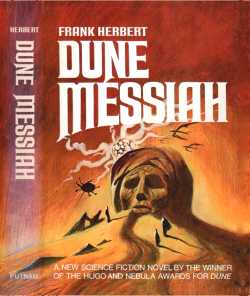
Firstly though, I feel that I must address the issue of why I think Dune was so successful and why it merited a sequel. Putting the background to Dune and Dune Messiah in context, I was reminded in the discussion that there was always a tone of ‘Lawrence of Arabia’ about Dune. In my opinion, part of the reasons for the book’s success was that the movie Lawrence of Arabia was released in 1962, whilst the book Dune, after being worked on for six years previous, was published in 1965. Readers of Dune would recognise a lot of the landscapes of Dune in the iconic imagery of the movie.
It could also be said that the similarity is not just in the visuals. Both in the film and in his autobiography*, Lawrence tells of the arrival of an Englishman to a new land (for him) where he takes on the values and customs of the local Arab tribes. He becomes their leader, is respected with near-religious fervour, and so leads the Arabs to the defeat of their enemies, the Turks, in 1918. Sound a little familiar?
Let’s not go too far here. I’m sure that much of this is coincidental. Frank got his inspiration whilst visiting and researching the Oregon Dunes back in the 1950’s, and after two World Wars there is more than one story of warfare and heroism like TE Lawrence’s. However, I am fairly sure that Dune was in the right place at the right time to benefit. By the movie raising a global awareness of desert landscapes and culture in the cultural mainstream Dune will have benefited from the movie’s popularity, in the same way that the James Bond movies led to a rise in sales in espionage tales.
Of course, in the science fictional setting of Dune this also involves a much bigger scale – not just a desert, but a planet – and the inclusion of many SF tropes – big weapons (heighliner starships, atomics), strange aliens (sandworms, the Guild) and exotic cultures (the Fremen, the Guild and the Bene Gesserit). These elements, when combined with the fact that it was a book written involving a drug (melange) at the time coincidentally of a burgeoning drug-culture, with a mystic element – it may be easy, with hindsight, to see the attraction of Dune.
The success of Dune was, I understand, rather unexpected. (According to Gollancz, the UK publisher, it is the best selling science fiction book of all time.) With such pressure to write a sequel, and after such an unexpected triumph, where could you go?
Part 3: Dune Messiah: the review.
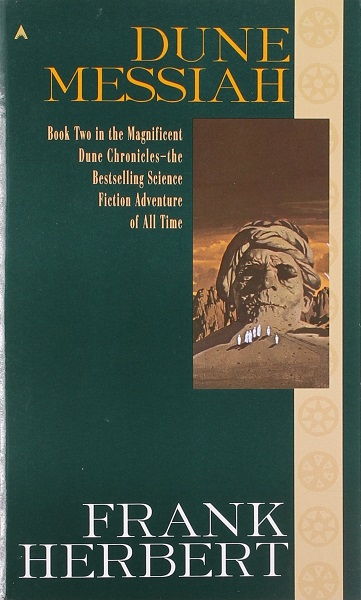
Dune Messiah deals with the perplexing issue of ‘what’s next?’ As any student of History will tell you, once the battle is won, maintaining the victory is the hardest thing to do. Dune Messiah is the book that tells us of the time after Dune, when Paul Atreides has become Emperor and been Emperor for over twelve years. He now has to maintain an unequal balance of power between the people across the galaxy his troops have conquered, the demands of his adopted Fremen people on Arrakis and the needs of his family and friends. At the same time there is the constant threat of treachery and betrayal, as those defeated in Dune do not accept Paul’s reign easily. Whilst the Harkonnens are barely mentioned this time around, there are others who wish to return to the old days and remove Paul from power.
On rereading, what impresses me most initially is how much depth there is here. This is no retelling of the old ‘heroes are good, bad guys are bad’ stereotypes of space opera, (see Star Wars) but a nuanced and thoughtful examination of what can happen after the war has been ‘won’. Dune Messiah is where good guys do difficult things and make near-impossible choices, albeit with the best of intentions, to the point where both they and the reader question that what they are doing is for the greater good.
”I don’t like the world we’re making, you know that? It was better when we were alone in the desert with only the Harkonnens for enemy.”(Fremen to Paul.)
The novel also tackles the issue of what happens after a person becomes a messianic-figure, albeit very reluctantly. Arrakis has become a religious shrine where visitors become pilgrims and Paul its figurehead, although his sister Alia is also involved as the leader of a sub-cult group. The effects of that are often unpleasant to those involved. Paul really does not like the role and is plagued by self-doubt, even though he has god-like powers of prescience.
The nature of sacrifice and the need for sacrifice when in such a position is not only examined but proposed as a necessary consequence of such an event. Enormous life-changing decisions are made here because of it, and although they are made in a much quieter, more introspective manner than in Dune, the effects are just as great.
One of the more interesting consequences of sacrifice here, but one which was seemingly disliked by some on the book’s publication, was the resurrection of a beloved character killed in Dune. Now known as Hayt (say that one out loud to get a not-subtle reason for the nomenclature), Duncan Idaho is returned as ‘a ghola’ – a person whose body has been returned to life but with the mind wiped clean – and then given as ‘a gift’ to Paul from the Guild. If this book was being written now, some might see this as a response to fan-requests, but in the 1960’s such things were less common.** No, Hayt/Duncan’s role is much more complex and more involved than you might expect, the ultimate sacrifice as well as the ultimate reward. It is a touch that is both nasty and yet typical of the complexities of court on planet Dune.
Of course, in these days of A Game of Thrones, such Machiavellian manoeuvrings are rather commonplace in fiction, if not rather expected. What is a revelation to me here is that this was written nearly thirty years before GoT. Much of the plotting is done subtly and quietly, seemingly without fuss or in the background – a quiet revolution, if you like. To my mind, many of the events of Dune Messiah are like the aftermath of the Russian Revolution of 1917, when horrors were happening on the part of the government but not in plain sight. Dune Messiah shows this, and how events become altered and glorified by history, the difficulties and the un-pleasantries glossed over and rewritten into something more justifiable.
Such activities in life may not be new. However it would be unfair to say that this was not noticeable from the start of Dune Messiah: the first thing in the book is the script from a recording of Bronso of Ix, someone who is about to be put to death because has said that Paul Muad’Dib was a kwisatz haderach (‘a captive messiah’) for the Bene Gesserit before he was a prophet and of being in a sham marriage to Princess Consort Irulan, both of which are true. When a person can be seen to do no wrong, then that becomes a problem.
For that reason, I am not surprised that Dune Messiah was not published in Analog. I really can’t see John W Campbell (Analog‘s editor) wanting such a downbeat tale, as it doesn’t seem to fit the template of Analog at the time. One of the key elements of Dune Messiah is that Paul fails, possibly knowingly. (The clue is rather in the title.) This must run contrarily to the usual Campbell idea that, by use of logic and intelligence, our ‘hero’ succeeds. (Interestingly, though, the third book, Children of Dune, was published in Analog.)
But I now find that it is a stunning piece of work, logically and relentlessly making its point – the hints of downfall were there even in Dune, but now, even when you can see the accident about to happen, you can’t do anything about it:
“Power tends to isolate those who hold too much of it. Eventually they lose touch with reality… and fall.”
Whilst there is still a certain degree of philosophical ideas reproduced as mystical mumbo-jumbo prevalent, I was pleasantly surprised at how contained it was, much more than I remembered. I was also surprised by how much internal dialogue there was here, as such thoughts and feelings are made clear – I remembered some but not as much as there was. This second book is generally more restrained and yet more complex than Dune. The characters have evolved, the situation become increasingly more complicated and the risks, whilst less overt, perhaps even greater.
Again, fiction echoes the mistakes of history, for historical events in real-life are also repeated here. And in the same way that the decisions made in Arabia in the 1920’s and 30’s may have contributed to the civil unrest of 2015, so too on Arrakis. Changes shown in Dune Messiah may have long term effects, which I’m sure the later books in the Dune series will show. My abiding impression towards the end of Dune Messiah was how easily such gains as those made in Dune could be lost. And I’m pretty sure that that was Frank’s point too.
I now realise (finally) what Frank Herbert has done. He has taken the situation created by Dune and with Dune Messiah covertly turned it into something greater than it initially appears to be, whilst simultaneously keeping the plot both small scale and focused, on a tight group of characters. It is really clever, and for something written 45-plus years ago quite an achievement.
It’s not perfect – there’s still the odd lapse in dialogue (phrases like “Dehydrate the Zabulon computations!” still sound like they’ve wandered in from a 1930’s pulp story), and some of the philosophical thoughts are still a little too esoteric for my tastes. What I found most clumsy of all though was the romance of the novel between mystic ice-maiden (and Paul’s sister) Alia and Paul’s resurrected mentor – though we are lucky that we are spared the version where, at one point, the romantic lead could have become Paul – what I will refer to as ‘that Luke Skywalker – Princess Leia moment’. It jars a little, but given the time it was written for is not enough to kill the book for me.
Nevertheless, though not without faults, being older and wiser, I have had to readdress my previous view and tell my younger self how wrong I was. You could even say that this is some form of Road-to-Damascus-ean conversion! Weirdly, and from the position of an older reader, it’s rather like comparing The Hobbit to The Lord of the Rings – whereas The Hobbit/Dune are the access point for many, it is Dune Messiah/LotR that is the real deal, the meat in the sandwich. In short, it is Dune Messiah, not Dune, that steps up to intelligently tackle the difficult questions and ideas, even when some of the outcomes are not what I wanted to read. It is as relevant today – perhaps even more so – than it was when it was first published nearly fifty years ago.
I cannot believe (but can understand) how much I misjudged this book on my first reading.***
I’m pleased to say that I thoroughly enjoyed it this time around.
Recommended.
Dune Messiah by Frank Herbert
Originally Published in Galaxy Magazine in an abridged form as Dune Messiah, July – November 1969.
ISBN: 978 045 0 022 852
256 pages
Review by Mark Yon
* The autobiographical book on which it was based, The Seven Pillars of Wisdom, was first published in 1922 and was the basis for the movie, though it was the movie that garnered global acclaim.
** LATER ADDENDUM: I may have this wrong. According to Dreamer of Dune, the biography of Frank written by son Brian, the inclusion of the ghola in Dune Messiah was actually as a response to fans who were upset by Duncan’s death in Dune.
***Actually, it might be a couple of readings…





LATER ADDENDUM: According to Dreamer of Dune, the biography of Frank written by son Brian, the inclusion of the ghola in Dune Messiah was as a response to fans who were upset by Duncan’s death in Dune.