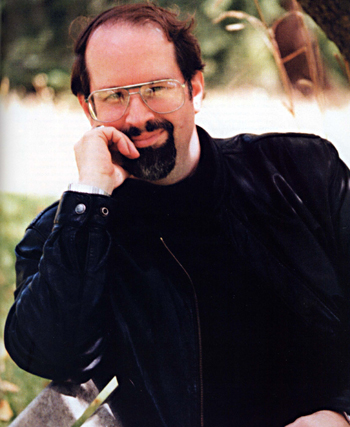
 Hello, Timothy: many thanks for giving us some time here. Welcome to SFFWorld. We’re writing these questions as Open Road Media are releasing more of your older work in the USA as e-books.
During the last few years you have had several older books released as e-books, how has the response been and do you have any particular personal favourites among them?
As near as I can tell, it’s been pretty positive. Obviously, no one comes to a signing with an e-book for me to autograph, but the sales numbers indicate that there are at least a core of readers out there who are buying, reading, and enjoying them.
As to any favorites, my books are like my children. I really can’t pick and choose between them.
How comfortable are you generally with seeing the re-appearance of older work? Is it something you’re happy to do, reaching a potentially new, wider audience, or are they something from your past but something you’ve moved on from?
Obviously, if I didn’t want these books to be available to the readers, I wouldn’t have agreed to let them be reissued in e-book form. Of course I’ve moved on to other projects – time does that to people – but I have no regrets or embarrassments over any of my earlier books and stories. Each one represents the very best storytelling I was capable of at the time, and I think they’ve all held up pretty well over the years.
This time it’s the complete Quadrail series being released as e-books. How would you describe this series to new readers?
In the Quadrail series, all of the galaxy’s inhabited star systems are connected by a network of large tubes that run through the outer edges of those systems. Inside the tubes run the Quadrail trains that carry passengers, cargo, and information at a speed of one light-year per minute. The trains and stations are run by a mysterious race called the Spiders, who have recently discovered hints of a mysterious threat to both the Quadrail and the rest of the galaxy. They recruit a human ex-Intelligence officer named Frank Compton to investigate, give him an enigmatic female assistant named Bayta, and send him to discover the truth. Needless to say, the truth isn’t quite what anyone expected.
When I say the complete Quadrail series there are actually enough loose ends in Judgement at Proteus to allow for sequels. Any plans to revisit the Quadrail universe in any way in the future?
I have some ideas for a sequel series, but unless a publisher expresses interest in buying new books this is probably all for now. Still, never say never, and I would certainly enjoy spending more time with Frank and Bayta. We’ll just have to see.
We also have to talk about Star Wars. How did you get involved in the first place and was it a given that you said yes to write the Thrawn Trilogy?
The original impetus came from Lou Aronica at Bantam Spectra, who suggested to Lucasfilm that Bantam publish a sequel trilogy to the Star Wars movies; and from the Lucasfilm people themselves, who were at that same time discussing the possibility of restarting their Star Wars fiction line. The two plans came together, Bantam suggested several authors, Lucasfilm liked my writing style, and the offer of the trilogy came to me in an out-of-the-blue phone call from my agent in early November 1989.
Was accepting the offer a given? Yes and no. I definitely wanted to write the books, but I first spent a day pondering whether or not I would be able to capture the atmosphere of the Star Wars universe and the personalities of the movie characters, as well as whether or not I could write a compelling story the fans would want to read. In the end, I decided to take the chance.
Thinking back, how did you start writing? Was there a particular book or moment in your life that spurred you on?
In November 1975 I watched a very bad TV show. When it was over, I said to myself, “I could write a better story than that.” So over the next two weeks, in my spare time, I wrote a story.
It wasn’t better than the TV show. In fact, it was pretty terrible. But it showed me how much fun writing could be, and so I made it my new hobby. Eventually, I started selling stories, and later novels, and I’ve never looked back.
Undoubtedly, the science fiction field is a genre that has grown in style, maturity and complexity over the years. Do you find yourself still reading for entertainment much? Or do you tend to read away from the genre?
Sadly, reading fiction these days feels more like work than entertainment. I find myself analyzing the plot, rewriting dialog in my head, wondering about the consistency of the characters’ personalities, etc. I therefore mainly read non-fiction these days, mostly history.
Over the years you have written a stunningly impressive number of books: we make it at least 40! In all that time, has your writing process changed much?
The process itself hasn’t changed much. I still create outlines for each book, though the outlines have gotten shorter and less detailed over the years. I still usually write at least an hour or so every day, and I nearly always know where the book is headed before I start writing.
I have gotten faster, though. I can now do up to three novels a year instead of the single novel I could produce when I first started. Dialog, which used to be a terrible chore, is now one of the easiest parts of each book, and my descriptions and time transitions are much smoother.
Though we perhaps know you best for your novels, you also write shorter fiction. How different do you find writing short stories and shorter fiction rather than novels? Do you have a preference?
I think most ideas have a natural length, and that if you try to create a story that’s either longer or shorter than that length you’ll run into problems. The Quadrail idea is way too big for a short story or novelette, whereas the idea behind my story “The President’s Doll” (voodoo acupuncture: the acupuncturist sticks his needles into the voodoo doll instead of into the patient) could never be stretched out to novel length.
I enjoy doing both types of stories. It’s merely a matter of knowing which kind of idea I’ve come up with, and writing the story to fit.
How are you finding the e-book revolution? Personally, are you happy with an e-reader these days, or do you still prefer ‘tree-books’?
I have an e-reader for travel, since I don’t want to carry any more weight aboard a plane than I have to. At home, though, I still prefer the feel of a paper book in my hands.
Which is just as well. I have an entire shelf full of books I haven’t yet read, and it would be a shame to waste them.
Once again, thank you very much for your time, Timothy.
* * * * * * *
Interview by Dag Rambraut – SFFWorld.com © 2015