
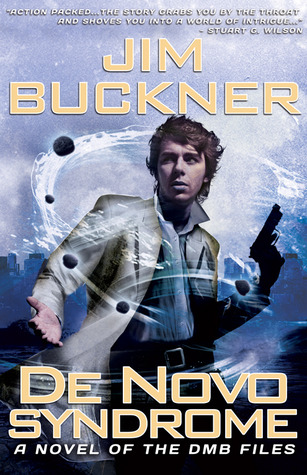
 De Novo Syndrome by David Mark Brown reviewed by fellow author Cleland Smith.
Dr Jim Buckner is on the brink of rediscovering a gene for immortality that could save his daughter’s life, but someone is trying to steal his research. When he finds himself in possession of a paperback book he shouldn’t have, he is thrown headlong into a maelstrom of action. His lab is attacked and in the chaos that ensues, his daughter is kidnapped. We are propelled with him in his quest to rescue her and discover the identity of his enemies.
De Novo Syndrome’s blurb characterises the novel as “a father-daughter story written as paranoid thriller” and, on the face of it, it’s a SciFi action thriller. It’s also a part of something much larger – the Lost DMB Files – but more on that later. De Novo Syndrome delivers a lot of pace and has more twists and turns than your small intestine. It begins with a short and compelling flashback scene which draws us in well, providing a tantalising glimpse into the protagonist’s past. We are then transported to a lecture theatre in a ‘present day’ very different from our own, where mankind is threatened by the spectre of genetic disorder ‘the twitch’. Brown, writing as the protagonist Jim Buckner, uses the lecture to good effect in setting the scene and from there on the action comes pretty thick and fast. The dominance of action in the novel will suit some readers, but I could have done with more variation in pace to build tension and enable more detailed scene setting. I sometimes felt as if Brown had already made De Novo Syndrome: the movie in his head and was describing it to me. At times this worked, and at other times was less successful. While Brown does a good job of describing some tricksy bullet-time manoeuvres, I occasionally found myself going back over the detail of what had just happened to gain a sense of clarity.
Brown has worked hard to create unique characters in De Novo Syndrome and I think he’s done well here. I found the key characters quite memorable, and Buckner’s relationship with his daughter is easy to identify with and well drawn. One of my favourite things about the characterisation was the way Brown handles Buckner’s ‘two minds’; his ability and compulsion to occupy his ‘background mind’ with mundane tasks of calculation and visualisation in order to keep what he terms ‘the river’ from bursting its banks. The transition from Buckner keeping the river under control to harnessing its power is nicely done and I enjoy the way the river passages are written. Similarly, Brown upends convention in making his ‘tough-guy’ head of security a charismatic ‘tough-gal’, Marisol Cruz (my favourite character). Despite the pace we have plenty of page-time to get to know Buckner and Marisol, and their personal journeys as characters are clear and satisfying.
There are a few areas that I do think are impacted adversely by the pace of the novel. Sense of place, for example, can seem disjointed at times. I sometimes felt I was leaping from set piece to set piece, without ever really stepping back to see the bigger picture; I’d like to see a bit more comprehensive world-building within the novel. There is also little room for back story. It would have helped my understanding to have some more solid information on the nature of the twitch and the twitchers. It wasn’t really clear to me exactly how the twitch manifested and progressed as a condition, how it was spread, what twitchers looked like, or what a ‘hybrid’ twitcher might be if the twitch was a retrovirus infection as described. Here’s where it helps to know that De Novo Syndrome is not only part of an ongoing series but has a supporting cast of ‘historical’ pulp novels, novellas and serials set in the same universe. Now, it may well be that everything I need to know is elsewhere in the Lost DMB Files, but some of it really needs to be present in De Novo Syndrome for it to make sense if it is your entry point to the DMB universe. Having said this, I like the idea of the Lost DMB Files and if you are a lover of conundrums and series alike, then Brown’s device should have you salivating.
The main thing that keeps De Novo Syndrome from really taking off for me is craftsmanship. For me the prose could have done with a fierce copy edit and for this StoneGate Ink must take partial responsibility. There are a number of wrong word usages (e.g. ‘drug’ for ‘dragged’), instances of poor sentence structure (e.g. ‘the air grew acrid, like touching the tip of your tongue to a nine-volt battery’), the occasional unfortunate phrasing and word choice (e.g. Buckner and his daughter finding themselves ‘atop a small knob’), and sentences which just didn’t seem to make much sense to me. All of these things are like potholes in the road; they jolt your suspension of disbelief and make you start to question things you might otherwise happily accept in the run of the story.
I enjoyed De Novo Syndrome. It does gallop along too quickly for me at times, but perhaps this is a measure of the author’s passion for his characters and storyline. Allow yourself to go with the flow and you’ll enjoy it too, but be aware that to get the most out of De Novo Syndrome you should also commit to investigating the Lost DMB files (David Mark Brown’s website is a good place to start if you want to do thishttp://davidmarkbrownwrites.com/lost-dmb-files/). It’s worth mentioning that the Jim Buckner novels are marketed squarely at Jim Butcher (Dresden Files) fans (see publishers description and cover design). I can’t credit this recommendation, having not read any Butcher. However, I would recommend De Novo Syndrome to readers who relish a series and who are looking for the feel of a Dan Brown thriller in a science fiction setting.
Reviewed by Cleland Smith
Sequela out now on Amazon Kindle





Cover design
I would go farther than your suggestion that the publisher is marketing to Jim Butcher fans; they’re intentionally confusing the two series.
See this Jim Butcher cover for comparison: http://upload.wikimedia.org/wikipedi…_Hardcover.jpg
…ethically dubious, in my opinion.