
As World of Water, the second book in James Lovegrove’s Dev Harmer Mission series has been released we have had the chance to catch up with him and talk a bit about the series and what lies ahead.
Welcome to SFFWorld James, many thanks for giving us some time here. In your own words, who is James Lovegrove?
James Lovegrove is an artificial construct dreamed up in the government military science laboratories of Porton Down in Wiltshire to serve as a living meme, capable of delivering ideas straight into the brains of anyone he infects and leave them with a lingering sense of possibility and unease. That or a 50-year-old author who has been scratching a living in the world of publishing since he left university and has produced more than fifty books and a similar quantity of short stories while also freelancing as a fiction reviewer and very occasional journalist – and husband and father of two. He lives in Eastbourne, a seaside town famous for its gentility, its preponderance of residents of pensionable age, and its vicious seagulls that will steal the pain au chocolat straight out of your hand if you’re not careful.
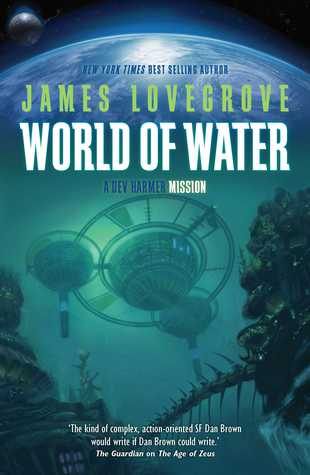 You have now released World of Water, the second book in your Dev Harmer Mission series. How would you describe the series in your own words, what do you feel is unique?
Dev Harmer is a Bondian super-spy who is as much a victim as a hero. His consciousness is sent across the known galaxy from world to world as a beam of pure information to be downloaded into cloned host bodies that are suitable to each planet’s individual environment. His life consists of repeatedly adapting to unusual circumstances, fast, and thinking on his feet, fast. He has a smart mouth and, buried somewhere deep inside, a good heart. The fun of the series is that each book is different from the previous one but part of a continuum, which stops me – and, I hope, the reader – from becoming bored. It’s outer-space action-adventure with a flawed but irrepressible protagonist. And lots of hideously weird interstellar wildlife. What more could you ask for?
How did you get the idea in the first place?
I had a hankering to write an outer space series, and Solaris’s Head of Publishing Ben Smith suggested the idea of a character visiting different worlds one after another, each with its own unique challenges and hazards. This appealed to me because I have a short attention span and a horror of repeating myself. My Pantheon series – all those novels with titles beginning Age of… – reworks the same basic theme in a variety of permutations, and that satisfies both my creative restlessness and my love of consistency at once. The Dev Harmer books allow me to do much the same: freedom and routine merged together in a sublime, comforting-as-a-duvet whole.
As already mentioned World of Water is the second book in the series. What new goals did you set for yourself with the second book?
Naturally, given what I’ve just said above, I wanted it to be as different in tone and setting from its predecessor, World of Fire, as I could make it. So instead of a Mercury-like planet where the surface is too blisteringly hot to support life, this book takes place on a water planet. One of the fun aspects of writing it was working out what sort of ecosystem a water planet would have and also creating an indigenous humanoid race for Dev to interact with. I spent some time figuring out how these mer-people would communicate and came up with the idea of them having photophores, light-emitting cells in their skin like some cephalopods have, and using colours and patterns to convey thoughts and emotions.
Do you have more books in the series already planned, anything you can reveal?
The basic concept and setting for the next volume, World of Air, are in place. All I have to do now is find the time to write it! My schedule is crazily busy for the next couple of years…
What is it with Science Fiction you find fascinating?
The endless possibilities. With SF, you’re not constrained by the laws and mores of the real world. You can go anywhere, write about anything, invent to your heart’s content, make and break rules, and no one can tell you you’re doing it wrong. It’s wonderfully liberating.
What books inspired your career as an author, and what authors do you enjoy now?
I grew up reading an enormous quantity of Marvel comics, and comics are still a huge passion of mine, but I’m also deeply indebted to the authors whose books I read as a kid and an adolescent, especially Ian Fleming, Stephen King, Ray Bradbury, Alan Moore, Colin Wilson, Kurt Vonnegut, J.G. Ballard, and many others. I don’t get as much time to read nowadays as I used to, and a lot of what I read I’m reading because I’m being paid to, for reviews and suchlike. I think the stuff you read during your formative years really sticks with you and shapes you. Nothing you come across in later life has quite the same effect and impact.
What is your favorite and least favorite part of the writing process, and why?
I don’t particularly love or hate writing itself. Some days it goes well, others not so much, but as long as I’m getting the pages done I’m content. Once a book is finished, however, I tend not to want to have anything to do with it any more, so when the time comes for editing I’m always a little antsy and wary to re-approach something I’ve left behind. I’m also rather reluctant when it comes to promoting my books and doing public appearances and speaking engagements, since I feel this takes away from the time I could be spending actually writing, but I know that these things have to be done and, secretly, in retrospect, I always have fun doing them.
You also write shorter fiction. How different do you find writing short stories and shorter fiction rather than novels? Do you have a preference?
I like to write a short story every now and then just because it’s an instant result. I usually can manage to turn one out in a day, two days at most, and they arrive in a huge splurging rush, which is always fun and refreshing and sometimes exhilarating. A novel is a long drawn out plod, whereas a short story is a thrilling sprint. I don’t prefer the one over the other, but it’s nice to have the opportunity to do either.
What’s next? Do you have more new and exciting projects you’re working on?
I have a raft of Sherlock Holmes novels lined up, including the next two volumes in my Holmes-versus-Lovecraftian-monsters trilogy Cthulhu Casebooks. On top of that, I’ve recently set up a boardgame company with a friend. We’re developing various concepts, including a card game, a word game app, and an all-ages fantasy tabletop game. So, for the foreseeable future, I’m going to be fairly busy.
Once again, thank you very much for your time.
You’re welcome!
*****
Interview by Dag Rambraut – SFFWorld.com © 2016