
Two explorers take a boat upriver to discover ancient tombs buried deep in the jungle. A bemused girl exploring her new-found freedom finds a man singing most beautifully. An expedition finds itself running for its life against jackals. A mining corporation on Mars finds artefacts and anomalies. A pilgrim is looking for a lost city, findable only if you really want to and you’re wearing the right body. A scientific study to recreate a habitat goes wrong. And don’t, whatever you do, go to the door in the mountain…
This is an anthology of twenty Lovecraftian horror stories from authors such as Joyce Carol Oates, Caitlin R. Kiernan, Molly Tanzer, Lois H. Gresh, Nancy Kilpatrick, Elizabeth Bear and Gemma Files.
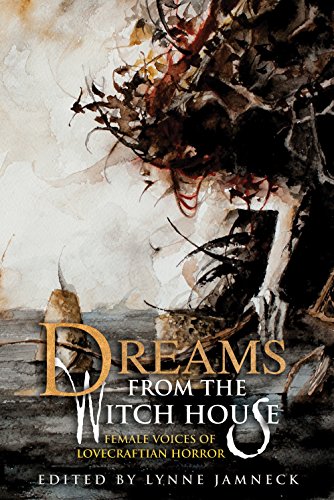
I’d describe this horror anthology as subtle. Although there are tentacles in several tales, most of the stories aren’t the horrors-from-beyond and madness-inducing terrors that characterise a lot of the genre. The horror here is insidious and gentle; it’s told in letters and conversations, in stories and fables, in dreams and nightmares; and it’s not world-conquering monsters, but rather the small doubts and flaws and choices that nag at the human mind. There’s a brilliant mix of genres, from sci-fi and wild west to childhood and almost fairytale. The stories are all different, which makes for a nice read overall – they’ve all got the horror theme mixed with madness and strangeness, the unusual and the fantastic, but each story brings its own style and version of Lovecraft to the genre.
While the anthology is well-mixed, a lot of the stories can be categorised in their themes or influences. About a third of the stories have ‘traditional’ Lovecraft styles or influence; 1920s, usually exploratory or scholarly, and with the tinge of strange horror that’s so alien and spine-tingling. Shadows From The Evening, the opening story, is a subtle piece; a young girl in a new city discovers a man singing, and he can’t stop singing… The Genesis Mausoleum is more traditional, with two explorers in the jungle finding something they didn’t expect. All Gods Great And Small is also in this style, with an added dose of creepy; an outcast in Ecuador hates the rainforest, hates the wildlife, hates the natives – but finds that his efforts to change his surroundings to his liking are not going down well. If you don’t like ants, don’t read this story!
One of my favourites in the ‘traditional’ style was The Woman In The Hill; a woman’s letter to an old friend describes the women who vanish, raving about a door in the mountain, and her efforts to stop them – and the kick at the end is excellent. But Only Because I Love You is also an excellent and well-written story – explorers are being chased by jackals, and stumble across treasure. I loved the multiple layers in this, and the title gives it an added twist at the very end.
I’d highly recommend getting this anthology simply for the three ‘genre’ pieces. Mnemeros is a wild-west themed piece, set in a country of canyons and ghost towns and don’t-go-down-to-the-river with an explorer, looking for pieces of rock that hold a strange secret. It’s one of the more visceral stories and works really well, combining action and horror with some different twists and unanswered questions. Our Lady Of Arsia Mons is a sci-fi piece, set on Mars and following the discovery of a cave / tomb / shrine by archaeologists working for a mining corporation. The mix of horror, mystery and corporate pragmatism brings a very different feel to the story, and it’s a much more practical tale than many of the others, which brings the horror elements out in a different way. The characters in this are all very well done, and although there are a couple of tangents and loose ends, the overall story is really good. And my favourite – both of the genre pieces and overall from the anthology – was The Wreck Of The Charles Dexter Ward. While it’s probably the story furthest away from Lovecraft’s traditional horror, it’s a brilliant story with excellent worldbuilding, strong characters and so many amazing details that are just hinted at or dropped in. The horror elements come from unexpected places (I didn’t expect to feel sorry for the Charles Dexter Ward itself!) and the unusual take on zombies is done well. The story also wins a place in my heart for making multi-eyed tentacle things (called Cheshires) sound sweet and adorable!
There are several sea-themed stories; Down At The Bottom Of Everything is a short piece about a man who nearly drowned, and lives with the memory. From The Cold Dark Sea is almost a fairytale, or someone watching a fairytale…the horror element in this isn’t as spine-chilling as many of the others, and in many ways it’s almost a sweet story about family, about secrets and children and mysteries from the deep ocean. And All Our Salt-Bottled Hearts wins the second place in my heart for a favourite story; it’s a beautiful tale rather than a horrific one, about a bloodline linked to the sea and the journeys of the children left on land. It’s poignant, heart-wrenching and strange, and it’s full of mythology and emotion and homesickness; it’s an ode to the sea, to places remembered, to tugs of heartstrings and people who never quite belong, who are waiting to go home – and who might never be able to get there.
Eye Of The Beholder is more of a modern themed piece, about a woman searching for a husband and the drastic consequences of her attempts to look younger. Spore is set in the modern world, and I liked the faintly futuristic thread; in many ways this was one of the sweeter stories, of people just looking for connections and a woman searching for a lover she couldn’t quite forget. The Face Of Jarry is a very modern style, and I loved the mix of lyrical thoughts with prosaic normality; “…just the other day I opened my tea to find a collection of silvery pearls – snail eggs – buried in among the composting oolong.” The story itself is part fantasy, part dream, part horror; a man trying to find his way back to a perfect world, but unable to do it alone. And The Body Electric mixes Lovecraft’s traditional scholarly theme with Artificial Intelligence; a PhD recreating and studying habitats goes wrong when the program goes rogue. However, this story did leave me with more unanswered questions than I’d like; how did Tarn come to the notice of the outside world? Why did people start studying his creator? Is Tarn still there?
The final ‘theme’ of the stories is children. The Child And The Night Gaunts is almost poetic, a story about a child growing up and the nightmares that keep following him, nightmares that are realer than he’d like. Every Hole In The Earth We Will Claim As Our Own has a more modern setting, but plays on the fear of our children not being our own, and the desperation of a parent just wanting to keep their dying child for a little longer, whatever the cost. Dearest Daddy is a turn-of-the-century story about an abandoned child who never quite forgets her father, never quite stops hungering for his love – and when he reappears, finding her a whore and barmaid in a forgotten mine, she takes steps to ensure that she does keep him. Cthulu’s Mother is a very short comedic sketch which will amuse any Lovecraft fans, and the final story, Pippa’s Crayons, is possibly the most unsettling of the collection; I needed two reads to decipher it, and its sheer familiarity makes it all the more terrifying. Any adult who has every tried to decipher a child’s colouring, tried to work out if that brown splodge is a cow and been told NO, it’s a PIG – this adds a very unsettling undertone to those conversations!
Overall? Unsettling, horrifying, sweet, eclectic and interesting. If you like subtle horror and unusual settings, give this a try.
© Kate Coe, August 2016
Dreams from the Witch House: Female Voices of Lovecraftian Horror by Lynne Jamneck (ed)
Published April 12th 2016
Review copy courtesy of the editor
350 pages


Thanks for this review. I’ve added this book to my to be read list. I always like to see fresh approaches to mythos fiction, and this seems like a decidedly different take!
Thanks for this review, Kate – look forward to reading these stories!