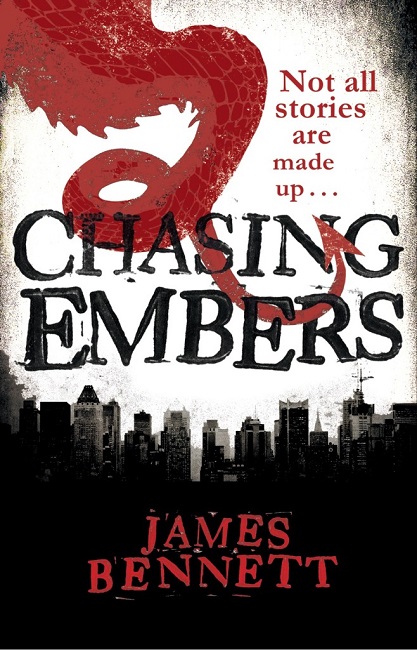
 From the publisher: Behind every myth, there’s a spark of truth…
There’s nothing special about Ben Garston. He’s just a guy with an attitude in a beat-up leather jacket, drowning his sorrows in a downtown bar. Or so he’d have you believe.
What Ben Garston can’t let you know is that he was once known as Red Ben. That the world of myth and legend isn’t just a fantasy, as we’ve been led to believe. And he certainly can’t let you know the secret of what’s hiding just beneath his skin…
But not even Ben knows what kind of hell is about to break loose. A centuries-old rivalry has just resurfaced, and the delicate balance between his world and ours is about to be shattered.
So…. ‘Strange creatures live amongst us’. A common enough trope, from mysterious aliens to gods, witches, demons and dragons. Here, in Chasing Embers, it’s the story of the world but told from the perspective of a long-lived Dragon. ‘Red’ Ben Garston to most people looks like a nondescript, a man living in Manhattan on an inheritance with little fuss. However the truth is stranger. Ben is one of the few Dragons left with ties to his birthplace of Albion, England. Since the signing of the Lore at Uffington in 1215 (the other document King John signed that year) Ben is one of the few ‘Remnants’ who have not gone for the Long Sleep, there to maintain the peace between the magic creatures and non-magical humans. Looking like a large red dragon might create a bit of a flap, so Ben has assumed human form, though he can change back to a dragon in the blink of an eye.
The book begins in Manhattan when Ben is attacked in a bar by the member of an old clan with a grudge and a long memory – something which, according to ‘the Lore’ – a centuries-old, non-violence agreement – is not allowed. Surviving this, further investigation on Ben’s part and a consultation in England with Sir Maurice Bardolfe, Knight of the Order of the Guild of the Broken Lance, suggests that there are forces at work that would like to break the peace and revive all those mythical creatures who left for the Old Lands or agreed to sleep until their time of need again.
Anyway… dragons. What more can be said? Surely this trope has had its day and there’s little more to say?
I’m usually of the opinion that tropes for me are fine, as long as the author brings something new to the tale, some kind of little twist. We are, after all, a set of genres that to some extent relies on such matters. And it must be said that in Chasing Embers James does put his own spin on the myths. What impresses me most of all in Chasing Embers is the thought and detail that’s gone into creating the backstory.
There’s a great history there about the role of dragons in Albion through the ages, from the so-called Old Lands to the rise and fall of King Arthur to King John, most of which Red Ben has seen. We read of the rise of the Knights as the Guild of the Broken Lance, uncomfortable adversaries to the dragons and other creatures of the Remnants, these days brokering the uneasy peace of the Lore. We get a connection to Egyptian history which rather reminded me of old Hammer Horror movies, The Mummy and its ilk. (Definitely not the Brendan Fraser remakes, though.) The idea of ‘dragon’s gold’ is also briefly covered here too.
Ben is, surprisingly for a creature that hundreds of years old, remarkably un-travelled, so our journey in the novel from the US to London to Europe and then Africa is like it is to Ben, a revelation. I liked the global travelling, which provided attractive backdrops to the events herein.
The plot is fast paced and straightforward to follow. The main plot is about the reappearance of an ancient goddess who has a quest for mythical objects to retain her power and wreak revenge on those who dispatched her in the first place. This also involves the ripping up of the Lore and allowing open season on those who wish to restore order and maintain the agreement made centuries ago – like Ben and what is left of The Fay, who left centuries ago with only a few envoys remaining. Others, like the witch-coven known as the CROWS, see this as a time for revolution, taking advantage of a weakness in the usual pattern of Order. The removal of the Lore has also led to the weakening of the Long Sleep, the agreement made in 1215 that put many mythical creatures in hibernation. The fact that many creatures of ancient myth may be waking is not something modern society needs.
It’s a wonderful set up that uses versions of traditional myths to create a backdrop, maintain a relentless pace and have enough action to keep the pages turning at the end.
It also helps that generally the characterisation is pretty good, though the plot relies heavily on its homage to traditional clichés – gruff liquor-drinking hero, pompous professor types, sexy and horrific femme-fatale villainess and so on. This is part of the fun, though, as long as you don’t think about them too much. The pace of the book generally ensures the reader hasn’t to worry over such details. James manages to bring a number of twists to the tropes though and not everything is as the reader should expect.
In places I was very much reminded of the film and book Highlander (though, again, not the sequels.) There’s some nice points made about the consequences of being something that has lived beyond a normal human lifespan. The effects of global change, for example, show that not all change is seen by Ben as for the better. In fact, at the beginning of the book James manages to create an eloquent impression that Ben seems rather weary of it all. It’s not all bad, though – at other times James writes eloquently about the joys of being a dragon.
So far, so good. On the downside, there’s a fair bit of obvious info-dumping along the way, and the occasional lapse of logic. I found it a tad tedious that at first, rather like The Incredible Hulk, Ben usually ended up naked after every transformation and had to find clothes. Surely after 800 or so years you’d have found a solution to this problem, even if it’s only to carry spare clothes with you some of the time! On the good side, though, the author is clearly aware of this and resolves this problem about midway through the novel, even though the solution is a bit of convenient magic-ery. Of the minor annoyances, however, there’s nothing too jarring and my sense of disbelief, on the whole, remained unsullied.
In summary, Chasing Embers is a superior piece of magical myth-making. Clearly thought out and obviously done with a great deal of research, the author creates a logical and surprisingly sensible tale that was an extremely promising debut. I’d be very happy to read more of these novels, which is a good job as there is clearly a sequel expected.
Chasing Embers by James Bennett
Published by Orbit, September 2016
464 pages
ISBN: 978-0356506647
Review by Mark Yon, August 2016.