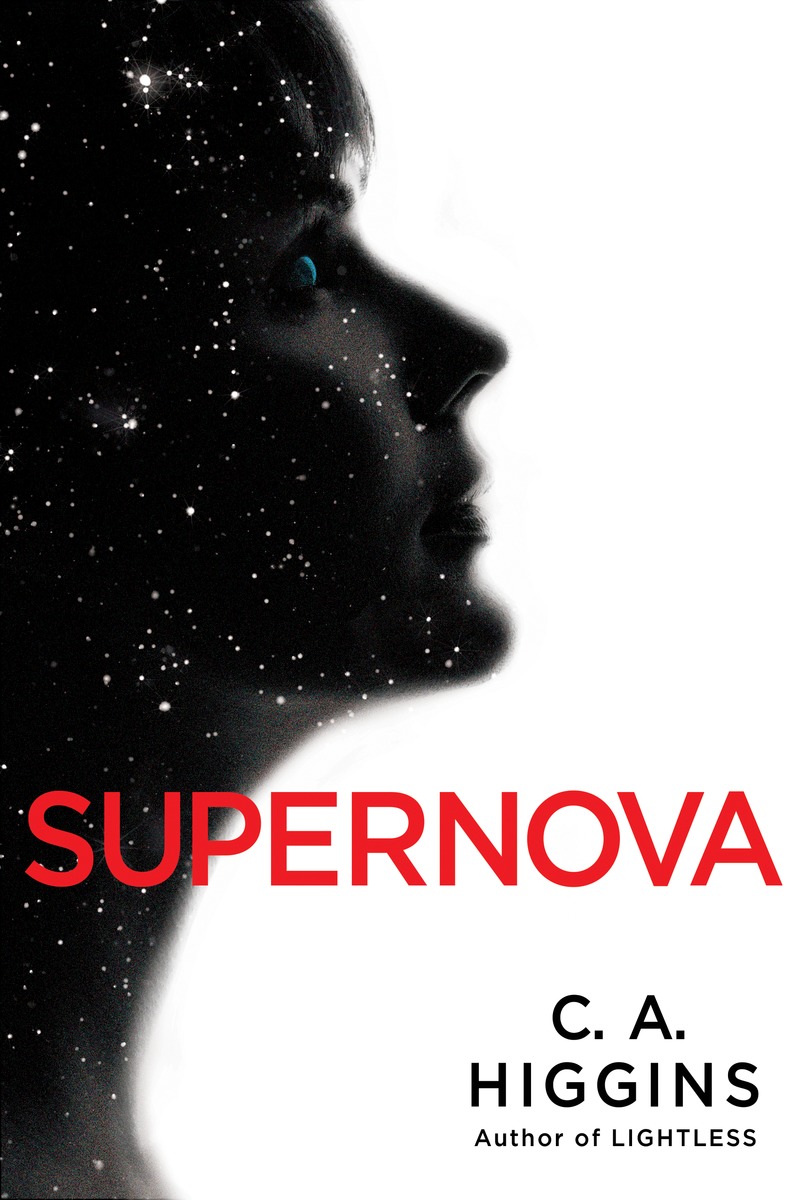
C.A. Higgins burst onto the SF scene in 2015 with her stunning debut Lightless (reviewed here), and less than a year later, she follows it up with Supernova, the second book in the trilogy, which plays with the ramifications of the momentous events in the first volume: the awakening of an Artificial Intelligence and Interplanetary War.
I enjoyed Lightless a great deal and was looking forward to following the further exploits of these characters, which is why I found Supernova to be more frustrating than anything else. There are flashes of brilliance in the moral quandaries Higgins explores, but other elements of the novel weren’t quite as balanced and didn’t live up to the promise of Higgins’ debut.
One of the risks a writer takes when constructing a novel with parallel storylines is that one may be more gripping, or interesting than the other. I was much more engaged in the Ananke and Althea storyline. Higgins tackled some heady themes there: motherhood and its intersection with artificial intelligence in Ananke and Althea’s search for Mattie who either died or disappeared. Over the course of the first book, the ship Ananke was awoken and gained sentience. The majority of Althea and Ananke’s storyline is dealing with that fallout, with Althea in the role of a mother and Ananke in the role of child. Part of the friction there is that Ananke is not human and therefore inherently has a different rule-set and ethical standard. What began as an engaging storyline that was showing signs of hope after a very dark moment, slowly devolved into something horrific. I mean that as a compliment because Higgins handled this storyline deftly, thoughtfully, and with an engaging voice.
The other storyline featured Constance Harper, the Mallt-y-Nos, A.K.A. the Huntress, and her continuing “revolution” against the Earth-centric populace of the Solar System. Like Althea, Constance is searching for Mattie. That is where the similarities end, unfortunately. Constance’s story didn’t have as much weight and Constance and her crew’s reason for revolution felt very nebulous. I simply didn’t feel empathy for their plight. The System, the governing body of the solar system against whom Harper has set herself, exists mainly in Supernova as a Big Faceless Government. For all the death Constance threatens and affects against them, there didn’t seem to me to be a reasonable justification for her revolution. The System was of course touched upon as a controlling government in Lightless just as it was here in Supernova, but not much more than that.
In the end, for me Supernova is a mixed bag. The brilliant, thought-provoking storyline featuring Ananke and Althea made for some very gripping storytelling and moral quandaries. Just about everything (even the rather abrupt cliffhanger ending) worked for me. Unfortunately, I found myself less enthralled with the Constance storyline, it felt disconnected and like a story treading water.
Supernova is not a sequel that be can picked up without having read the first installment, Lightless. I suppose I may have enjoyed Supernova more if I read the two novels back to back. However, at this point, I can only give a mild recommendation to Supernova if you’ve read Lightless and are already really invested in the characters and story.
© 2016 Rob H. Bedford
Interview with C.A. Higgins here at SFFWorld: http://www.sffworld.com/2016/08/interview-with-supernova-author-c-a-higgins/
Hardcover, 304 Pages
Published by Del Rey, July 2016
Review copy courtesy of the publisher
http://www.cahiggins.com/