Welcome to SFFWorld Andrew, many thanks for giving us some time here. In your own words, who is Andrew Post?
Thanks. Well, Andrew Post is a guy who, as a kid, spent a lot of time alone with his imagination who wrote some of it down, (sort of) grew up, and decided, “Let’s see if anyone else might want to read this stuff.”
Can you tell us a bit about your new book, Rusted Heroes? What do you feel is unique about your story?
Rusted Heroes is a fantasy novel except in the traditional setting being a perpetual medieval period like a lot of fantasy, I decided to shove this world’s timeline ahead to the equivalent of our 1914. War is a business now for the folks living in Rammelstaad. People don’t want to fight but because of these little books, called thrill-rags, they’re hearing about the derring-do of heroes past and they go off and fight, bolstered by the stories, hoping to be like them. Anoushka Demaine, the protagonist of Rusted Heroes, had a story written about her (without her permission). We meet her when she’s retired from the life of a warrior, working in a sawmill. After reading the thrill-rag about her, she decides to go back and get the ol’ gang together, her squad tank, and continue the fight against the orcs. Of course, she may’ve just fallen into the trap the same as so many other Rammelstaadians, but she’s been inspired by her own story, of who she used to be, or who the book portrays her as. She doesn’t know why she wants to go to continue fighting for her realm, or if she was ever that person in that book. She sees war is a product now, a brand, something to sell to continue the cycle. But she isn’t blameless; she, at one point, contributed to that happening to her world. And that’s where things start get interesting.
 Can you give us some insight into your main characters?
Anoushka, our central character, believes she is a good person, as we all do, but spoiler alert: she is not. Her best friend, Kylie-Nae Browne (the great-great-grandmother of Aksel Browne from my Fabrick series) is the squad’s gunner and sharpshooter, who, after retirement, now works in a circus as a trick-shooter. These two are really the heart of the story and a lot of the squad’s past exploits are told through them reminiscing about their glory days. We also have Peter the berserker with his battle-ax. We have a dwarf. We have a burnout wizardess. We have a bard, the one recording the team’s story in hopes of selling more thrill-rags. And because every story needs one, we have our antagonist, the necromancer, the squad’s target who may not be all that he seems.
Did you set yourself any new challenges with this book?
I did. Previously, with Fabrick and Sired by Stone, I had a cast of many characters whom I’d jump from perspective to perspective as the story unfolded, which was a challenge to keep all of that straight, who was where, whose “eyes” the reader was seeing the scene through, etc., but with Rusted Heroes I wanted this story to be told exclusively from Anoushka’s POV.
I wanted it to be almost claustrophobic to be in her head with her all the time because of the distrust she begins to have with herself, learning who she really is. Like my other novel,Knuckleduster, which also deals a lot with war and war culture, Rusted Heroes is centered around guilt. Which, as you can probably imagine, isn’t real sunny material to spend eight hours a day zeroing in on. I took Anoushka to some pretty dark places, both mentally and geographically. And sometimes both at the same time, readers will find out, when our heroes venture into the Scorch . . .
Tell us a bit about the book cover.
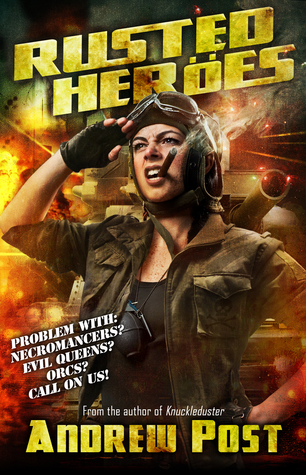
Medallion, Rusted Heroes‘ publisher, sends out a questionnaire to their authors shortly after the contracts are signed. You’ll answer questions about the main characters; their ages, what they look like, etc., and if certain colors or shapes are germane to the plot so they can work all of that into the cover. Which I think is a fantastic approach. I detailed Anoushka to the art director and a few months later they sent me the cover they had done. I was blown away — the model they got to stand in for Anoushka looks exactly like I imagined her. And the propaganda poster vibe fits so, so well with the story.
How did you start writing? Was there a particular book or moment in your life that spurned you on?
I wanted to be a writer since I was very young. I was five when I wrote my first “book” which I think came in at about two and a half pages. More of a pamphlet, I guess. But from that moment it’s all I’ve ever wanted to do and that has yet to change.
But what first got me into writing, or thinking about crafting stories longer than pamphlet-length, was Robert A. Heinlein’s Red Planet. I read that when I was in second grade (I think) and it blew my mind. I read a lot of fantasy, sci-fi, and horror in high school and would look at the little tricks they’d do and I’d try to imitate styles and eventually found my own voice and, well, never looked back.
What sort of challenges, as a writer, might you have faced before your first book was published? Any insights you would be able to share for those aspiring writers seeking advice?
I thought I was wasting my time for a very long stretch before I was published. I’d put stuff together, a short story or a novel, send it out, wait, and often you don’t hear anything — whether they got it, liked it, didn’t like it. And often what comes out of the silence, more often than not, is a bland no, thanks. Each time I’d get one of those I’d sit outside and stare at nothing and brood and wait, wondering if the one thing I wanted to do was never going to happen for me. But when an editor or agent would respond with more than two words, I’d take people’s advice and I’d apply it if I believed they were onto something, hoping it’d make my next attempt stronger. I don’t think doubt ever goes away, even after you’re “successful” which is another thing that’s all but impossible to measure. But if you want to do something, it’s just a matter of sheer force of will. In Rusted Heroes, during a pretty bleak period for the characters, Anoushka tells her squad: “There is only forward.” And this isn’t just something badass for a character to say (though I think it definitely is) it’s also a personal mantra for me. I tell myself “There is only forward” all the time.
But, in the cold light of day, you’re still acting out the definition of insanity if you’re punching a brick wall and only getting bloody knuckles for your efforts again and again. Though, if you’re a writer and know you’re a writer, you’re probably not a hundred percent upstairs anyway so keep punching, I say. Eventually, EVENTUALLY, the wall will say fine, all right, you’ve earned it.
Besides saying never give up (thinking that should just be automatic for anyone working in a creative field) I think authors would be well advised to always be polite to people who gave them their time. Publishing is one of the last industries to have retained its dignity (for the most part) and I think authors should work to preserve that. And that begins with little things like not being a pissy little prima donna about being told no. If an agent or editor responds with anything more than a form letter, even in the case of a rejection, THANK THEM for it. Manners are free and the publishing world is not really that big. Editors are always moving to different positions within the industry all the time, and besides their red pens they’re also bringing along their stories. Tell someone off and it’s not just them that hear it, but dozens, hundreds. And reputations stick. Plus, it’s just nice to be nice, isn’t it?
How do you go about the marketing aspect and especially related to your online presence? Anything you’ve seen work better than other things?
This is somewhat of a tricky area for me because I’m still figuring out. In full disclosure, I like doing things like this, interviews, because I think people enjoy looking at books as having come from somebody and not just as products popping up in their Amazon recommendations list. Word of mouth is important and great if you can somehow nudge that boulder in motion. Being engaged with your readers is also important, let them see you’re not just a stack of three salesmen dressed in an author’s clothes. Being funny on Twitter works for a lot of people if you can key into that particular “internet voice” everyone seems to be trying to hit — which is scary to me because everyone is starting to sound so alike, it’s like some kind of smarmy hive-mind is taking over.
Personally, I like doing the conventions the best. The last one I attended I sold out in less than two hours. And I think it was because looking a potential reader in the eyes (the same set that I hoped would be glued to my book shortly after we’re done speaking), I could tell them, human to human, why they might like what I’m offering. It’s still being a shill, I was still hustling books, but it felt a lot more genuine than spamming my Twitter followers begging them to click. I could talk to the con-goers, find common ground, see what they like and maybe find some connective tissue between their likes and my work. Plus, at cons, I get to be around like-minded people. Or just be around people in general, something a lot of writers — myself, the Hermit of the North Hill, included — could probably stand to do more often. Point being: every author needs to find where they feel most comfortable.
What’s next? Do you have more new and exciting projects you’re working on?
The next thing after Rusted Heroes is my comedic horror novel, Aftertaste. It’s about an undead chef who has been tasked with hunting down the Were-Amphibian of North Carolina and he’s really not very good at it. It’s due out next year, I haven’t heard when exactly yet, but I’m very excited to see what people make of it. I’m also beginning to practice magick of the left-hand path. You know, for fun.
Once again, thank you very much for your time.
Thank you, this was great!
* * * * * * *
Interview by Dag Rambraut – SFFWorld.com © 2016