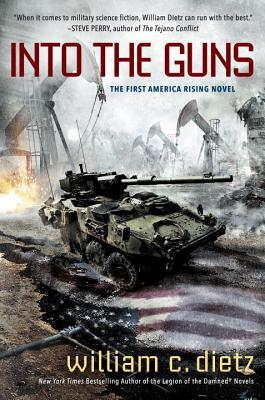
 “From the New York Times bestselling author of The Legion of the Damned Novels and The Mutant Files comes the first novel in a post-apocalyptic military science fiction series about America rising from the ashes of a global catastrophe…”
Into the Guns is the first book in a brand new series from military science fiction author William C. Dietz.
First of all can you in your own words tell us a bit about Into the Guns?
The U.S. Strategic Petroleum Reserve consists of underground oil storage facilities in Louisiana and Texas. While reading an article about them I was struck by the fact that all of our reserves are in the south. That caused me to think of the Civil War, and being an author, I put one and one together took off.
What if the south seceded for a second time? Some southerners claim to favor such a thing even now. But what would precipitate an event like that? How about a series of devastating meteor strikes? Yes, I decided. That could set the scene for a second civil war. A war in which a recreated confederacy would control the country’s petroleum reserves and have the upper hand. That was sufficient to get things rolling.
You have some unlikely heroes in Mac and Sloan. Can you give us some insight into your main characters?
I have a special interest in female military officers because my youngest daughter served in Iraq–and is presently a Lieutenant Commander in the inactive reserve. Plus I enjoyed writing the Andromeda character in the Legion of the Damned™ prequel series.
So Robin Macintyre (Mac) was a natural for me. As I started writing I wanted to make a statement about how women should be allowed to serve in every possible role including that of cavalry officer. But when I was halfway through volume two the rules were changed and women became eligible for the cavalry! That’s progress for you—and a good thing too.
During Into the Guns Mac finds herself in command of a group of soldiers who are cut off from the chain of command, and forced to fend for themselves. As a result Mac has to deal with a wide variety of challenges as she seeks to move her command to a better location and keep her soldiers alive.
Samuel Sloan is the Secretary of Energy when the story begins, and on official business in Mexico, when meteor strikes decimate the federal government.
While Sloan struggles to return home, the people who govern the New Confederacy are looking for him because they know something he doesn’t, which is that he’s the President of the United States! And, if they can control him, they can control the country.
 What new challenges did you set for yourself with Into the Guns?
Into The Guns presented me with a technical challenge because I was writing about two protagonists whose paths cross from time-to-time but who operate independently for the most part. Quite a bit of planning was required to keep their individual stories moving along, while arranging for crossover points, and building the relationship between them.
Has there been any special consideration you’ve had to take since the story is set in such a near future?
Definitely. As someone who often writes novels set hundreds if not thousands of years in the future, and can generally make stuff up, I had to do a lot of research. Thank goodness for the Internet, Google Maps, and Google Earth.
Is this a sort of chaos you envision that America would turn into should something like this actually happen?
The answer is, yes. And in a nation that is roughly 48% liberal, and 48% conservative, the potential for conflict is plain to see. Nowhere is that more visible than in the run up to our presidential election, in which the entire population is split into two very polarized tribes.
Were the forces of law and order badly weakened by some sort of catastrophe, and in a country where so many people own guns, I fear that the sort of civil unrest depicted in my book would be a virtual certainty.
What is it with military science fiction you find so fascinating?
I think we’re hardwired for stories about good versus evil, the kind of stories that were told around campfires thousands of years ago. And military stories are typically about the good/bad dynamic. Additionally, military plots provide me with opportunities to dig into subjects like valor, honor, self-sacrifice, survival, cowardice, futility, loss, and comradeship. It’s been said that the overriding purpose of science fiction is to describe what it means to be human, and nowhere can the qualities of humanness be seen more clearly than within the structure of a well told military science fiction story.
What sort of challenges, as a writer, might you have faced over the years? Any insights you would be able to share for those aspiring writers seeking advice?
It used to be that getting published was the biggest challenge. Now, thanks to changes in technology anyone can self-publish a book and put it up on amazon. And as thousands of people do that, competition increases, prices drop, and writers make less money with each passing year. Remember… Those of us who write aren’t in the literature business. We’re in the entertainment business. Which means as Heinlein famously said, we’re competing with a six pack of beer, not to mention movies, television, sports activities, and so forth.
Therefore, I would advise a beginning writer to keep his or her day job and view any money they make as gravy. Because the chances of producing a bestseller, and retiring in comfort are about the same as hitting the lotto. Sorry, but there it is.
Have you ever struggled between what you would like to happen to a character and what you considered more sensible to occur? Can you tell us when and what did you do at last?
It’s been awhile. But, when I was writing the Legion of the Damned stories I came to a point where it made sense for a long standing and much loved character to die in battle. After struggling with that I eventually decided yes, it was the only honest thing to do. Some readers complained. But most of them accepted it.
What kind of books do you read, any favorite authors?
I’m a huge fan of the old masters, people (in no particular order) like Heinlein, Norton, Asimov, Pohl, Dickson, Pournelle, Niven and many more–along with people I think of as the new masters like Jack Campbell, Kevin J. Anderson, Shepherd, Drake, Perry, Ringo, Douglas, Weber and Flint. And then there are the rising stars like Ochse, Larson, Corey and many more. The trouble with lists like this is that I’m sure to leave people out only to curse myself for it later on. Anyway, as the discerning reader already knows, I love military science fiction. No surprise there.
What other new and exciting projects are you working on at the moment?
Shh… That’s a secret.
For more about me and my fiction please visit williamcdietz.com. You can find me on Facebook at: www.facebook.com/williamcdietz and you can follow me on Twitter: William C. Dietz @wcdietz
* * * * * * *
Interview by Dag Rambraut – SFFWorld.com © 2016