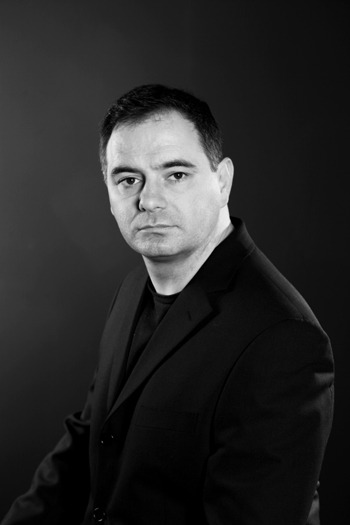
 Thank you very much for joining us here at SFFWorld! Tell us a bit about your newest book: The Waking Fire.
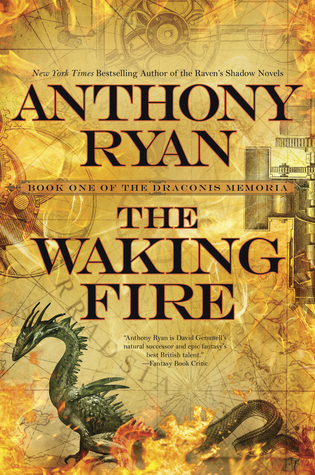
The Waking Fire is the first volume in my new series The Draconis Memoria. It’s somewhat different to my previous work in that it’s set in a world in a the midst of an industrial revolution, so people fight with guns and cannons rather than swords and bows. But it’s also a world where dragons exist and certain individuals – known as the Blood-blessed – can gain magical powers by drinking their blood. The plot revolves around a quest to find the possibly mythical ‘White drake’ which sets of a chain of world-changing events.
When I started reading The Waking Fire I found myself instantly enveloped in the world you laid out. You quickly introduced me to the fact that this was going to be action packed, smart, have an interesting magic system, and that commerce and economics would play a role. What was it like thinking up this world? Is it one you’ve been working on for a while?
Like most of my ideas, the world of The Waking Fire hung around my head for a long time before it was ready to come out. I tend to find that the longer an idea has to germinate the better the results will be when I come to write it. I’ve always been a big history buff and a lot of the details of this world came from my reading of the simultaneous phenomena of industrial progress and colonial expansion in Europe and America in the 19th century. Consequently my research tended to concentrate on subjects like The British East India Company and the disappearance of what had been called the ‘frontier’ in the USA. I also did a lot of reading around the Franco-Prussian War and the naval aspects of the American Civil War in order to add an authentic feel to the battle scenes.
Did it take you long to solidify the rules of your magic system?
Once the basic idea of drinking dragon blood to gain magical powers popped into my head it all slotted into place pretty quickly. The notion of there being four different breeds of drake was also key in putting it all together in a way that made sense. There were some ideas I dropped, like the notion of Red blood being an addictive opium-like substance for non-Blessed humans, because it made the whole thing too complicated.
 One more thing about the intro. I was very impressed with how you wrote it like a formal business letter – that was genius – was that something you planned from the beginning, or did that prologue come after the fact?
I wrote the prologue before starting the main narrative. It was a way of introducing the principal elements of this world, as well as some important characters, in as immediate and concise a way as possible. Also, presenting it as an official letter underlined the fact that this is a world dominated by commerce whilst also giving an insight into the workings of the corporate hierarchy. The general advice to new writers these days is to omit prologues in favour of diving straight into the story, but speaking as a reader I’ve always liked them, provided they’re not overdone.
Your book follows three different characters. Were there any you preferred writing over the others?
In all honesty I enjoyed them all equally, probably because they’re very different from one another. Clay is a criminal, Lizanne is a spy, Hilemore is a dutiful naval officer and their attitudes are often incompatible. If they had been too similar I think I’d have gotten bored pretty quickly, and so would the reader.
How do you feel writing in a new world? Like, Is it refreshing after having written in other worlds for so long, or is intimidating knowing you need to come up with new material?
It some ways it’s refreshing, in others frustrating. Altogether I spent about a decade playing in the world of the Raven’s Shadow books and consequently new it very well. For The Waking Fire and the sequels it feels like getting to know an entirely new environment and set of characters. As a result the writing time for both The Waking Fire and the sequel, The Legion of Flame, was considerably longer than the last two Raven’s Shadow books (still managed to deliver on deadline though).
One of the choices you made for this book was to stick with Drake’s instead of Dragon’s. What was your reasoning behind that?
Basically because ‘dragon’ didn’t scan as well as ‘drake’ when I was writing the dialogue. I’m not sure why but it just worked better with ‘drake’. Maybe ‘dragon’ sounds too archaic for a book with a comparatively modern setting.
You worked in the Civil Service before taking up writing full time. Do you feel you draw on that experience in your writing?
Not a great deal to be honest. If I wrote a book about my Civil Service career it would probably earn me an award for services to boredom. I did write a lot as a Civil Servant, all official documents of course but it’s still writing and any practice is useful.
What’s your favorite part of having made the jump to being a full time writer?
My favourite part is that I get to write every day and don’t have to face the daily commute to the office. I also get a lot of free books.
What’s your least favorite?
My least favourite part is that I get to write every day. There are no excuses anymore, the work has to be done which is its own particular kind of stress. I’m not complaining though, the pros far outweigh the cons and I’m doing the job I always wanted to do. How many people get to say that?
Last question. I know you’ve said before in an interview that The Waking Fire is “un-shootable” as a film, that aside, what would your dream casting be for your characters if it did happen.
John Boyega would make a great Clay, and Emily Blunt would be terrific as Lizanne. I initially thought Henry Cavill for Hilemore but now I’m tending to favour Liam Hemsworth.
* * * * * * *
Interview by Adam Ganong – SFFWorld.com © 2016