Welcome to SFF World, Jodi. Could you tell us a little about your recent release, Bury the Living?
Absolutely! Bury the Living is about a former IRA fighter from Belfast named Nora O’Reilly who goes back in time to 1923, at the height of the Irish Civil War. She’s looking for a stranger who has been appearing to her in her dreams, asking for help. But when she finally finds him, it turns out he has secrets of his own. Nora and the stranger (I’ll keep his identity a secret for now) set out to try and change the outcome of the war, a move they hope will prevent the Troubles in Northern Ireland from ever happening.
Your main character Nora, a former IRA member, travels back in time to the Irish Civil War. Why did you choose this particular chapter of history to focus on?
At first I planned to start the series with the Easter Rising of 1916, but then I saw the heartbreaking film The Wind that Shakes the Barley and was so moved that I decided to focus on the Irish Civil War instead. It would have been easier to focus on the conflict between the Irish and the English, I suppose, but I was drawn to the tragedy of civil war. The more I dug into it, the deeper I wanted to go. I wanted to tell the stories of these people and make them come alive. Besides, the civil war is a perfect launching pad for a time travel series because it has its roots in the centuries-old conquest of Ireland by England, but also reaches into the future as the instigation behind the modern-day Troubles in Northern Ireland.
What have you found to be the greatest challenges in writing historical fiction?
Finding information about day-to-day life is more difficult than I thought it would be. There’s plenty of information on the political and military events of the Revolutionary period, but when writing a novel you need the everyday stuff—what your characters ate, how they cooked, what they wore, how much a pint of Guinness cost. Thankfully, a visit to Bunratty Folk Park in Ireland answered a lot of my questions. Finding these essential details gets even trickier the further back in time one goes! When researching Summon the Queen, which takes place in the 1580s, I discovered that the Irish didn’t eat breakfast and forks were not commonly in use yet. These are the little details that I try to get right, but the research can be challenging!
What was your favorite part of researching 1920s Ireland for Bury the Living? Did you uncover any interesting surprises?
I absolutely loved learning about the role of women during the Easter Rising, the War of Independence, and the Civil War. They were spies, snipers, couriers, gunrunners, medics, and smugglers. They were a critical part of the revolutionary effort. I love reading some of their stories, especially their experiences behind bars in Kilmainham Gaol.
Celtic mythology features heavily in your work. Where does this fascination come from?
When I started writing Through the Door, the first book in the Thin Veil series, I was trying to come up with my own magic system … and failed miserably. So I turned to mythology for some ideas, and came across Celtic mythology. My family heritage is part Irish (like most families on the east coast of Canada), but I didn’t know anything about the mythology until I started digging into it. As with the Civil War, the more I learned, the more I wanted to learn. I still feel like I’ve barely tapped the surface, and see many more mythology-inspired books in my future.
When starting a new novel, what sparks it off? Do you tend to be start with character, setting, or plot?
Character, usually. With the Thin Veil series I wanted to write about a struggling single mother who gets taken out of her mundane life when she discovers her child has magical abilities (I was a stay-at-home mom of two toddlers at the time, which is why this idea was so appealing to me…). In A Cure for Madness I wanted to explore the relationship a mentally-well woman and her mentally-ill brother (my own brother is mentally ill, so it was a very personal project for me). And for Bury the Living I had an idea about a woman who kept dreaming about a man who needed her help, only to find out that he was dead. Once I get these germs of an idea or main character, the rest tends to fall into place.
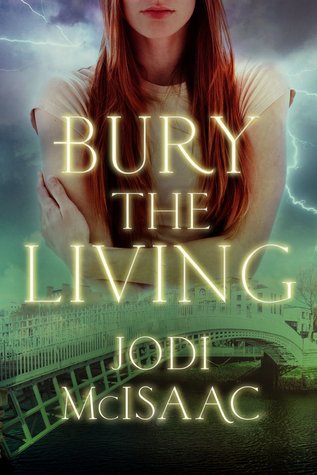 Bury the Living is rich with local description and detail. How do you get in the mood for immersing yourself in a story? Do you use music, images, movies?
Everything! My novels tend to have pretty tight deadlines, which means total immersion, much to the chagrin of my family (my children know more about Irish history and mythology than most Irish children, I reckon). I don’t watch a lot of TV, but when I do it’s usually related to my research subject. I read every book I can get my hands on (thanks, inter-library loan!), seek out experts and bombard them with questions, and, best of all, travel to Ireland for some on-the-ground research. Google is great, but nothing beats actually standing in the places about which you are writing.
You find a portal to the past. Where does it lead, and why?
Depends on the day! But today I would definitely go to Ireland, in 1002…which happens to be the time period I’m researching for the third book in the Revolutionary period. It’s so hard to find reliable information about the distant past, especially when our sources are often also propaganda pieces for certain families or clans. So I would go get the real scoop on early medieval Ireland, if I could avoid being killed or enslaved in the process.
You jump through that portal. You can take one character from mythology with you as a companion. Who do you choose, and why?
Fionn mac Cumhaill, of course! In Irish mythology he is a great warrior, half-god and and half-human. And he happens to be a major character in Bury the Living and the other books in the Revolutionary series, so it would be nice to have some time to get to know the man behind the myth. Besides, he speaks Old Irish, which would come in handy.
Nora’s story continues in January 2017 with Summon the Queen. What do you have planned for your readers after that?
I’m working on a third book in the series, which will come out in spring or summer 2017. After that…I have a few ideas up my sleeve, including a middle grade novel and another contemporary fantasy series, but I’m trying to not give them too much thought until this series is wrapped up!
* * * * * * *
Interview by Juliana Spink Mills – SFFWorld.com © 2016