Hello James! Welcome to SFFWorld.
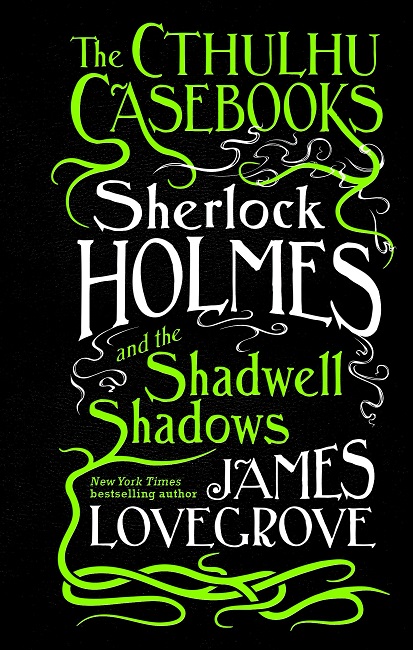
Your new book, The Cthulhu Casebooks: Sherlock Holmes and the Shadwell Shadows is an intriguing mix of two classic characters and their worlds. How did the idea of mixing the two come about?
I would love to say that it was all my own idea, but in truth what happened is that my editor at Titan, Miranda Jewess, got in touch and asked if I might know someone who could write a Sherlock Holmes/H.P. Lovecraft crossover pastiche. Me being a somewhat naïve individual, I began reeling off names of potential candidates at her, mentioning the anthology Shadows Over Baker Street and in particular Neil Gaiman’s contribution to that book, “A Study in Emerald”, which I think is one of the best things he’s written. I told her if she could get Gaiman for the job I would be very surprised, but you never know, might be worth a punt. What I failed to appreciate was that she was subtly enquiring if I’d be up for it. Once the penny dropped, I immediately said yes and set about putting together an outline for a trilogy which would cover Holmes’s entire career but recast it in an altogether more “Elder Godly” light. And so was born the Cthulhu Casebooks trilogy.
How much did you know of Conan Doyle and Lovecraft’s writing before you began writing this book?
Having written a number of Sherlock Holmes novels and short stories myself, and read all the original canon several times over, I think it’s fair to say I have a pretty good working knowledge of the character and his world. I haven’t read quite as much Lovecraft, although I did go through a Lovecraftian phase at university. I have since read pretty much his entire oeuvre, concentrating mostly on the Cthulhu mythos tales. I’ve also read around him, for instance Michel Houellebecq’s critical study Against the World, Against Life and the supporting matter in the excellent annotated edition of Lovecraft by Leslie S. Klinger. I also have Klinger’s annotated Sherlock Holmes; they’re both terrific works of reference and research, as is Daniel Harms’s Cthulhu Mythos Encyclopedia. Not only that but I’ve played the tabletop games Cthulhu Realms, Elder Sign and Cthulhu Dice. As you can see, I take this job seriously!
 Did you have to do much research? Or did you prefer not to do the background study and “blaze your own trail”, so to speak?
My aim with the trilogy is to tie the two fictional worlds as tightly and tidily together as I can. There is a major problem, namely that the original Holmes stories take place roughly between 1880 and 1914, while the Cthulhu mythos tales are mostly contemporary to the period in which they were written, between 1925 and 1935. There is no chronological overlap, so human characters from Lovecraft cannot realistically interact with characters from Conan Doyle. That, however, hasn’t stopped me from intertwining Lovecraft’s non-human characters – gods, demons, monsters – into Holmes’s life and career. Essentially the Cthulhu Casebooks cleave as close as possible to the themes and tone of both fictional worlds.
Is there anything that surprised you about writing this book?
My intent with the trilogy is to present a “true” account of Sherlock Holmes’s life and work. Everything Watson published about him is pure fiction, a smokescreen for the real story, which is that Holmes’s cases were almost exclusively investigations into eldritch and Elder God–related mysteries. I thought that it might be quite difficult to make this work, but it turned out to be fairly straightforward – and fun! There is often a streak of the uncanny in Holmes tales. Think of The Hound of the Baskervilles, “The Yellow Face”, “The Creeping Man”, and “The Sussex Vampire”. I was worried, too, that it might be tricky to have an arch-rationalist like Holmes confront supernatural menaces, but I decided that the solution was to have him become a believer in the otherworldly early on and continue to apply his deductive methods when dealing with it. The surprise was that it all seemed to come together quite neatly.
What do you hope the book achieves? (I’ll accept that “massive sales” and “mega-money” are a given, if that helps!)
I’d like to think the book, and indeed the trilogy, will be successfully true to both the traditions being pastiched. I’d like to think that fans of both Conan Doyle and Lovecraft will feel that I have played fair and done both authors justice. I’d like to think that readers who enjoy a rattling good supernatural detective yarn will be satisfied. And yes, of course I’d like to think that massive sales and mega-money will ensue. Those luxury private yachts don’t come cheap, y’know.
Thinking further around the topic, we’ve recently been counting down to Hallowe’en at SFFWorld. Is Horror an area that you’ve always had an interest in?
Horror was a big influence on me early in life. I tried to watch as many horror films as my parents would allow (which was not many) and I read voraciously in the genre, particularly novels by James Herbert, Guy N. Smith, Clive Barker and of course Stephen King, not to mention M.R. James and Herbert Van Thal’s Pan paperback anthologies. My first novel, The Hope, is more or less horror, and the novel I co-wrote with Peter Crowther, Escardy Gap, has plenty of horror elements. Since growing older and having kids I must say I’ve become a bit more squeamish about the genre. I like shows like The Walking Dead but I tend to get turned off by “torture porn” and anything that has a bleak, non-redemptive ending. These days I want resolution and catharsis, not having my nose rubbed in the misery of existence.
What were your first encounters with it? Was there anything/anyone that inspired you?
A couple of Hammer films which I watched in the 1970s have stayed with me since: She and Blood From the Mummy’s Tomb. She isn’t strictly speaking horror but has memorable Gothic moments, while Blood From the Mummy’s Tomb, with its crawling, disembodied hand, is pure joyous Egyptology hokum.
Many thanks, James!
The SFFWorld review of James’s latest book, Sherlock Holmes and the Shadwell Shadows, is here. It is published by Titan Books this month. Many thanks to Lydia at Titan Books for helping sort this one out.
Review by Mark Yon, October/November 2016