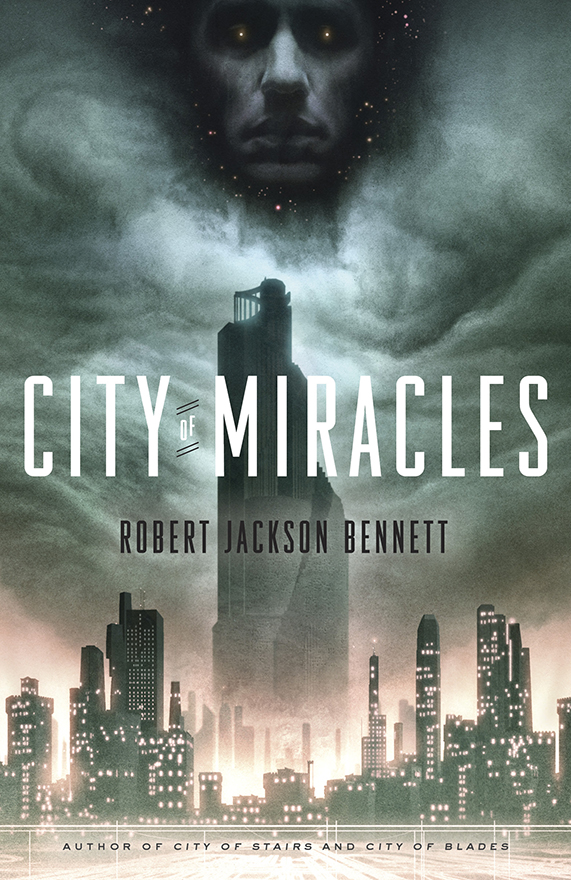
To all things an end, and so it is with Robert Jackson Bennett’s marvelous Divine Cities trilogy. Over the course of the two novels preceding City of Miracles, Bennett took the spirit of epic fantasy and fashioned unexpected and wondrous novels. Turning the lens of his story on a supporting character and reader favorite in Sigrud je Harkvaldsson, Bennett sort of gave readers what they wanted in a giving more of Sigrud, but takes the story down a path that is far less predictable. Bennett wastes little time getting the ball rolling, having the protagonist of the previous two volumes, Shara Komayd, assassinated in a calculated explosion. In the decade or so since the conclusion of the previous novel of the trilogy (City of Blades), Sigrud took a break from civilization, became a lumberjack. When he learns of his friend/mentor’s death, he drops his proverbial gear and heads back to Bulikov, kicking off the major theme of the novel: revenge.
Revenge. It’s something Sigrud je Harkvaldsson is very, very good at. Maybe the only thing.
So when he learns that his oldest friend and ally, former Prime Minister Shara Komayd, has been assassinated, he knows exactly what to do—and that no mortal force can stop him from meting out the suffering Shara’s killers deserve.
Yet as Sigrud pursues his quarry with his customary terrifying efficiency, he begins to fear that this battle is an unwinnable one. Because discovering the truth behind Shara’s death will require him to take up arms in a secret, decades-long war, face down an angry young god, and unravel the last mysteries of Bulikov, the city of miracles itself. And—perhaps most daunting of all—finally face the truth about his own cursed existence.
There’s something very appealing about the revenge theme, and add a nigh indestructible character like Sigrud to the mix, then that makes it even more interesting. What Sigrud wasn’t fully prepared for was Shara’s daughter, whom Sigrud seeks out in order to protect, for he has an inkling Tatyana (Taty for short) is at least a part of the reason why Shara was assassinated. Throwing Sigrud and Taty together gives a little bit of the vibe of a Western revenge not unlike True Grit, with some truly tender, heartwarming scenes between the two; Sigrud teaching Taty how to defend herself while Taty also learns more about her mother from the man whom Shara trusted most in the world.
For all the human emotion conveyed, there are some heady supernatural divine elements that are at the forefront. The responsible parties for killing Shara aren’t exactly human, but aren’t quite divine either. In many mythological stories, perhaps best illustrated in the Gods of Greek Myth overthrowing their “parents” the Titans, the offspring often overthrow their parents to rule over the world and reality. The fall of the Gods in this series is somewhat different, but somebody still is required to pay the price, especially if the “children” of the gods aren’t quite happy with their upbringing and are seeking revenge for how their lives turned out.
Although the emotional and introspective nature of Sigrud’s character is on full, heartbreaking display, his physical presence is the proverbial white elephant in the room. There’s a few wonderful physical confrontations between Sigrud and a nebulous supernatural being, but the capper is an amazing pages-long action sequence which takes place on a magnetic train, itself a fascinating invention that seems to be a hybrid of science and supernatural.
And that conclusion? Whoa, boy. Something powerful, a little unexpected, but satisfying and appropriate.
As has ever been the case, at least with everything I’ve read by Mr. Bennett, the prose is a delight. A lulling melody that enchants while the plotting and characters thrill, a wonderful and evocative turn of phrase here, resonant descriptions there, all add up to as perfect and addictive a novel as one could hope to read in any genre.
In my review of City of Blades I wondered how/if Bennett could top himself again. That is a tall order, but at the very least, City of Miracles is the equal of City of Blades and an apt finale to the story begun in City of Stairs. For me, City of Stairs was a revelation of a novel so it isn’t necessary a slight on City of Miracles that I enjoyed Stairs more. (My grain of salt on that comment: I think I tend to enjoy series openers as a whole more than the other books of a given series). As a whole The Divine Cities is simply that, Divine.
A highly, highly recommended fantasy saga. With the new Hugo Award for series, I would hope City of Stairs finds itself at least on that ballot during award season.
© 2017 Rob H. Bedford
The Divine Cities #3
Broadway Books May 2017
Trade Paperback, 464 pages
http://www.robertjacksonbennett.com/books/city-of-miracles-tr
Review copy courtesy of the publisher, Broadway Books