Jumping into a series for the first time at book 3 may not be the wisest reading choice, but that’s exactly what I did with The Queen of Swords, the third book in R.S. Belcher’s Golgotha series. Reading the jacket description (quoted below) was intriguing enough and positioned the book as welcoming to new readers to Belcher’s books enough that I decided to give the book a read. In short, I was pleased I did so. For the longer, read my review below the book description and cover.
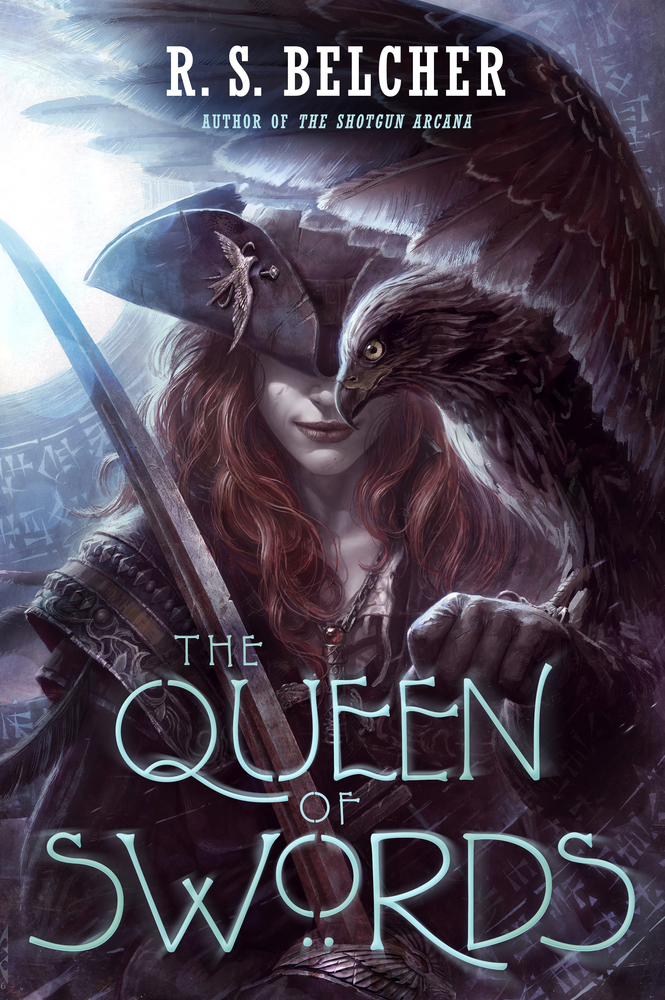
1870. Maude Stapleton, late of Golgotha, Nevada, is a respectable widow raising a daughter on her own. Few know that Maude belongs to an ancient order of assassins, the Daughters of Lilith, and is as well the great-great-great-great-granddaughter of Anne Bonney, the legendary female pirate.
Leaving Golgotha in search of her daughter Constance, who has been taken from her, Maude travels to Charleston, South Carolina, only to find herself caught in the middle of a secret war between the Daughters of Lilith and their ancestral enemies, the monstrous Sons of Typhon. To save Constance, whose prophetic gifts are sought by both cults, Maude must follow in the footsteps of Anne Bonney as she embarks on a perilous voyage that will ultimately lead her to a lost city of bones in the heart of Africa—and the Father of All Monsters.
One of the most popular characters from The Six-Gun Tarot and The Shotgun Arcana ventures beyond Golgotha on a boldly imaginative, globe-spanning adventure of her own!
Told through the use of dual, parallel narratives, Belcher follows assassin Maude Stapleton (a popular character from the first two novels) as she fights to secure her daughter Constance and family inheritance in 1870. In a storyline taking place in 1721, Maude’s great-great-great-great grandmother the (in)famous pirate Anne Bonney searches Africa for an ancient secret treasure.
Seems fairly straightforward, right? When I say ‘Maude fights’, it is meant in all senses of the word. She finds herself at odds with monsters – the Sons of Typhon who are “men” with qualities like some sea creatures. For example, one such man has lobster-like claws. Also a mortal enemy is Typhon himself, the most fearsome monster in Greek Mythology who possesses some minimal/superficial similarities to Cthulhu, lost his attempt to topple the gods and was sent to the underworld (Tartarus) when Zeus flung his thunderbolts at the serpentine monster. Maude is at odds with some of her own “sisters” of the Daughters of Lilith. Lilith refers to the first woman of the Bible, Adam’s first wife and mother of monsters. Lilith and Typhon were once allies, but years ago parted ways when Lilith tried to correct the error of her ways. The Sons of Typhon are his minions, monstrous men who are as the arch-rivals to the Daughters of Lilith.
The common ground for these two supernatural sects is their hope to use Maude’s daughter Constance (because of the unique nature of her blood) to strengthen their foothold in the world. Lastly, and perhaps most emotionally, Maude is contesting her inheritance and the guardian-ship of her daughter with her own father.
Meanwhile in 1721, Anne gets out of prison and soon finds herself fighting against an African Queen to replace her as the consort of an African King. This is one of the tasks she must complete so that she can eventually get to the heart of Carcosa, the fabled city of monsters where she hopes to close off the escape point of those monsters. Anne is not one to just do what she’s supposed do, she hews her own path to a goal regardless of who she upsets. If it happens to fall in line with what some wish her to do, so be it. If not, so be it. I don’t know if Belcher has any more tales or anecdotes featuring his interpretation of this larger than life historical figure, but it they would make for great reading.
As much as Anne and Maude’s story parallel each other in their quest-ish structure, themes of subjugation or de-humanizing also parallel. With Anne’s story, the way the white world unfairly treats Africa is paralleled how women are treated and function in society of Maude’s time, especially her hometown in South Carolina.
These narratives are both told with gusto and focus on two extremely charming characters. There’s a great balance between the action, particularly when Anne and Maude are fighting the monsters, and the tension-induced human interactions where ideologies clash.
In both storylines, Belcher masterfully upends gender stereotypes, especially those associated with pulpish tales that The Queen of Swords strives to evoke. Maude was living on her own in Golgotha as a single mother before returning to her hometown Charleston, SC. Charleston being part of the South, women have far less rights, typically having their inheritance and basic person-hood rights signed away upon marriage than she grew accustomed to during her time in Golgotha. This conflict comes to an emotional head between Maude and her Father as they clash about Maude’s inheritance, familial legacy, and who should be watching over Maude’s daughter Constance. There’s also the gender division between the Sons of Typhon and the Daughters of Lilith that plays out through the course of the novel.
Wonderful characters, snappy/snarky dialogue, and a world that blends history/historical characters with mythic monsters make for a delightful, thought-provoking, and entertaining novel. Good (yay more books to read!) or bad (I have piles of unread books at home already), I think I’ve found another “new to me author” whose backlist – especially the two novels in the Golgotha sequence preceding this one – I want to explore with immediacy.
Highly Recommended
Review copy courtesy of the publisher, Tor Books
Hardcover 368 Pages June 2017
http://rsbelcher.net
Excerpt: http://www.tor.com/2017/05/24/excerpts-rs-becher-the-queen-of-swords/