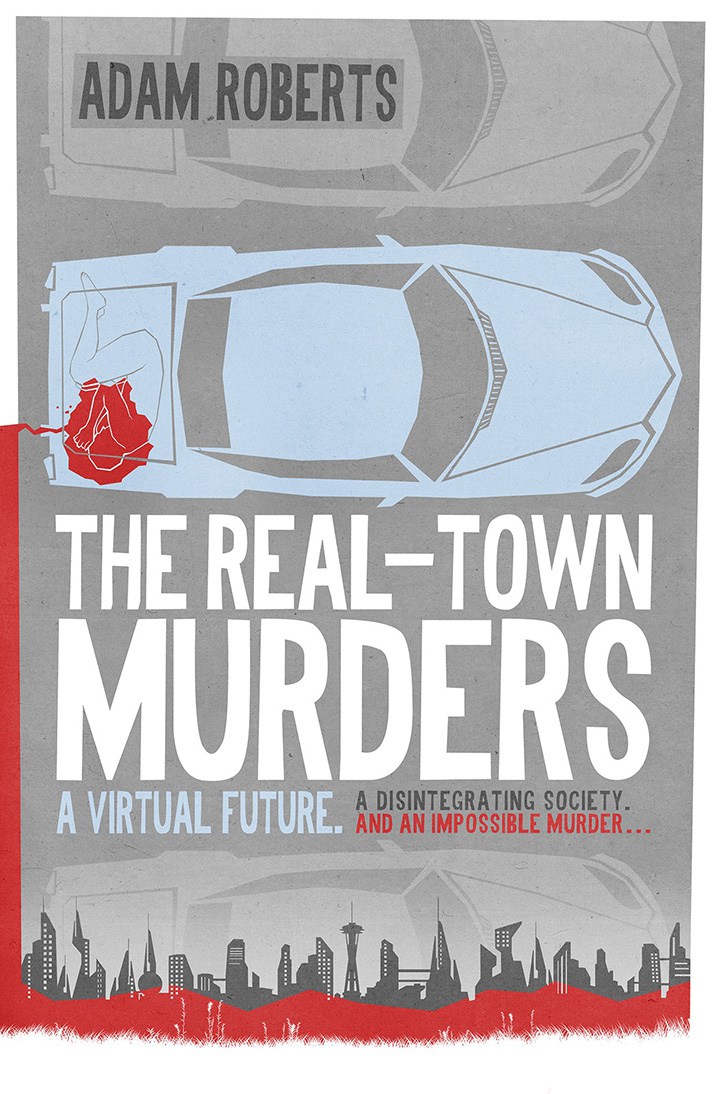
 In crime novels one of the most common scenarios of the ‘whodunnit’ is ‘the locked-room mystery’ – that is where a crime (usually a murder) has been committed without any evidence for an entrance or an exit. It’s so common that Otto Penzler has created one of his huge anthologies on it.
Adam Roberts’ future-noir story begins with an updated version of this trope – there’s a body been found in the boot (aka ‘a trunk’ in the US) of a car being assembled by robots – in a place continuously monitored by three cameras in three different places and a an assembly point where no humans can normally access.
It can’t be denied that Adam likes to set a challenge!
Like many of his other books he plays with traditional tropes and gives them his own personal slant. Here he’s clearly channelling Dashiell Hammett and Alfred Hitchcock noir to create a detective story with a near-future angle. Think The Maltese Falcon meets Charles Stross.
The style is tight, though not quite a la Sam Spade. In these more enlightened times of the 21st century Sam is now Alma, but her role as a protagonist is the same trope as ever. The new angle is where the story becomes a plot based on AI and political shenanigans (again, something that Charlie Stross fans will recognise.)
The skill that Adam shows is that he manages to add new and unusual elements to what is a traditionally structured tale. This is a near-future England where we discover most of the population spent time in the Shine – a virtual online world. As a consequence of this the streets of England are often filled with robotic walkers that Shine-users use to exercise their sleeping bodies whilst in near-suspended animation. People are rarely seen out otherwise and direct face-to-face communication is declining. Alma’s need for direct interviews with witnesses and workers causes many of them concern and an inability to feel comfortable whilst doing so.
In another complication Alma’s partner Marguerite is bedridden, someone who has been given the latest in malware, a virus that needs regular medication every four hours and four minutes – it is something that cannot be done too early or late and has to be administered by Alma. Alma feels guilty and obliged to maintain Marguerite’s health. Marguerite is also a valuable asset in Alma’s work as a private detective, a means of helping Alma work through problems to a solution.
When Alma is met by Michelangela, allegedly a Government agent, she begins to realise that there may be more to this case than at first expected. The solution to the dead man, Adam Ken, in the trunk is very sf-nal, and leads to clandestine meetings with a mystery analyst amusingly referred to, in a nod to Watergate, as ‘Derp Throat’.
When things take a Hitchcock-ian turn and Alma is seemingly arrested and transported for further questioning in Berlin. However Alma escapes, worried about what will happen to Marguerite. Whilst we read of Alma’s attempts to keep Marguerite safe, a situation that becomes increasingly more complicated every four hours, a bigger picture emerges, that there is a political coup going on that the victim and now Alma & Marguerite seem to be connected to.
The conclusion of the book deals with how these situations are resolved.
“This is about the whole balance of life: real life or the Shine. This is about the power bloc that has decided we need to encourage the ongoing migration of people into the Shine, because there we can surveil them and keep them bread-and-circused with perfect efficiency.”
I’ll be the first to admit that some of Adam’s other books, and in particular their endings, have left me rather cold, if not baffled. He’s clearly a clever writer with things to say, but at times the grand ideas have left me rather perplexed, and often with an ending that dissatisfies. (I know, I know – not everything should wrap itself up neatly, etc.)
Nevertheless I’m very pleased to say that The Real-Town Murders is, for me, the most enjoyable Roberts book since Jack Glass (2012). Like Jack Glass, The Real-Town Murders still has those big Adam Roberts ideas – as the quote above shows, this time about the nature of identity, the importance and relevance of social media and the means and manner of governance that may be clearly relevant in these post-Brexit UK times.
“People with a grip on power can get pretty ruthless when they feel that grip slipping.”
Where it wins most of all for me is that this intelligence is reined in to meld with a manageable and engaging plot. It may not be a coincidence that both books mentioned involve mystery-solving, whose structure gives the characters and concepts something to stick to without being generic. Whilst not all the twists and turns in the plot are entirely convincing, The Real-Town Murders is clever without becoming a victim of its own intelligence, which is why I think it mainly works.
The Real-Town Murders is tight and not overly ambitious, and all the better for it.
The Real-Town Murders by Adam Roberts
Published by Gollancz, August 2017
ISBN: 978-1473221451
240 pages
Review by Mark Yon, July 2017.
Review copy received.