

You are using an out of date browser. It may not display this or other websites correctly.
You should upgrade or use an alternative browser.
You should upgrade or use an alternative browser.
Science Fiction Reading in July 2017
- Thread starter Hobbit
- Start date
Av Demeisen
Prime Detester of God The Infernal Wizard
- Joined
- Jul 1, 2015
- Messages
- 3,708
I finished the Japanese crime novel, but before I go back to Gene Wolfe's TBOTNS, I had to satisfy my curiosity and read Matthew Hughes' A Wizard's Henchman: First Book of the Kaslo Chronicles. A very entertaining and fast-paced tale so far.

Ropie
Member of the Month™
- Joined
- Jun 6, 2005
- Messages
- 2,848
Someone mentioned Greg Bear's Anvil of the Stars here recently, which reminded me that I used to have a copy of the prequel, The Forge of God, which a friend of mine bought for me when we were at school. Sadly, I seem to have lost that copy now but it wasn't hard to track down a second hand copy with the same cover. I can't actually remember if I read the whole thing back then, but I'll be doing so this month 
Last edited:

Sfinx
Life's a riddle
- Joined
- Nov 27, 2007
- Messages
- 1,053
Just started The Barbarians, by Algis Budrys (then writing as John Sentry); first appeared in "If" in 1958. Fun, fast paced read so far. Other Budrys short stories scheduled for later this week.
PS: good issue, the Feb '58 one; Budrys doesn't even get a mention on the cover
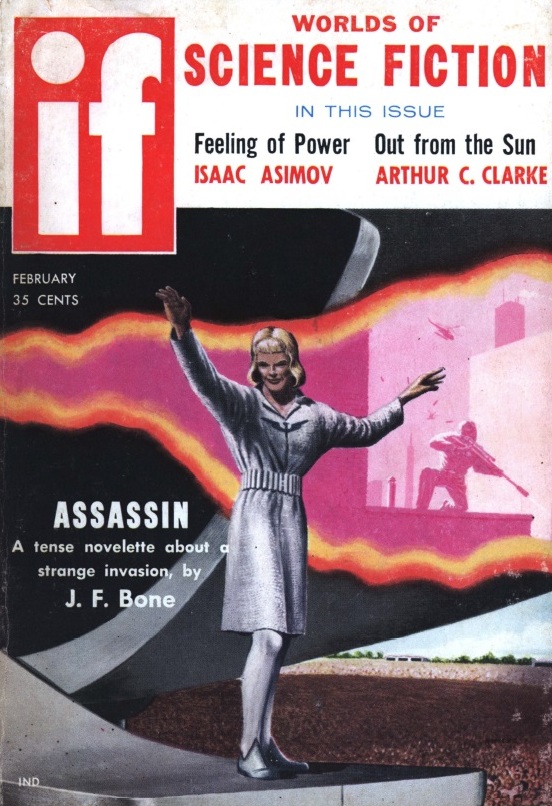
PS: good issue, the Feb '58 one; Budrys doesn't even get a mention on the cover
Last edited:
Ropie
Member of the Month™
- Joined
- Jun 6, 2005
- Messages
- 2,848
good issue, the Feb '58 one
I see The Feeling of Power on the cover - I just read that story. Amazing to think my father was the age my daughter is now when that was published. Of course, in the scale of universal time it's not that long ago


- Joined
- Jul 16, 2001
- Messages
- 18,434
I see The Feeling of Power on the cover - I just read that story. Amazing to think my father was the age my daughter is now when that was published. Of course, in the scale of universal time it's not that long ago
I know what you mean with that one, Ropie: I am always awed by the age of some of the magazines I have. Reading Astounding from the time WW2 began (or earlier!) is always a sobering experience!

farseer2
Registered User
- Joined
- Nov 24, 2006
- Messages
- 1,308
I just finished We Are Legion (We Are Bob) by Dennis E. Taylor, book 1 of the Bobiverse trilogy.
This book was entertaining. Extremely and compulsively entertaining.
It has been compared a lot with The Martian, by Andy Weir. The reason is clear: both are told from the point of view of a similar protagonist: an intelligent and technically accomplished nerd, with a nerd's sense of humor, as he struggles to survive under difficult conditions. The differences are also clear: The Martian was more down-to-Earth (down-to-Mars, I guess), with more emphasis on the technical details of the solutions to the problems. We Are Legion (We Are Bob), on the other hand, tends to hand-wave technical details and in exchange it presents a grander vision, involving multiple solar systems, alien races, wars and the stakes are the survival of humankind, not just of the protagonist.
So, the premise goes like this (with no more spoilers than the blurb):
Taylor is not a great stylist. I had just read a Joe Abercrombie novel, and after Abercrombie's prose, the first chapter of We Are Legion, when the main character is established, was a bit painful. As soon as the plot gets started, however, it doesn't matter any more. The story is fascinating, with sense of wonder and plenty of excitement. A very fast and pleasing read.
The story doesn't end in a cliffhanger, but it just ends, without a real sense of conclusion. This is the first book of a trilogy, and the whole thing needs to be read. Fortunately, the second book is out and the third is announced for August 2017.
This book was entertaining. Extremely and compulsively entertaining.
It has been compared a lot with The Martian, by Andy Weir. The reason is clear: both are told from the point of view of a similar protagonist: an intelligent and technically accomplished nerd, with a nerd's sense of humor, as he struggles to survive under difficult conditions. The differences are also clear: The Martian was more down-to-Earth (down-to-Mars, I guess), with more emphasis on the technical details of the solutions to the problems. We Are Legion (We Are Bob), on the other hand, tends to hand-wave technical details and in exchange it presents a grander vision, involving multiple solar systems, alien races, wars and the stakes are the survival of humankind, not just of the protagonist.
So, the premise goes like this (with no more spoilers than the blurb):
Bob Johansson is a successful entrepeneur who has just sold his software company and is looking forward to a life of leisure. Unfortunately, he immediately gets killed in an accident. He wakes up a century later to find that he has been uploaded into computer hardware and is slated to be the controlling AI in a Von Neumann probe (a spacecraft capable of replicating itself) looking for habitable planets. Unfortunately, the world is an unstable place, marked by a cold war conflict between several enemy powers. It's not clear that Bob will survive long enough to get to space...
Taylor is not a great stylist. I had just read a Joe Abercrombie novel, and after Abercrombie's prose, the first chapter of We Are Legion, when the main character is established, was a bit painful. As soon as the plot gets started, however, it doesn't matter any more. The story is fascinating, with sense of wonder and plenty of excitement. A very fast and pleasing read.
The story doesn't end in a cliffhanger, but it just ends, without a real sense of conclusion. This is the first book of a trilogy, and the whole thing needs to be read. Fortunately, the second book is out and the third is announced for August 2017.

Contrarius
You talkin' to me??
- Joined
- May 16, 2011
- Messages
- 3,932
I have the second book waiting for me right now.
farseer2
Registered User
- Joined
- Nov 24, 2006
- Messages
- 1,308
I have the second book waiting for me right now.
One thing that bothered me is that Bob
is not very keen to make copies of himself, at least not very quickly. That's kind of dangerous with Medeiros around. If the Brazilian probe finds some out of the way systems with natural resources he could be making copies of himself at a very fast rate, and then everyone will be in deep trouble if there aren't a lot of Bobs around.
Also
I did not understand why Bob's copies all have their own distinct personality. That was a good idea from an entertainment point of view, but it makes little sense from a scientific point of view. The explanations suggested in the book are not convincing...
Sfinx
Life's a riddle
- Joined
- Nov 27, 2007
- Messages
- 1,053
If/Worlds of If..... hmmm. I have some of those..... but not all. *begins to twitch*.....
Looking at all these fantastic covers: http://www.luminist.org/archives/SF/IF.htm I very much understand the twitch
And what a list of names...from Ted Sturgeon in the very first issue (March '52, $0.35) to the last one (Fall '86, $1.95) featuring Zelazny, Scott Card, Niven, van Vogt...I'm usually not a sentimentalist, but...PS: you can download ALL of the "If" issues in PDF format!!
Last edited:
- Joined
- Jul 16, 2001
- Messages
- 18,434
Ooooooh...... not quite the same thing, admittedly, but not a bad way to start. Thank you, Sfinx. LINK.PS: you can download ALL of the "If" issues in PDF format!!
LATER EDIT: Evidently this is my 13 000th post.... who'd've thought it?
Ropie
Member of the Month™
- Joined
- Jun 6, 2005
- Messages
- 2,848
Congratulations, Hobbit!!! I did a quick calculation: if each post takes you on average 1 minute, that works out as just over 9 days of continuous postingsLATER EDIT: Evidently this is my 13 000th post.... who'd've thought it?

farseer2
Registered User
- Joined
- Nov 24, 2006
- Messages
- 1,308
13.000? All those posts are belong to you?? Impressive!
Nah, he probably has a couple of ghostwriters.

- Joined
- Jul 16, 2001
- Messages
- 18,434
Ah: but sometimes it seems MUCH longer....if each post takes you on average 1 minute, that works out as just over 9 days of continuous postings
Well, there are worse ways of spending my time!Evidently you do indeed LOVE it...And we love you for it
But that was a lovely comment, thank you. I wouldn't be here if I didn't love it, though - although there have been times.... Funny, that: there was a point a few years ago where I was spoofed by some nasty spambot. But none of those count.Nah, he probably has a couple of ghostwriters.
But yes, I haven't mentioned the minions toiling under stress below Hobbit Towers who take my place when I occasionally have to tear myself away and sleep...

chitman13
Staff
- Joined
- Nov 8, 2006
- Messages
- 1,514
I knew it!!But yes, I haven't mentioned the minions toiling under stress below Hobbit Towers who take my place when I occasionally have to tear myself away and sleep...
I've just read Here Comes Earth: Emergence by William Lee Gordon. It was okay, nothing special, but enjoyable enough. I think the whole galactic society he's created is very interesting and hope to read more about them in the next two books.
Also finished Hidden Empire by Kevin J Anderson, the first Saga of Seven Suns novel. I actually really enjoyed it with the widescreen feel and large cast of characters. Kind of a lighter Peter F Hamilton without all the expalnations and intricate detail, but it works and works well. I only had one real issue with it, and that was
the fact that nobody put two and two together to figure out that the reason the hydrogues are pissed was because the humans turned the Oncier gas giant into a star, thereby killing all hydrogues living there.

mylinar
Getting old is only good when avoiding alternative
- Joined
- Sep 25, 2007
- Messages
- 724
After several months of on and off reading I finished 'The Long Cosmos' by Pratchett and Baxter. The series had continued to decline as it went along and this was no exception. It was a mostly forgettable book with an ending that did not even slightly satisfy me. Not sure what I wanted but an 'So that's it?" is certainly not.
Ropie
Member of the Month™
- Joined
- Jun 6, 2005
- Messages
- 2,848
Finished Greg Bear's The Forge of God. A masterpiece of orchestrated planet-wide invasion, told in that Stephen King-esque way Bear does almost as well as King himself: introducing each of the main characters through their own chapter of previous-life info before lowering them slowly into the middle of the situation. For a generic SF novel, this results in strong characters, although the meat of the story is really short on women, who are limited to minor characters, wives or girlfriends. So what? Well, it bugs me a bit, as does the fact that
Other than those misgivings, a fine read!
even though the entire Western world is well aware of the impending destruction of the planet by aliens (who have already introduced themselves), when the destruction actually starts happening for some reason the Americans all wonder if it might be the Russians attacking!! I know it was written in the late 80s, but come on!
Last edited:
Sponsors

We try to keep the forum as free of ads as possible, please consider supporting SFFWorld on Patreon

Your ad here.