Reading in Science Fiction, February 2022

Neptune’s Brood

220px-Neptune%27s_Brood%2C_UK_cover.jpg


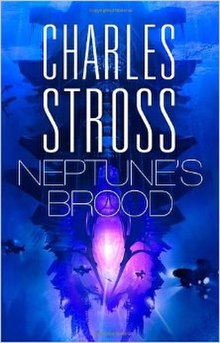
Krina Alizond-114, a historiographer of accountancy carrying knowledge of an audacious 2000 year-old fraud, sets out to find her missing sister in a far flung corner of colonised space. After securing passage as crew on a space-faring church, she discovers an assassin is on her trail. At the same time, her ship is boarded by pirates.

Set in the same universe as Saturn's Children, where original humankind has been superseded by metahumans, Neptune's Brood is a tale of fraud on an interstellar scale. Stross relates this primarily through Krina Alizond-114 who reveals the con as the story moves forward. Given the enormous distances and subsequent travel time involved in this slower than light universe, slow money is used as the currency for the huge investments transferred to new colonies by the banks which fund their start-up costs. This forms the background for the overarching storyline and is fascinating in itself, but what gives the book its originality is the metahuman society that populates this eccentric vision of the future, where form can be grown or surgically adapted to suit any environment or purpose and concepts come thick and fast on almost every page. This is what (just as in Saturn's Children) I enjoyed most about the book. As for the story itself, it is reasonably engaging though its pace is often affected by Krina's frequent expositions and the ending is anticlimactic, leaving me with a slight feeling of unfinished business. Which is not to say it isn't a good read; its sheer inventiveness makes sure of that.
 
That cover is just terrifying in its naffness. It looks like medieval re-enactment group, who haven't had time to change out of their office clothes, performing on a tv gameshow set, with a stuffed big cat.
Like krisbslick had to look up "naff". Thought that I knew the meaning of this British locution. I was wrong.
More than naffness, it's the sheer inaccuracy of the illustration. Beyond the treecat, it's Honor, the center of these books entire universe. She is a huge muscly galoot, not the small stylish coiffed damsel pictured,
 
Last edited:
I started reading what I think is an English SF novel suggested to me on my Kindle, called Harry's Lattice by Don Harrison. I really knew nothing about it except that the subtitle, "Nothing is real except consequences" sounded intriguing. And it is so far!

41ykJpHIpBS.jpg
 
I started reading what I think is an English SF novel suggested to me on my Kindle, called Harry's Lattice by Don Harrison. I really knew nothing about it except that the subtitle, "Nothing is real except consequences" sounded intriguing. And it is so far!


Really liked the sample so got a copy too and will start on it as one of my current sf reads - this is the start of a series and book 2 is also out btw
 
Just finished Too Like The Lightning by Ada Palmer. Despite having seen some very positive things about the Terra Ignota Series, of which this is Book 1, I was very disappointed by this book.
Set on a Utopian Earth of 2454 that someone is apparently intent on changing/destroying. Our narrator (Mycroft Canner) is the most famous criminal on the planet who is hiding several large secrets. As a result of his crimes he is living a life of indentured servitude, but with access, due to his non criminal skills, to most of the highly placed leaders of the world. All good so far. The biggest secret he is hiding is the existance of a child who can change pretty much everything about their society. However following two mysterious break ins that used a technology that is associated with Canner's earlier crimes he is tasked with assisting those investigating the crimes. The investigation goes off the rails when 'competing' bodies within the authorities get too close to two of the secrets the 'bash' Canner is associated most with.

My biggest problems with the book were the gender fluidity whereby multiple characters are each referred to with the revolving personal pronouns he,she and they, often having no resemblance to their physical plumbing. I found much of this excess of fluidity to be unnecessary to the plot and merely kept distracting me from the story. Another distraction is the constant 4th wall breaking between Canner and 'The Reader' again much of which I found to be distracting rather than helpful.

However the fatal blow to me was the stopping of the story 70-80ish pages from the end for a philosophical exposition on De Sade (yes that De Sade but not what he is most famous for) and some of his peers that lasts an entire chapter. And that was not the last philosophical dump in the final phase of the book. Just killed the momentum stone cold dead.

And the ending. The crimes which started the book are not solved, another crime that has been barely alluded to has been solved by an investigation that has not featured at any point of the book has been solved though 'punishment' will apparently have to wait like everything else for book 2. Which it means a very long wait if they expect me to read it.

Have moved on from there to Jack Four by Neal Asher. This was also initially a tad disappointing in that the story is presented single 1st person POV and is very lineal. Not what I was expecting after the Cormac and Orlandine series. However as the story has progressed and I have become more comfortable with the character of Jack I have definitely warmed to it.

Cheers
Lee
 
Just finished Too Like The Lightning by Ada Palmer. Despite having seen some very positive things about the Terra Ignota Series, of which this is Book 1, I was very disappointed by this book.
I gave up fairly early on it, so you did well!!
 
Managed to finish Bujold’s Captain Vorpatril’s Alliance. As Pog warned me, this is quite a disappointing volume in an otherwise excellent series. It feels like Bujold purchased some cheap machine learning software from AliExpress, fed it the previous dozen or so Vorkosigan novels and set it to work. Resulting in a fairly flat story, uninteresting characters and a lot of dialogue and descriptions rehashed from previous books. I do so hope things will pick up again in Cryoburn...
 
For We Are Many

71ZoAfzciSL.jpg


In this book, Bob and his iterations continue to expand across galactic space in their search for suitable planets on which the survivors of the human race can settle. Their earlier encounter with the system-raping species known as the Others is developed further, as are the other storylines begun in the first book.

Touched on in We Are Legion [We Are Bob], one of the storylines in For We Are Many plays with the idea of a kind of reverse-transhumanism when a few of Bob’s cohort attempt to develop forms in which they can interact with the real world on a physical, more human level. I found this quite intriguing, if not entirely unexpected given Bob’s very human consciousness. Where this eventually goes, I don’t quite know yet, though androids seem to be high on the list. Androids are a tried and tested trope in SF, I know, but Bob’s growing desire for real human contact was a different angle on the purpose of creating a synthetic body, at least for me it was. The outcome of the Others storyline is the one that sets up the next in the series, and that alone is enough to read it. There is much more to the Bobiverse, though; it’s not complicated stuff but it is very enjoyable.
 
Been listening to The Midwich Cuckoos by John Wyndham, narrated by Stephen Fry (a freebie in the Audible Plus catalogue). Enjoyable, but many aspects are very much a product of its time. Also, a very narrow view when there could have been a much deeper and wider exploration of the idea. Still, enjoyable enough and nearly finished.
 
Finished Harry's Lattice by Don Harrison. Interesting stuff and a main character with potential, sadly hidden in a very amateurish writing mess; my Goodreads review:

Very intriguing concept (see Amazon blurb below) but the execution is quite muddled; lots of characters scattered with abrupt transitions between them, a storyline without too much of a plan, and a sort of "this came to my mind, got to put it next" approach to writing that makes the book feel very amateurish. The part of the storyline with Harry of the blurb ( I would estimate maybe about a third of the novel, maybe less) is quite good and he is the one character that is really fleshed out, naive but endearing, and if the novel would have focused mostly on his (mis) adventures with enough godlike narrator explanations interspersed here and there, it could have been quite good, but this way it's a bit too much of a mess to really recommend it or continue with book 2

Amazon blurb:

Imagine if you got home one evening, unlocked your front door, opened it and went into your hall; only it wasn’t your hall. Imagine it was completely different to anything you had ever seen before. Not a hall at all, but a dizzying tableau of clouds, sky, ice fields covered in dazzling snow; all seen from the top of a huge mountainous Himalayan peak. Just inside your front door.
Or imagine you were faced with an alien landscape, maybe from one of Saturn’s moons with Saturn himself and his rings low against the horizon against an inky black sky. The temptation would be to close the door again without stepping over the threshold; give it a moment, then open up again in the hope that the unwarranted intrusion of craziness would have gone away.
Harry lived his life and went about his normal business, unaware as the rest of us that nothing is real. An impossible meeting uncovers the truth and introduces him to the true nature of the world we take for granted.
But awareness of the truth is rationed, for a good reason. Harry's world soon turns upside down and he must rely on new friends and acquaintances to help him make sense of it all.
Drawing on several current scientific ideas, Harry's journey explores his personality; illuminating the experiences that form him as well as opening a door into a shadow-world of incredible concepts which seem crazy but which nevertheless underpin our world
 
Finished Harry's Lattice by Don Harrison. Interesting stuff and a main character with potential, sadly hidden in a very amateurish writing mess
I only got about halfway so far but agree entirely, although I will say that I am still kind of endeared to it - it is certainly different. There are some really good moments scattered throughout the mess, and really it just needs an editor to cut away the many boring diversions into office life and family problems. I will finish it.
 
52027273._SX318_SY475_.jpg


Providence (by Max Barry) is the name of the latest high-tech, AI-manned ships designed to defeat the aliens dubbed "Salamanders". The story is set aboard the last Providence, as the crew of four try to maintain their sanity on the tight confines of the ship whilst seeking out and destroying the aliens.

After a couple of false starts recently, this was one of those books that I knew I would like even after the first 20 pages or so - it just had that flow and ease to read straight away.

Much of the story is a character study of these four very different people on the ship - Anders (Weapons), Gilly (Intel), Talia (Life) and Jackson (Captain) - as they strive to maintain normality between themselves and the ship itself. It was an engrossing read; the characters are very well developed and different in outlook, and the author presents an intelligent study on what makes each person tick. Talia is like the HR person, the peacekeaper keeping track of the other three, while hyperactive Anders is constantly trying to find something to do, Gilly needs to keep his brain stimulated, and Jackson fights to keep her hard military persona in check.

Then in the last third or so things change course to focus on the increasing conflict with the salamanders, leading to a dramatic conclusion. Although the very end was a bit to quick and "happy" (I thought there could have been an alternate ending that would have been more nihilistic, but that wouldn't keep most readers satisfied), on the whole a great story, and the author is one I will check out more after reading the very good Lexicon a while ago as well.
 
the author is one I will check out more after reading the very good Lexicon a while ago as well.
I first heard of him with Jennifer Government, I enjoyed an earlier one of his that was like a business innovation satire - Syrup
 
I first heard of him with Jennifer Government, I enjoyed an earlier one of his that was like a business innovation satire - Syrup
Thanks I have Jennifer Govt on the list, will check out Syrup too.

**edit** actually another thing I've noticed - and really like - is that a lot of his books around 300-350 pages, which is often a great length for a succinct story without the waffle.
 
Reading The Vanished Birds by Jimenez.
I had started Starship's Mage by Stewart. Mix of fantasy and scifi is right up my alley. It's pretty lightweight. It is episodic so I'm taking a break and can jump back in anytime.
 
Been listening to The Midwich Cuckoos by John Wyndham, narrated by Stephen Fry (a freebie in the Audible Plus catalogue). Enjoyable, but many aspects are very much a product of its time.
New TV series on the way (Sky?)
He's got a new book out this summer,

The Spear Cuts Through Water. Due May (LINK)
 
Stephen Fry is a fine reader for audible. Another arrow to his polymath's bow.

I have his complete reading of all the Sherlock Holmes books to listen to in my car when I have to take the long drive to Boston for more medical tests.

The only time the last 2 years; I leave my house other than the weekly shop is to go for tests or treatments or consultations. But with 4 or 5 preexisting "flag conditions" I can't be too careful.
 

Sponsors


We try to keep the forum as free of ads as possible, please consider supporting SFFWorld on Patreon


Your ad here.
Back
Top