Non Fiction being currently read

Windshadow

need more dried frog pills
Joined
Oct 25, 2015
Messages
3,156
61uxOyXpCDL._SX342_.jpg

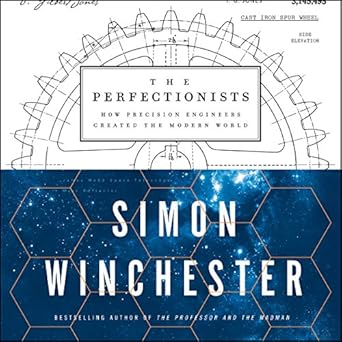
Highly recommended; written by a fine author that does meticulous research on his topics and one that I think many lovers of hard science fiction would enjoy.
here is the blurb
The revered New York Times best-selling author traces the development of technology from the Industrial Age to the Digital Age to explore the single component crucial to advancement - precision - in a superb history that is both an homage and a warning for our future.

The rise of manufacturing could not have happened without an attention to precision. At the dawn of the Industrial Revolution in 18th-century England, standards of measurement were established, giving way to the development of machine tools - machines that make machines. Eventually, the application of precision tools and methods resulted in the creation and mass production of items from guns and glass to mirrors, lenses, and cameras - and eventually gave way to further breakthroughs, including gene splicing, microchips, and the Hadron Collider.

Simon Winchester takes us back to origins of the Industrial Age, to England where he introduces the scientific minds that helped usher in modern production: John Wilkinson, Henry Maudslay, Joseph Bramah, Jesse Ramsden, and Joseph Whitworth. It was Thomas Jefferson who later exported their discoveries to the fledgling United States, setting the nation on its course to become a manufacturing titan. Winchester moves forward through time, to today's cutting-edge developments occurring around the world, from America to Western Europe to Asia.

As he introduces the minds and methods that have changed the modern world, Winchester explores fundamental questions. Why is precision important? What are the different tools we use to measure it? Who has invented and perfected it? Has the pursuit of the ultra-precise in so many facets of human life blinded us to other things of equal value, such as an appreciation for the age-old traditions of craftsmanship, art, and high culture? Are we missing something that reflects the world as it is, rather than the world as we think we would wish it to be? And can the precise and the natural co-exist in society?
 
Marc Morris The Norman Conquest
A pretty fair summary of sources. The author is a bit tendentious about some quite unknowable points and his disdain for Snorri Sturluson is annoying('After all; he wrote almost 150 years after the events.' How many centuries after the same events did Mr. Morris write?:p)
A good intro, on the whole.
 
I'm not going to fit in another NF read this year, so here is what I've read this year (not a lot, but hope to do better with my NF reading goal next year):

The Immeasurable World: Journeys in Desert Places by William Atkins (Travel Literature). Listened to audio read by Jonathan Cowley. This was rather meandering and sometimes I wasn’t sure whether the “I” narrating was the author or a source he was channeling. This is also more about how people have interacted with deserts and what it symbolizes than about the desert itself. I thought the Burning Man chapter in particular went on too long. Rating: 3 out of 5 stars.

Empty Mansions: The Mysterious Life of Huguette Clark and the Spending of a Great American Fortune by Bill Dedman (Biography/History). Listened to audio read by Kimberly Farr. This was interesting, which my rating reflects, but I really don’t know how to judge it beyond that. Rating: 4 out of 5 stars.

Traffic: Why We Drive the Way We Do (and What It Says About Us) by Tom Vanderbilt (Automobiles / Social Psychology). Listened to audio read by Marc Cashman. This was full of interesting stats and what studies have shown about driving behavior, our own cognitive abilities and limitations, and other sociological information. Some of what I learned: people are, in general, overconfident drivers with a serious lack of awareness of their own limitations and the many close calls they have while driving (no surprise there); roundabouts, once people get used to how they work, are safer than intersections; and drivers often behave more recklessly once safety features are installed because they develop a false sense of security provided by those features and push them beyond their intended limits/purpose. There's a whole lot more like that in this book. This was first published 10 years ago, so the information on machine learning for autonomous cars could probably use an update. I think we've come a long way with AI since 2008. I think there are plenty of examples that could support the theory that while we are social creatures who cooperate for a greater good, our own self-interest is always in conflict with that and will often win out. Rating: 4 out of 5 stars.

Border: A Journey to the Edge of Europe by Kapka Kassabova (Travel Memoir/History). Listened to audio read by Corrie James about the history, myths and personal stories of people who have lived along the borders of Turkey, Bulgaria and Greece. Rating: 4 out of 5 stars.

A Brief History of Everyone Who Ever Lived: The Human Story Retold Through Our Genes by Adam Rutherford (Prehistory/Evolution/Human Genetics/Paleoanthropology). Scientists are constantly adding and discarding to what they know and accept to be true for the intersecting scientific fields, and we learn new things every day. This is a good book for a layman to catch up on what's currently thought about our evolution and genetic past and present. There are two parts. I found the first part (how we came to be) more engaging than the second part (who we are now). Rutherford provides footnotes. Some of them are true citations while others are just expanding on personal anecdotes that I thought weren't really necessary and didn't really add anything.

Savage Continent: Europe in the Aftermath of World War II by Keith Lowe (WWII History). Listened to audio read by John Lee. I'm no expert, so I'll leave it to others to debate the author's analysis and stats. For me, this was a good filling-in-the-gaps book, especially concerning what occurred in Eastern bloc countries. 4 out of 5 stars.

Everybody Lies: Big Data, New Data, and What the Internet Can Tell Us About Who We Really Are by Seth Stephens-Davidowitz (Data Science). Listened to audio read by Tim Andres Pabon. Included a lot of interesting information and food for thought, but I found many of his assumptions and therefore his methods for arriving at his conclusions deeply flawed. I'm just a lay person, though, so what do I know? Rating: 2 or 3 out of 5 stars, depending on my mood and which section of the book I’m thinking about.
 
Here's my best-of nonfiction for 2018:
David Grann, Killers Of The Flower Moon
Lawrence Friedman, The Lives Of Erich Fromm
Jamie Bartlett, The People Vs Tech
Mary Aiken, The Cyber Effect
Karen Armstrong, The Great Transformation
Catharine Arnold, Bedlam
Kathryn Harper, I Have Something To Say!
Dick Taverne, The March Of Unreason
Lawrence Krauss, A Universe From Nothing
Ward & Brownlee, Rare Earth
 
Kiese Laymon's Heavy: An American Memoir. I love the language, but I am really not deep into it.
 
I’ve turned my attention to some war books I have in my TBR and just finished Spearhead: An American Tank Gunner, His Enemy and a Collision of Lives in World War II by Adam Makos, and found it utterly riveting. I’ve also been listening to the audiobook, but reading the actual book outpaced my listening. War buffs should love this, but it also works as a great human interest story. I recommend the book trailer for it as well, as it utilizes the actual war footage of one of the pivotal events described in the book.
 
uiRZb5Q.jpg

I finished The Millennial Manifesto, the latest release by Michael Fletcher. A group of Millennial's wage an eco- and corporate-war, kidnapping CEO's and making demands using social media. But another ex-military group are hired to track them down, and we follow in alternating chapters, as the Millennial's try to stay a step ahead.

This was a real page turner, funny and so relevant to where we are today. It's also a bit different from the other dark fantasy books of his I've read (ie Beyond Redemption) which is great to see.
 
Russia: A History - Edited by Gregory Freeze
Great Basin Kingdom: An Economic History of the Latter-day Saints - Leonard Arrington
Mormon Hierarchy: Extensions of Power - D. Michael Quinn
Plato: Complete Works - Edited by John M. Cooper
 
Last edited:
Let us know what you think. I bought this in September on release and liked it enough that I bought two more Dalrymple hardcovers on Abebooks. You know, Royal Mail Sucks, part of the five books spread over four orders that got lost in the mail that month. I have since put the book aside as reading it gave me too much stress, but now that I have been refunded for the lost books, I intend to read The Anarchy soonish again from the beginning.
 
Caesar Against the Celts, by Ramon Jimenez.

I read Caesar's The Gallic Wars during my History Book Club days, back in the eighties, so I know the basics. But Jimenez's comments and clarifications make for interesting reading.
 
Not finished with Steven Pinker's The Blank Slate just yet, but so far its sixth chapter has helped me understand my objections to another book I read two years or so ago: Ibram X. Kendi's Stamped from the Beginning: The Definitive History of Racist Ideas in America.

At the time I did not write down my exact thoughts on it at SFF World, but later did post the following someplace else:

I bought the book a while back. It started out interesting enough, but eventually I gave up on it.

I happened to have read Richard Dawkins' latest collection of essays, letters, etc. (Science in the Soul) just before I read Kendi. In it there is a piece 'More Darwinian than Darwin': The Darwin-Wallace Papers wherein Dawkins on page 112 explains how the word race in the subtitle, The Preservation of Favoured Races in the Struggle for Life, is sometimes misread in support of racialism (see here). According to Dawkins Darwin meant by race 'that set of individuals who share a particular hereditary characteristic', so varieties within a species.

Now Kendi quotes On the Origin of Species's full title in his book in the middle of a heavy discussion on racism, but never explains Darwin's very particular use of the word race. This seemed to me very irresponsible especially given how Darwin's work has been appropriated by racists in later decades, a topic Kendi immediately proceeds to discuss at length. This is about the point where I stopped reading Kendi's book attentively without skipping.

Through the index I skipped to a later page (432) where Kendi takes what looked like some mean spirited cheap shots at biologist E.O. Wilson ascribing to him a simplistic view of genetic determinism.

Now I am not at home in any of these topics (racism, Darwin, sociobiology), but this just didn't sit right with me. In the end I feel like I wasted €25 on this hardcover (which I no longer have in my possession). This book is neither definitive nor nuanced IMO. I couldn't recommend it.


Pinker details the vile ideological attacks Wilson suffered at the hands of leftist academics, accusing him of being a racist and supporting slavery, eugenics, Social Darwinism, genocide, etc. All through purposely misreading and misquoting of course. Standard tactics of believers of unverifiable bullshit. In this case a political ideology that denies reality when it does not suit their idea of human nature, culture, language, etc. being divorced from hard science. This leads certain (hard) scientists to take all kinds of schizophrenic positions in public in order to distance themselves from the implications of valid research in certain fields like biology.

One reason I was so pissed off when reading Kendi's book was that I noticed no (professional) reviewer called him out on his dangerous, mendacious, ideological bullshit. A facile you're-either-with-us-or-against-us cataloguing of all of humanity in either of 3 catagories (racist, abolitionist, anti-racist) where anyone who does not buy into Critical Race Theory and it's definition of racism is a racist. I remember watching an interview clip with him where he states he studied the problem of racism throughout history and found that everyone falled in either of three categories. What a clown! Everyone who does not buy into Critical Theory bullshit is simply lumped together in either of two categories (racist, abolitionist).

Racist (ha ha ;)) rant over.
 
Starting a new book:
519mfhoNOgL.jpg

A Specter Haunting Europe: The Myth of Judeo-Bolshevism by Paul Hanebrink
 

stunning in its thoroughness as potus condemns himself with his own words..... sigh what will it take for his flock of maga hat wearing sheep to see him for what he is..... what is far worse are those folk who do see and understand but don’t care as long as he gives them the tax breaks and government contracts for their enrichment.... but they are far to few to get what they want with out the millions of those in the MAGA hats
 
I think a lot of his supporters do see him for what he is: boorish, unprincipled, a hustler and a bullshitter. But he entertains them, and entertainment (especially at the expense of the know-it-alls) is what they love. As for what he does to the country, they couldn't care less. Such concerns have never been theirs.

The worst are the supposed Christians, who believe themselves literally to be under siege by Satan and his legions. They see Trump as a latter-day King Cyrus, come to free them from captivity and restore them to their past powers. And then, of course, he'll bring on Armageddon and they'll all be raptured up into Heaven, while the rest of us get what we deserve.
 
It is a remarkable book I recommend it. I should note that I am a centrist who voted for our independent senator King I just wish there were more real independent politicians and modern politics was less polarized, focused on compromise to get the important parts of government done...and I agree with everything you said Matthew,
I just keep telling myself worst case 5 more years...
 

Sponsors


We try to keep the forum as free of ads as possible, please consider supporting SFFWorld on Patreon


Your ad here.
Back
Top