Reading in Science Fiction, June 2022

It was good for the most part, human colonists incorporating Jain technology into their bodies and becoming super soldiers to fight Pradors. (But things go awry!)
I do like Asher's earlier work up to around the Transformations series, and after that I've struggled to really enjoy his books. For me he starts to go down the road of telling more or less the same thing, and it annoys me that all the build up he had to the big Jain revelation in Orbus is pretty much taken for granted in later books, all of which are set hundreds of years earlier in the Polity timeline. It's a niggle I just can't get past. And I do wish he'd stop revisiting the same eras of the Polity for his novels... But anyway, his short story collection Lockdown Tales is probably the best thing he's written in the Polity since The Technician, even with it including stories set during familiar points. I'd love to see a novel with a narrower focus in a post-polity time, and without all the ridiculously overpowered technology that seems to be all-too common in current novels. Sorry, rant over!
 
I finished After the Flood by PC Jersild. This is a powerful novel, written in a simple narrative style from the point of view of the sole protagonist, a young man named Edvin, who lands on an island after having lived the greater part of his life so far on various ships in the world's endless flood waters. We see and hear everything he does, and share his memories of tragedy, sorrow, cruelty, killing, torture, suicide, rape, starvation. Nothing is left uncovered and it's a harrowing book from beginning to end. There's also a strong sense of the excitement that comes from that grim determination to survive and to enjoy the fleetingly beautiful moments of life that can occur in the desolated landscapes of post-apocalyptic fiction. For me, the novel is balanced somewhere between a science fictional rigour and a more dream-like fantasy setting. The scenarios and societies that evolve are not truly convincing but they have an internal logic that serves the plot. It reminded me at different times of Wolfe, Ballard and (John) Christopher, and is written with just as much skill. Well worth reading!
 
Finished Replay - Pretty great! I needed that after having read a few mediocre books these past months.
But as said before - ending was a bit anticlimactic. Still, I enjoy time travel plot lines way too much.

Jumping on the bandwagon and going to take a slight detour to read Eversion. See what all this fuss is about... you hooligans!
 
Finished Eversion and thought it was OK.

Started The Three Body Problem, which has been on the TBR pile forever. Liking it so far.

The Three Body Problem was excellent! Hope you enjoy it as well.

I thought Eversion was pretty good.
I was surprised by the twist. Is it possible that I've never read a book with an unreliable narrator? Or maybe not one used in this fashion? Either way, definitely something different/unique for me!
Thanks for the recommendation ya'll!
 
9781250256737.jpg


I just read Axiom’s End which is the debut novel by Lindsey Ellis, and it is a strong start to her Noumena Series. It’s a different type of science fiction novel, which technically can be classified as alternative history, and first contact. It’s a character-driven story, with exciting action, and emotional impact. It’s set in an alternative 2007 America, where the significant departure from our world involves aliens.

Our protagonist is Cora Ortega, who was a linguistics student before she dropped out of college. She’s working a temporary job near her family home in Southern California, when the second meteor event occurs. This Obelus Event follows a previous event which was called Ampersand. These meteor strikes seem to many not to be natural, especially to Cora’s estranged father and radical transparency proponent, Nils Ortega.

Nil’s is best known for having released the “Fremda Memo.” This US Government document indicates that there have been aliens in custody for forty years, and that attempts to communicate with them have been completely unsuccessful. Cora wants nothing to do with these conspiracy theories, until suddenly one night, an alien appears in her home.

This begins the story of Cora, and the being called Ampersand. This relationship is really at the heart of the novel. It is the story of two radically different beings, coming to try to communicate with, and eventually to understand each other. It is a story of communication, assumptions, learning, and growth. It’s a surprising story, which had me from the beginning. I’m definitely planning on reading Truth of the Divine the next novel in the Noumena Series.
 
I read A Star Named Vega by Benjamin J. Roberts. It's a YA novel that has been named as one of the finalists in the first SPSFC ‘Self-Published Science Fiction Competition. I liked it and the reviews I have seen are all very positive, but my reaction was a bit more lukewarm than that.

Non-spoiler summary: A good read, with an interesting setting and raising interesting questions, but ultimately not entirely satisfying for me. The story depicts a (relatively) peaceful post-scarcity future where humanity lives in several star systems, led by nurturing super-AI's. There are also lesser AI's that more or less behave like human beings, even if they have artificial bodies. The characters are likable enough although with very young-adult-like quirks, for example the insistence on graffiti as a meaningful form of self-expression and civic rebellion. But the whole thing is entertaining and easy to read. The book also raised some interesting ethical dilemmas, but I was a bit frustrated because, in my opinion, it missed the opportunity to explore those issues more deeply.


My review with spoilers (although the resolution is not spoiled):

I'm going to emphasize in this review the negative things a bit more because it's what other reviews do not explore, but I want to emphasize that I enjoyed reading it, and it was a original SF scenario. There will be some spoilers although I will not spoil the resolution.

There's a lot to like here, starting with the worldbuilding. The story depicts a (relatively) peaceful post-scarcity future where humanity lives in several star systems, led by nurturing super-AI's. There are also lesser AI's that more or less behave like human beings, even if they have artificial bodies. The characters are likable enough although with very young-adult-like quirks, for example the insistence on graffiti as a meaningful form of self-expression and civic rebellion. But the whole thing is entertaining and easy to read.

The book also raised some interesting ethical dilemmas, but I was a bit frustrated because, in my opinion, it missed the opportunity to explore those issues more deeply. It comes again to it being very YA. I'm complaining about that a lot, when I actually enjoy YA stories, but here the questions raised deserved a less superficial treatment.

First, were the Skarid justified to make attacks against a foreign star system in order to, as they claim, protect themselves? The problem here is that the novel acts as if they are, but actually the discovery of an old biological weapon that can affect them does not mean much. Given the technological level, surely if the Tau Seed wanted to exterminate them they could do so without that biological weapon.

So the Skarids attack in a way that's sure to cause multiple deaths, but the novel cops out by having these "pirates with a heart of gold" save the main characters. All right, but what about the people who actually die in these attacks, as unavoidably has to happen? The novel has nothing to say about that. They are not shown, the whole thing is skipped over.

The antagonists of the main characters, of course, are incredibly inept, to allow a bunch of people in their early teens to defeat them. Also, why is everyone so quick to rebel against the government to help what can very easily be described as terrorists? It's very unrealistic that people would act that way without a clear reason or a clear understanding of the situation, and without seriously thinking about the consequences. Of course, there are no consequences for anyone in this novel, but that's rather unrealistic. Unfortunately, the most interesting part of the setting, the benign super-AIs that protect and govern humanity is not explored. They are in charge, but they allow humanity a reasonable amount of freedom. How does that work exactly, how is stability maintained? Are there no political dissidents, no revolutionaries? How are they treated? That's all very relevant given the way the characters act.

Then the whole history of the Skarids and the Omicron Seed is not explored enough. What actually happened in the past between them? How are we supposed to make a moral judgment on the Skarids if we never really find out?

So, a good read, with an interesting setting and raising interesting questions, but ultimately not entirely satisfying for me.
 
Just finished Remote Control by Nnedi Okorafor. Reads to me like she's responding to her own Binti stories, that at some point her thoughts on the power gained from alien artifacts might take the bearer in a different direction, and so she conjured Sankofa/Fatima and created a different sort of story. I don't think it's a great read, but it's a good one, a solid effort that should appeal to those seeking a different point of view in their s.f., and a quick read at 159 pages.
 
I was slow to embrace the TV show of The Expanse, but when the fourth season came around I rewatched the first three and got properly hooked. So this year, when the final episode aired, I decided I'd actually read one of the books. I bought all the rest of them before I finished it.

I pretty much immediately decided I'd read them all in 2022, but I also forced myself to space them out a bit. Still managed to do all nine novels and the book of collected shorts in six months though! I think the one thing I've not read of it now is a novella that was only ever packaged up with an RPG.

Anyway, I thought they were all at least "good" and a few of them "great"; for me the first six (basically in line with the TV show) are the strongest overall, and the weakest probably #7, Persepolis Rising, as it felt a bit like only the front half of a bigger story (in particular with what follows in Tiamat's Wrath - if those two had been one really big book with a page in the middle that just said "Part Two" I'd have been completely unsurprised).

Anyway, overall I am a satisfied customer twice over, biding my time before I watch the series all over again. And I'm going to write up some other thoughts about the two formats of the one story as the editorial on my zine later this month, along with comments on other spec-fic things I've read this year.
 
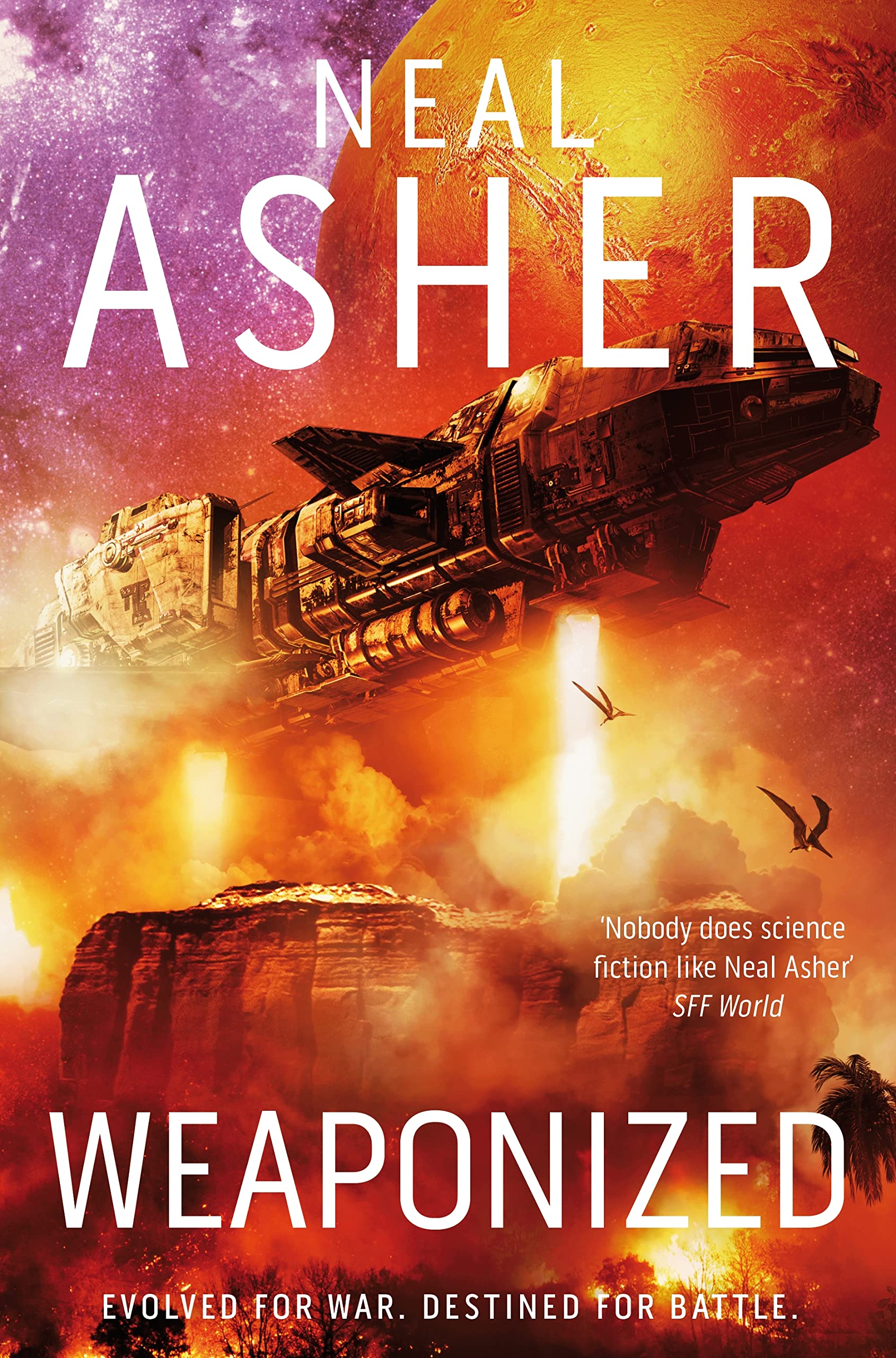
Weaponized

9176nxFpA+L.jpg


This book follows the story of Ursula, a Polity citizen who has reached the ennui phase of her long life. Seeking a new challenge away from the supervision of the ruling AIs and the safety of Polity technology, she and 800 people at a similar stage in their lives set out to colonise the planet Threpsis, complete with its own very harsh environment and hostile flora and fauna. Meanwhile, the Prador/Polity war erupts on the outside leaving Ursula and the colonists isolated on the increasingly hostile planet. Faced with utter destruction, Ursula looks to her ECS biophysicist to come up with some upgrades.

This is military SF turned up to 11 with the humans steadily becoming 'weaponized' in order to resist the increasingly intelligent and deadly native lifeforms - not with big guns - but with Jain technology derived nanosuites, and for those of you familiar with Asher and Jain tech you’ll have more than an inkling of the weird and wonderful and downright nasty that follows. Throw in a Prador assault ship that crash lands on the planet and you get all the ingredients for a human-alien conflict, except this is Asher so expect it to play out in his own inimitable way. And it does just that and is pretty enjoyable for the most part, though I couldn’t help feel that it could have been done better. By this I mean the story’s structure which, though mostly set in the present, has frequent flashbacks to the near past and the past. Many of these occur at the most inopportune moments and were annoying, and personally I would have preferred a more linear storyline or, alternatively, a shorter novel with no flashbacks. It’s not my story, I know, but I strongly suspect others will feel the same after reading it. However, Weaponized is a fun read and if you like Asher you’ll like the story - or at least some of it, but it does have faults.
 
Nice cover.... and lovely to see the SFFWorld quote! Am now trying to think who that could be from.... it could be me, but I think it may be MarkC! :)
 
Still trying to get more pages into Eversion (not that it's bad, just that, for now, am in the mood for something different, more "personal").

Also started the Ghost trilogy of LE Modesitt (alternate steampunk history with a bit of the supernatural, but quite sf, Of Tangible Ghosts being the first volume) - I remember reading from it on and off years back, but now in his new Grand illusion fantasy series second volume, Councillor, (by far my favorite novel of 2022) there are some intriguing allusions to one Johan Eschbach and a book written by him (set in the Grand Illusion universe but seemingly a fantastic work there) and of course, that is the name of the narrator and hero of the Ghost trilogy which has a lot of similar technology and I am quite curious if there is more to that than the name

And for fans of Anyar and Joseph Kolsko, A Fearful Symmetry by Olan Thorensen, book 8 of the Destiny's Crucible series, is due on Saturday (June 18) as an ebook - preordered it and of course, I expect I will start it the moment it drops into my inbox as that is my joint top highest expected novel of the year and if looks really interesting and a return to the top-top of the series after two quite good but transitional novels in Passages and A Dubious peace; from the posted chapter 1, there are actually 5 21st century Earth humans on Anyar (mysterious aliens kidnapped pre-technological humans long ago from Earth and took them to Anyar where they spread, and the more advanced countries formed by them developed at the time the series starts a sort of 18th century technological civilization with guns but no electricity or steam power), so two more in addition to Joseph, Mark Caldwell, and Heather Chen; and of course Joseph took personally the recent assassination attempt against him and Maera, so despite his desire to guide Caedellium to prosperity in peace, he realized that there will be no such thing as long as the expansionist empire of Narthon is not destroyed; now, of course, he has in Mark a top weapons and engineering expert (Joseph being a chemist and war games hobbyist but not an engineer could develop modern weapons on Anyar only so far and he defeated the Narthani attempt of conquest mostly by superior strategic skills - and of course the Narthani believing the Caedelli clans to be backward "savages" and incapable of strategy or modern tactics - and the willingness of the Caedelli to follow him, no matter what after his first "miracles" and his endorsement by the equivalent of the local living saint), so will see...
 
Last edited:
personally I would have preferred a more linear storyline or, alternatively, a shorter novel with no flashbacks. It’s not my story, I know, but I strongly suspect others will feel the same after reading it.
My view on Weaponized (from SFF Chronicles)....

I'm not enamoured of the way he's telling the story, it's jumping from Past to Near Past to Present throughout the chapters, I keep scrolling back through the book to keep it clear in my mind
 
Last edited:
Nice cover.... and lovely to see the SFFWorld quote! Am now trying to think who that could be from.... it could be me, but I think it may be MarkC! :)

You know, I never really looked at the cover but you're right, Hobbit, it is pretty good!

My view on Weaponized (from SFF Chronicles)....

I'm not enamoured of the way he's telling the story, it's jumping from Past to Near Past to Present throughout the chapters, I keep scrolling back through the book to keep it clear in my mind

Totally agree, danny, and I meant to mention that you'd said the same thing earlier but forgot. It's an issue that should've been noticed and sorted out before publication...but what do we know? :confused:
 
Weaponized

9176nxFpA+L.jpg


This book follows the story of Ursula, a Polity citizen who has reached the ennui phase of her long life. Seeking a new challenge away from the supervision of the ruling AIs and the safety of Polity technology, she and 800 people at a similar stage in their lives set out to colonise the planet Threpsis, complete with its own very harsh environment and hostile flora and fauna. Meanwhile, the Prador/Polity war erupts on the outside leaving Ursula and the colonists isolated on the increasingly hostile planet. Faced with utter destruction, Ursula looks to her ECS biophysicist to come up with some upgrades.

This is military SF turned up to 11 with the humans steadily becoming 'weaponized' in order to resist the increasingly intelligent and deadly native lifeforms - not with big guns - but with Jain technology derived nanosuites, and for those of you familiar with Asher and Jain tech you’ll have more than an inkling of the weird and wonderful and downright nasty that follows. Throw in a Prador assault ship that crash lands on the planet and you get all the ingredients for a human-alien conflict, except this is Asher so expect it to play out in his own inimitable way. And it does just that and is pretty enjoyable for the most part, though I couldn’t help feel that it could have been done better. By this I mean the story’s structure which, though mostly set in the present, has frequent flashbacks to the near past and the past. Many of these occur at the most inopportune moments and were annoying, and personally I would have preferred a more linear storyline or, alternatively, a shorter novel with no flashbacks. It’s not my story, I know, but I strongly suspect others will feel the same after reading it. However, Weaponized is a fun read and if you like Asher you’ll like the story - or at least some of it, but it does have faults.
This does sound interesting, and I'll likely try it soon, even if it seems to contain a lot of what we've seen before from Asher. Hopefully it'll have a new spin on things.

Nice cover.... and lovely to see the SFFWorld quote! Am now trying to think who that could be from.... it could be me, but I think it may be MarkC! :)
From my review of (if memory serves!) War Factory.
 
56616572._SY475_.jpg


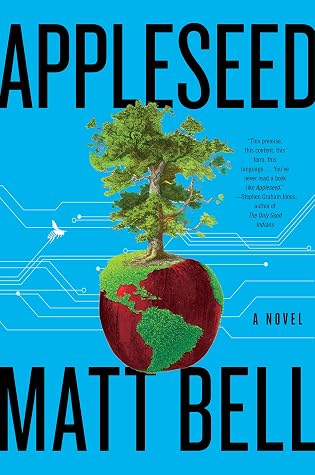
I read Appleseed by Matt Bell, I think after seeing it on the Locus Recommended Reading List for 2021.

It follows three storylines - eighteenth century Ohio, 50 years from now, and a thousand years in the future. In Ohio, two brothers travel across the State planting apple seeds, living off the land the best way they can to preserve it. It's a re-telling of the Johhny Appleseed tale with a difference; one the of brothers (called "Chapman") is a faun, and as such faces difficulties living in an increasingly urbanised environment.

In 50 years time climate change has devastated the Earth, and one company owns the technologically advanced resources needed to try to save the Earth from catastrophe - which leads to conflict with those opposed. And in the far future the Earth has entered an ice age and one inhabitant travels across the plains in search of other life.

This was a very inventive and well-researched novel, but also so relevant to today which gives it even greater impact. It was also unusual in it's cross-genre attributes (fauns and future tech), and the mythological faun story links well to the genetic engineering and cloning used in the future.

Another thing that stands out is the author's obvious love of nature, describing the beauty of Earth and it's living creatures with care and detail (and how disastrous it would be if it was lost because of human action). It's not all doom and gloom despite the dangers posited; there is a hopeful side to the story as well.

There are nearly always drawbacks to a novel, and for me the two main ones were the story of the brothers in Ohio wasn't as interesting as the other two, especially as it progressed, and also some of the ideas in the novel were repeated somewhat making the read a bit longer than it could have been (maybe a shorter Ohio section would have improved it).

But on the whole an ambitious and original story; not your everyday "Cli-Fi" book, but one with genuine love of the planet and an interesting blend of ideas.
 
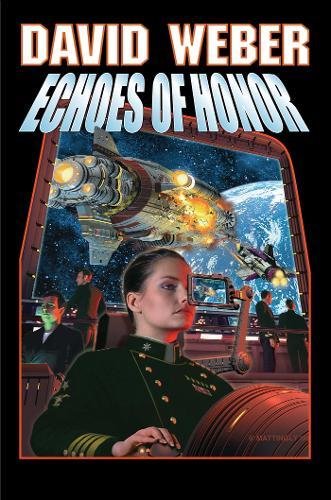
Echoes of Honor

51wqMsMAjYL.jpg


This, the eighth in the Honorverse series, relates events on the prison planet Hades and the progress of the war between the People’s Republic of Haven and the Manticoran Alliance. Following the appointment of Esther McQueen as head of the Havenite Navy, the PRH adopts a more aggressive stance by successfully attacking and destroying several Manticoran outposts. Meanwhile, Honor Harrington, believed to be dead after footage of her execution is released by the Havenite security services, is busy plotting her escape from Hades.

Well, I didn’t expect too much from this one following my disappointment with the previous book, though it actually turned out to be rather good! With the loss of an eye and an arm and the way that some of the events unfolded, Harrington evolved into a bit of a Lord Nelson caricature, but this was fine and stayed true to the series’ roots. Admittedly, I sometimes skimmed or skipped the inevitable long (and often unnecessary) characterisation sketches that spoilt the previous book’s story, but it worked a treat and my strategy kept the story moving along nicely, and myself fully immersed all the way through. Sorting the wheat from the chaff seems to be the right approach to take with these later Honorverse books; at least, it worked with this one. With the drossy parts neutralised, Echoes of Honor was an enjoyable read, with the result that I’m still interested in what happens next and I will look for a copy of the next book in the series.
 

Sponsors


We try to keep the forum as free of ads as possible, please consider supporting SFFWorld on Patreon


Your ad here.
Back
Top