Reading Verne's Voyages Extraordinaires

(44) Le Sphinx des glaces (An Antarctic Mystery, aka The Sphinx of the Ice Realm, 1897) (2 volumes) 114K words


The 44th Extraordinary Voyage takes place inside the Antarctic Circle, deep into the unexplored regions surrounding the South Pole. It's not the first time the series takes us near the South Pole, since we visited that area in "Twenty Thousand Leagues under the Seas", but in that case it was just a quick visit, taking only a small part of the novel. The Extraordinary Voyages have also taken us deep north, into the Arctic regions, in "The Adventures of Captain Hatteras". Novels like "The Fur Country" and "César Cascabel" also took us inside the Arctic Circle, but not very deep inside it.

"An Antarctic Mystery" was written as a sequel to Edgar Allan Poe's "The Narrative of Arthur Gordon Pym of Nantucket". It is the first out of two times that Verne wrote a sequel to a novel by another writer. The second one will be "The Castaways of the Flag", a sequel to Johann Wyss' novel "The Swiss Family Robinson".


First read or reread?: This one is a reread for me. I loved it when I read it as a kid.


What is it about?: In the remote Kerguelen Islands, near the Antarctic Circle, a wealthy American geologist called Mr. Jeorling finishes his studies and takes passage in the ship Halbrane, on its way to Tristan da Cunha. The captain, Len Guy, turns out to be the brother of William Guy, commander of the Jane, the ship whose story is told in Edgar Allan Poe's "The Narrative of Arthur Gordon Pym of Nantucket". To Joerling's surprise, the story told in that book turns out to be true, as a newfound clue allows Captain Len Guy to trace the fate of his brother's lost ship. Through the efforts of Mr. Joerling, the crew of the Halbrane is enticed to make the trip to Antarctica to search for any survivors of the Jane.


Since this is a sequel, the first question that comes to mind is "do I need to read Poe's book to understand this one?" The answer to that question is "no", because Verne gives the reader all the necessary information. In fact, chapter 5 is a detailed summary of the events of Poe's novel. Since I had just read it (see my review), I skimmed through this chapter. Nevertheless, I would recommend reading Poe's novel first, as it is quite a reading experience, and it combines well with Verne's novel to tell a complete epic. Two different styles, but they do complement each other. Besides, having read the first story, it's easier to get invested in the quest to discover what happened and rescue the survivors, if any.

While Verne greatly admired Edgar Poe, as he calls him, he also realized that they were rather different writers. Frustrated by the abrupt, mysterious ending of Pym's narrative, Verne would write "Who shall continue it? Someone braver than me, someone more willing to enter the domain of impossible things." Decades later, Verne took that task upon his shoulders.

So what about those "impossible things", the fantastic, extraordinary events observed by Arthur Gordon Pym near the South Pole? How does the rational Verne deal with that? Well, while most of the story told by Poe supposedly based on Pym's diaries turns out to be true, some of the most fantastic effects described at the end of it are not observed in this sequel, and it is implied that some of them may be hallucinations due to Pym's mental state at that point, or perhaps embellishments added by Poe himself.

This leads some reviewers to complain that Verne takes the magic out of Poe's story. I personally do not share that complaint, because while the vividness and exuberance of Poe's imagination is wonderful, I also appreciate Verne's more rational worldview. This sequel is a great, epic adventure in its own right, and it doesn't lack some extraordinary, although rationally explainable, phenomena.

I do not want to give spoilers here, so I can't discuss the details, but the fate of the Jane's expedition will be discovered and the narrative circle closed. According to Verne's story, while Pym's narration is mostly true, there were things he did not know, and we discover Pym's fate, different from what Poe told us. We also meet some survivors from the previous story.

I do not know why, but I really enjoy Verne's stories set in polar regions. I suppose it's because these were truly unexplored regions at the time, and any expedition there is a risky adventure. As modern readers, we know what's in the poles, but at the time Verne was writing they were unknown, so in his stories we never know what we are going to discover there. It's like we are in an alternate Earth, an imaginary geography, where we can be as surprised by what the characters find as the characters themselves.

On the minus side, there are a few details that are hard to believe, like what happened with the dog Tiger in the island Tsalal, and also some unlikely coincidences. Verne does telegraph some of the plot twists, not only here, but also in other novels. Funnily enough, the narrator in this one apologizes to the reader for not having seen an obvious twist before it was revealed, saying that the reader probably realized it much earlier.

This a fast-paced adventure, fast-paced for Verne's 19th century standards, anyway, but it's longer and not as frenetic as Poe's novel. It gives you more time to breathe and enjoy the interaction between the characters. The interest of the adventure is reinforced by the mystery of what happened to the previous expedition, which I, as a reader, was as eager to know as the characters.

By the way, for those reading in English: the original, public domain English translation is abridged, so if you want a complete English translation you should get the 2012 Frederick Paul Walter translation titled "The Sphinx of the Ice Realm" (with Verne's English translations this is a common advice: when possible, get the modern one).


Enjoyment factor: Very high. Verne was close to 70 when he wrote this and, although in the latest part of his career some of his novels were not as fresh and exciting as the ones written in the beginning, he still had a gift to tell great adventure stories, with that personal scientific touch that you don't find in other contemporary adventure writers.


Next up: The Mighty Orinoco
 
Last edited:
(45) Le Superbe Orénoque (The Mighty Orinoco, 1898) (2 volumes) 102K words


The 45th Extraordinary Voyage is the second one devoted to a river journey (after "Eight Hundred Leagues on the Amazon") and also the second one taking place exclusively in South America (again, after "Eight Hundred Leagues on the Amazon"). We had also been in South America in the novel "In Search of the Castaways", but only for part of it.


First read or reread?: This is a reread for me. This one was not among my favorites when I read it as a kid.


What is it about?: Three Venezuelan geographers, M. Miguel, M. Felipe and M. Varinas argue amongst themselves about the location of the headwaters of Venezuela’s majestic Orinoco River. They decide to make a journey up river to study the situation on the terrain and settle their disagreement. At the same time, Sergeant Martial and his nephew Jean are also making this same journey, although for a different purpose. They are seeking out Jean’s lost father, who they hope may still be found living somewhere far upriver. The two parties meet and travel together and are soon joined by another French party, composed of the explorer Jacques Helloch and his friend the naturalist Germaine Paterne. The parties on their travels upriver overcome many obstacles and dangers, both from natural causes and from a savage band of outlaws. More secrets than the source of the Orinoco will be discovered before this trip is over.


The book starts with the three geographers arguing like stubborn children over the Orinoco. Unlike the sources of the Nile in "Five Weeks in a Balloon", the headwaters of the Orinoco, although located in very remote areas, far from civilization, are not unknown. The disagreement is actually about which river in the upper Orinoco deserves the name Orinoco: the Parágua, commonly known as Orinoco, or one of its several important tributaries. One of the geographers believes that the river Guaviare, connecting the Orinoco to Colombia and the Andes, and surpassing the Parágua in length and water flow, deserves to be considered the main current of the upper Orinoco basin and therefore should rightly be called Orinoco. Another of the trio believes that the river Atabapo, connecting the Orinoco basin with the Amazonas basin through the Rio Negro is the one which deserves the name Orinoco. The third geographer, more orthodox, believes that the river Parágua is the upper Orinoco, as it is commonly believed.

I enjoy this kind of geeky disagreement between scientists, which is not uncommon in Verne's work, while the rest of the characters are thinking "what does this even matter?". The three learned men resolve to travel to San Fernando de Atabapo, where the Parágua, Guaviare and Atabapo join, and settle their argument there.

After the first part of the journey, which is made by steam ship, a longer journey, thousands of kilometers, has to be made by large canoes, guided by expert native boatmen. Continuing the journey with the three geographers, there is an irascible and overprotective old soldier called Sergeant Martial and his young nephew Jean, who are in search of the boy's father, disappeared in the upper Orinoco. These two become the main characters and are keeping a secret of their own.

The group is later completed by two French explorers and the expedition continues the journey along the middle Orinoco and later into the upper Orinoco.

This is one of the Verne books with a strong travelogue element. This is not at all uncommon, but perhaps in this one there's more level of detail than usual. Verne was using as his source the account published by Jean Chaffanjon, who had recently done extensive explorations of the Orinoco basin for several years. In fact, in the novel, the youngster Jean has a copy of that account and uses it as a travel guide to help them in their journey.

The novel has the usual Verne adventures, but the pace for most of the novel is slower than usual, and that's what prevented my younger self from enjoying this one as much as other Verne novels. Reading it now, I appreciate it more for the complete depiction it gives of this mighty river. In this sense, it's a better travelogue than "Eight Hundred Leagues on the Amazon", probably because of Verne's source material being so thorough. The pacing is slower, however. Because of this, your enjoyment as a reader will depend on how much you appreciate the travelogue element. It's certainly one where I enjoyed following the characters' progress on the map.

I wouldn't want to give you the impression that this is just a travel narrative. There's an adventure, with some twists and surprises (which often are not difficult to guess, since Verne always gives a lot of hints). The novel becomes more focused on that adventure plot towards the end, and there's also a romance. I enjoyed the characters, typical of Verne, and their motivation and associated drama.

I don't bother to comment on this most of the time, since I would just be repeating myself, but this is another example of Verne's 19th century attitudes towards colonialism and race. He makes some comments that would not be acceptable today, like saying some particular tribe was at the lowest end of the human scale (because of them being uncivilized and aggressive), but also depicts indigenous people in positions of authority, managing things in a very capable manner.


Enjoyment factor: I enjoyed it, with some reservations because of the slower pace, at least during the first part. Because of that, it would not be one I would recommend to a novice Verne reader, unless particularly interested in the travelogue element or in the Orinoco river. Beyond that reservation, I didn't lack things to enjoy here.


Next up: The Will of an Eccentric
 
Last edited:
(46) Le Testament d'un excentrique (The Will of an Eccentric, 1899) (2 volumes) 119K words


The 46th Extraordinary Voyage takes us to the United States. We had been there in the "From the Earth to the Moon" duet, and in "North Against South", as well as, in passing, in multiple novels of the series. However, this one is particularly devoted to exploring the geography of the country, its cities, states and natural wonders.


First read or reread?: First read for me.


What is it about?: William J. Hypperbone, an eccentric millionaire from Chicago, has left his fortune to the first person to reach the end of "The Noble Game of the United States of America." The game he devised is based upon the board game "The Noble Game of Goose". However, in his version, the game board is the United States, and the players are the tokens who will be sent to different parts of the country according to the whims of the dice, with a limited time to get there. The contestants, chosen randomly among the adult citizens of Chicago, are Max Real (an artist, accompanied by his servant and companion Tommy); Tom Crabbe (a boxer, accompanied and led by his trainer John Milner); Hermann Titbury (a miser and usurer, accompanied by his wife Kate); Harris T. Kymbale (a journalist, on his own); Lizzie Wag (a cashier, accompanied by her friend Jovita Foley); Hodge Urrican (a retired commodore of explosive temper, with his companion Turk, of even more explosive temper) and the mysterious player only known as "XKZ." And who is this mysterious "XKZ" who was added to the game by a codicil to the will? Time and completion of the game will tell.


After a couple of more serious adventure novels, Verne explores again his more light-hearted streak in this book. As he often does when depicting the citizens of the USA, he regards them with a half-admirative, half-ironic frame of mind. Verne clearly admired the energetic, can-do attitude of that country, but at the same time finds the funny side of that attitude, which can become satire when taken too far.

The premise, silly as it sounds, is not a bad setup for a story. Many other later fiction works have followed this idea of an eccentric millionaire who makes his prospective heirs take place in some kind of competition if they want to inherit.

The game here consists in turning the country into a game board inspired by the Game of the Goose, with each state being a square of the board. The late millionaire's solicitor rolls the dice in a public ceremony for each move, and given the stakes, the newspapers and the whole country's attention is on the game. It becomes a great national event, the players become celebrities, and lots of people bet money on the outcome, and some of them help or hinder the players accordingly. There are game obstacles such as the Inn, the Bridge, and Death, but in this case also real-world obstacles. The United States, of course, was a civilized country and there were suitable communications into most places, but at the time (near the end of the 19th century) in some of the remotest corners the train did not always reach and the game could turn more into an adventure, particularly given the time limit to reach the destinations.

Verne obviously uses this premise to describe different parts of the country and the means of transportation available at the time. In 1897, the first Baedecker guidebook for the U.S. was published, and Verne used this as his main source. I have commented in some of these reviews that some of his novels, such as this one, could be described as part adventure and part geography documentary. Of course, there was no TV to compete with books at that time. The danger with this kind of novel is that the descriptions may become boring and slow down the pace of the story. This happens here, but only on a few occasions. Mostly, having multiple characters and moving from one to the other makes for a decent pace. Of course, I'm used to Verne's style and I enjoy it, so a different reader may find these descriptions annoying. It offers a glimpse of the US in a different time, though, so in that sense it's interesting.

In some ways, this story reminded me of "Around the World in Eighty Days", with a bunch of travelers forced to make a race against the clock, but in this case the destinations are chosen randomly, so the characters have no control over them.

One problem of this story is that, for many of the players' trips, there is not much tension, since there's no doubt that the player will be able to reach the desired destination on time. But the colorful nature of some of the players, the ups and downs of the game and the occasional dangers and delays help maintain the interest. Verne, for all that he is normally more focused on the plot than on the characters, could use his characters to good effect when he needed.

We also have a romance between two of the players and a mystery regarding the anonymous player. The final twist is rather unlikely, but as Verne playfully says at the end of the novel, if this seems difficult to believe, the reader should remember that this happened in the United States, where anything and everything is possible.


Enjoyment factor: I enjoyed it, although I wouldn't place it in a top ten Verne list. At this time in his career, Verne, who was already 70, had health problems and would die within a decade, was still producing solid work, although perhaps not always as inspired as in the first part of his career.


Next up: The Castaways of the Flag
 
In some ways, this story reminded me of "Around the World in Eighty Days", with a bunch of travelers forced to make a race against the clock, but in this case the destinations are chosen randomly, so the characters have no control over them.
Or the animated TV series "Wacky Races"?
 
Or the animated TV series "Wacky Races"?

Yeah, I watched that show as a kid :D

This novel is a crazy competition too, but different, because each player races towards a different destination, so they are playing against each other but they are not racing against each other. Also, they need to be in a real hurry only occasionally. Most states were well connected by train even then.
 
The Swiss Family Robinson, by Johann David Wyss (1812) 125K words


Jules Verne's 47th novel in the Extraordinary Voyages ("The Castaways of the Flag", 1900) is a sequel and homage to Johann David Wyss' "The Swiss Family Robinson". In preparation for reading Verne's book, I first read Wyss' novel, a classic Robinsonade from the beginning of the 19th century.


What is it about?: A married couple and their four sons leave their home in Switzerland planning to settle half a world away. But things do not turn out as they had expected. The sole survivors of a terrible shipwreck, they wash ashore to learn that the danger has only begun. Their new world will test their courage, cleverness, endurance, and faith as they struggle to survive and create a civilization of their own in the wilderness.


Johann Wyss, a Swiss pastor, originally wrote this book to entertain and instruct his four sons. The book was very successful, and on each new edition he revised the novel, adding new stories. The situation becomes more confusing with the translations. The French translator Isabelle de Montolieu also modified and added new stories, and the most popular English translation (by William H. G. Kingston) is an abridged version of the modified French translation. Things got to a point when there's no such thing as the original, since every single edition seems to be different. So perhaps I should begin by saying the version I read, based on Kingston's translation, is one of the several versions available at Project Gutenberg. I read this one, to be precise: https://gutenberg.org/ebooks/3836

I don't know if the experience would be much different with another translation, but age has not been kind to this novel. Verne wrote one other sequel to a different writer's work ("An Antarctic Mystery", aka "The Sphinx of the Ice Realm", which was a sequel to Edgar Allan Poe's novel "The Narrative of Arthur Gordon Pym of Nantucket"), and Poe's style felt quite modern. However, "The Swiss Family Robinson" is missing several things that we take for granted in a novel.

After the shipwreck, the crew leaves the ship, abandoning the Swiss family they had as passengers alone on board. However, this family will be the ones who will survive. After they manage to get to land, they start working on basic survival tasks like obtaining food and finding shelter. They are able to rescue a lot of material and animals from the shipwrecked ship, which helps a lot (the ship had been going to provision a new colony, so it had a lot of useful material).

Now, some modern readers complain about old novels because the characters think or act differently from modern people, but I normally do not mind these things. People killed animals because they had to eat, and they did not have a slaughterhouse to do it for them out of their sight. They tended to be religious and had the values of their time, not of our time. Sometimes the pace is slower in these old novels, and they are not in a rush to tell the story. I'm perfectly fine with that. In fact, in the hands of a competent writer, these stylistic differences can add a certain charm and a feeling of period authenticity to the story. However, this novel is from 1812, earlier than most of my favorite adventure novels of that century, and even for a reader like me it was not easy to enjoy.

I certainly like the basic premise of the story, and in the hands of Verne, Stevenson or any writer like that I would have loved it, but here I had several problems.

First I have to mention the dialogues. More formality than we are used to is to be expected in novels from this period, but to my ear the dialogues here sound awkward and unrealistic. I don't know if it's the original or the translation. but did these people really speak like this?:

I observed to her that I could not but view with alarm the many cares and exertions to be made. ‘In the first place, a journey to the vessel must be made. This is of absolute necessity, at least, if we would not be deprived of the livestock and other useful things, all of which from moment to moment we risk losing by the first heavy sea. What ought we first to resolve on? For example, should not our very first endeavour to be the contriving of a better sort of habitation and a more secure retreat from wild beasts, as well as a separate place for our provisions? I own I am at a loss what to begin first.’

‘Return to the wreck by all means,’ replied my wife, cheerfully. ‘Patience, order and perseverance will help us through all our work, and I agree with you that a visit to the wreck is without doubt our first duty. Come, let us wake the children, and set to work without delay.’

The story is told in first person from the perspective of the father. It soon becomes very episodic. The problem is that the episodes are repetitive and, worse than that, they do not seem to contribute to the advancement of the plot, so that it feels as if at any moment you could skip twenty pages ahead without even noticing it.

The episodes go like this: the characters find some strange plant or animal. Then either the father, who is a human 19th-century version of the Wikipedia and seems to know every obscure trivia about natural history, or Ernest, the most bookish son, identifies it and explain how they can make use of it. If it's an animal, they kill or capture it in order to domesticate it. If it's a plant, they use it to make ink, or oil, or clothes, or any other thing. Rinse and repeat one hundred times. Or perhaps the episode is about them building a new home or a new farm, or a bridge or some other thing.

These episodes can serve for the father to teach the boys some moral lesson or, more often, some trivia about natural history or physical science.

I can see how this was an influence on Verne, who also has a didactic element in many of his stories and also wrote about shipwrecked people making a life for themselves and prospering through their hard work and ingenuity ("The Mysterious Island", "Two Years' Vacation"...). However, Verne was a gifted storyteller. Wyss, not so much. The episodes do not build on each other to tell a story, and that, and their repetitive nature, makes them a bit dull and lacking in tension.

The premise, and the idea of the family with four boys isolated on a desert island and working together to survive and prosper is fun, but the execution is less fun.

The fauna and flora of the island is completely unrealistic. We are talking about an island in the Indian Ocean, near the equator, but whatever animal or plant you can think of (and many you can't think of) are there. Seriously, anything goes. From monkeys to lions, from penguins to elephants, from seals to boas constrictor or weirder animals I had never heard of, they are all there in this island. Sometimes it's a single exemplar of the species, but every kind of animal seems to be there. Presumably, the author had access to books about world fauna but he, like his audience, did not have the slightest idea about what kind of animals one might expect on an island near the equator in the Indian Ocean. In that he also reminds me of Verne, who did have some unlikely fauna sometimes, but Wyss really takes it to the extreme.

The characters all have their own personality, but they do not talk and interact in a realistic manner. Also, they are very industrious and have a lot of ingenuity, but they do not do some very basic things one would expect of shipwrecked people. For example, after ten years in the island, they have only explored their more immediate surrounding. They have no idea about the shape of the island, or even if it's really an island. Seriously, for all they know there could be a town on the other side of the island, or they could be in a continent.

Maybe this works as a collection of tales to tell your children at night, where the repetitive nature does not matter, and where you can introduce some lessons, but the art of storytelling has left this behind, and I can't really recommend this novel, unless you are interested in the history of adventure literature. But I can't recommend it if you are just looking for entertainment.

I don't like being so harsh, and I can't help wondering if this is the victim of a bad translation (I love Verne, for example, but I hear he had some bad English translations). But as far as this translated version of "The Swiss Family Robinson" goes, I can't recommend it. Thankfully I now have the Verne sequel to enjoy. I have no doubt it will be better.


Enjoyment factor: Sadly, I didn't enjoy this one as I would have liked. There's not much of a plot. The premise is quite good, however. The family togetherness and the perseverance, ingenuity and hard work of the characters made it tolerable.


Note: checking other versions in Project Gutenberg, I found this one which seems to be in a less awkward English than Kingston's translation. It also has more plot coming from Isabelle de Montolieu French version, including natives. Verne's continuation does not have these natives, but nevertheless the reader might find this version of "The Swiss Family Robinson" more accessible: https://gutenberg.org/ebooks/11703
 
Last edited:
This book does seem clunky even for its time, farseer, and could be down to the translation, as you suggest. An old favourite of mine, Pride and Prejudice, was written in 1813 and is still very readable even today.
 
Austen (d. 1817), Radcliffe (d. 1823), and Horace Walpole's 1764 novel The Castle of Otranto are all more readable. In fact most if not all of the Gothic novels Jane Austen makes fun of in Northanger Abbey are quite fun. I suspect her of being a fan. All the books mentioned in that book (and maybe in others of hers) are real and most are available.

Mary Shelley published her famous book in 1818.

I think Swiss Family Robinson is poor for it's time
 
I think Swiss Family Robinson is poor for it's time
Most if not almost all who have knowledge of reading the Swiss Family Robinson Will be recalling one of the popular children's book reductions and total rewrites of the story into a full children's book.
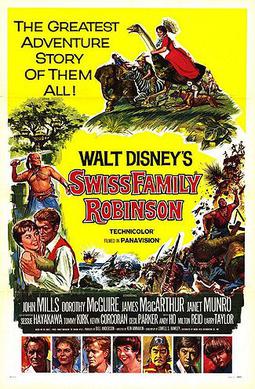
But even with those accounted for the vast majority will be remembering the Disney Movie version from 1960 Which of course is based on those "children's versions" It is a good movie and addresses the major themes honestly, and I think that someone working on that movie was able to read the original as a native speaker.
 
Last edited:
the vast majority will be remembering the Disney Movie version from 1960 Which of course is based on those "children's versions"

This was my only contact with the story until now. It's a good children's movie, disneyfied and not to be taken too seriously, but a lot of fun. I loved it as a kid. I think it captures the fun of the premise much better than the original novel.
 
This book does seem clunky even for its time, farseer, and could be down to the translation, as you suggest.

It's possible. I think the Kingston translation maybe be partially responsible for the stilted English (if so, it is a bad sign, because he made some of the contemporary Verne translations into English). The problem of the lack of plot is not the fault of the translation, though. Maybe it's just poor, as Ray suggests.

It was quite successful, however. I wonder what contemporary readers saw in it. Possibly it's just the feeling of exotic adventures when there wasn't much that could answer that need. The focus on natural history and on family, and the competent, pious protagonists may have helped.

I think Swiss Family Robinson is poor for it's time

I'm inclined to be more tolerant with pioneering works, the ones written without a tradition to back them up and build upon. It's true that good writing already existed in 1812, but when it comes to adventure stories there weren't many good things back then. Pioneers like Walter Scott, Fenimore Cooper or Dumas had not started publishing yet. There was the original Robinsonade, of course, although Defoe's novel is not an example of modern storytelling either. Gulliver's Travels, maybe? Although that was fantasy, and a satire of travel narratives and of Robinson Crusoe itself.
 
(47) Seconde Patrie (The Castaways of the Flag, aka Second Fatherland, 1900) (2 volumes) 118K words


The 47th Extraordinary Voyage is a sequel to Johann Wyss' novel "The Swiss Family Robinson". It's a story about sailing and castaways, but also about the founding of a colony. It's the second and last Verne novel written as a sequel to a work by another writer (the first was "An Antarctic Mystery", a sequel to Edgar Allan Poe's "The Narrative of Arthur Gordon Pym of Nantucket").

Be careful if reading an English version, because the novel was initially translated as two separate books, the first one titled "Their Island Home" and the second "The Castaways of the Flag". Later editions included the whole novel with the title "The Castaways of the Flag" or "Second Fatherland". Therefore, if you get an older book titled "The Castaways of the Flag" you may be getting only the second part of this Verne novel. That's the case, for example, with the free version of "The Castaways of the Flag" available at Project Gutenberg: it's only the second half. If your version has 32 chapters and begins in the island of New Switzerland, with the arrival of the British ship Licorne (Unicorn), then you are reading the complete Verne novel. If your version has 16 chapters and begins with a chapter called "The Castaways", on a boat with a group of castaways at sea, then you only have the second half.


First read or reread?: First read for me.


What is it about?: The story begins by retelling the last chapter of "The Swiss Family Robinson", with the arrival of the Unicorn, a British corvette commanded by Lieutenant Littlestone, whose commission includes the exploration of the waters in which New Switzerland is situated. No longer isolated from the rest of humanity, the former castaways intend to keep living on their island, which has become their home, and start a colony there. For that, some of the members of the family will travel to Europe, while the rest remain on New Switzerland to complete the exploration of the island and prepare it to receive new colonists.


First, I have to say that reading "The Swiss Family Robinson" is not required to understand this novel. Just as he did in "An Antarctic Mystery", Verne gives the reader all the information needed to follow the story. In fact, chapters 4 and 5 of this novel are an extended summary of the events told in "The Swiss Family Robinson". In the case of "An Antarctic Mystery", I recommended reading the Poe novel first, just for reading pleasure. In this case, I don't necessarily recommend reading "The Swiss Family Robinson" first, since I did not enjoy it that much (see my review). But that's just my taste, and your mileage may vary.

Like what happened with Poe's novel in "An Antartic Mystery", Verne presents here "The Swiss Family Robinson" as a real, non-fiction book, based on the journals of Jean Zermatt (the father of the family originally stranded in New Switzerland).

I mentioned in my review of "The Swiss Family Robinson" that I expected the Verne sequel to be better, and it was. Mainly, it was a relief that instead of a collection of random encounters, we have here a traditional novel, with a plot, characters who make long-term projects and carry them out in a logical manner.

The first half of the novel starts with the arrival and departure of the Licorne, and then it involves the original castaways and their new friends the Wolstons preparing New Switzerland to receive more colonists. This part was OK, but it lacked the spark of the best Verne stories, mainly because a story about castaways, where survival is at stake, naturally has more tension than a story about former castaways who have rejoined human civilization and are now working on projects like making a new canal to improve irrigation in order to help feed a future colony. Of course, Verne had already told stories about castaways from the beginning (see "The Mysterious Island", "Two Years' Vacation" and, on a lighter note, "Godfrey Morgan"), but this post-castaways situation is more low-key compared to that.

Fortunately, we move on to an exploration trip to discover the layout of the island, something that inexplicably had not been done in "The Swiss Family Robinson", despite the castaways being there for twelve years. This part was more interesting, including the attempt to ascend the highest peak of the central mountain range, although this is still not the heart of the novel.

The discovery of a group of hostile... well, not "natives", since they are newly-arrived to the island, so let's call them "savages", as the novel does, seeks to add tension to the story. This plot element felt a bit too trope-ish to me, the easy way to add danger on a desert island. Also forced, because, where had these savages come from? If it was from a nearby island, how is it that they had not discovered and colonized New Switzerland, a large and fertile island, much earlier? And if, as the novel suggests, they came from far away and had made a very long canoe trip, how come the group was so numerous?

Then, the second half of the novel, concentrating more on the characters who had left the island to go to Europe, turns out to be the most interesting. The original title of the novel translates to "Second Homeland", and I thought the English title ("The Castaways of the Flag") made reference to the original castaways on New Switzerland, with the "flag" being the banner they had flying at the islet on Deliverance Bay. However, it turns out we get another group of castaways, and the Flag is the name of the ship where there's a mutiny resulting in these characters being abandoned on a boat. Talk about bad luck, some of them becoming castaways for a second time!

I found this part of the story very enjoyable, compensating for the more laid-back beginning.

One thing I was curious about was whether Verne would retcon the surprising variety of animals on New Switzerland. He does not, although he places less emphasis on that. Of course, just like in Wyss' novel, the attitudes towards hunting and killing animals is 19th century rather than modern. This book was published in 1900, almost forty years after "Five Weeks in a Balloon", but Verne's attitude in that sense has not really changed during that time. This can be shocking for modern readers, but it's also authentic. The idea of protecting endangered species would have been an anachronism.

The same can be said about attitudes towards the "savages". The ones in this novel are depicted as an uncivilized, hostile enemy. Of course, it makes sense for the characters to defend themselves, but the attitude towards them is shown by how they keep shooting at the savages even after they have been defeated and are in retreat. Not they way it would have been written today, but it was the prevalent worldview at the time, even for an otherwise humanist writer.


Enjoyment factor: I did enjoy it. I thought the first part lacked some spark, and wondered if maybe it was a natural decline because of the author's old age, but it got better, and ended up being an entertaining adventure novel.


Next up: The Village in the Treetops
 
Last edited:
… that's the case, for example, with the free version of "The Castaways of the Flag" available at Project Gutenberg: it's only the second half.
Thanks for warning. Also the sold on Amazon Complete Novels of Jules Verne has neither part and while it has 47 titles, it's missing quite a few! It seems updated since some reviews written as missing most ot the faults complained of.
 
Thanks for warning. Also the sold on Amazon Complete Novels of Jules Verne has neither part and while it has 47 titles, it's missing quite a few! It seems updated since some reviews written as missing most ot the faults complained of.

The last edition of the Delphi Classics' Verne's complete works has The Castaways of the Flag, but I don't know if it's the complete version or just the second part.

In Amazon I see several cheap kindle versions that are just copies of the Project Gutenberg version, so just the second part, but there's also a paperback version with the complete novel, titled "The Castaways of the Flag (or Second Fatherland) (Includes The Complete Two Volumes: Their Island Home & The Castaways of the Flag)"

It's not the only case where a Verne novel had some editions in English in several volumes with different titles. For example, "The Mysterious Island" was also published as three books called "Dropped from the Clouds", "Abandoned", and "The Secret of the Island", but in this case it's more confusing because the same title has been used for the whole novel and for one of the volumes.

By the way, all of Verne's novels have been translated to English, but there are about 13 of them which have no English version in the public domain yet, since their translations are all more recent. It's easier in Spanish, all of them have decent, unabridged translations in the public domain.
 
Last edited:
(48) Le Village aérien (The Village in the Treetops, 1901) (1 volume) 53K words


The 48th Extraordinary Voyage takes us to Central Africa, where we hadn't been since... well, since "Dick Sand, A Captain at Fifteen", as I'm not counting the quick visits in "Robur the Conqueror" and "Captain Antifer". More recently than that, we travelled to the northern coast of Africa in "Clovis Dardentor" and to South Africa in "The Vanished Diamond". By the way, this is the first book in the series published in the 20th century (remember that 1900 was still the 19th century). When he published this, Verne was 73 years old and would only live four more years. Despite his failing health, he was still working hard. After this one, there would be six more novels in the series published in his lifetime, and another eight more posthumously.


First read or reread?: Reread. The first time I read it, I wasn't too impressed with this one.


What is it about?: In the heart of Africa, in the plains near Lake Chad, a stampede of wild elephants devastates an ivory hunting expedition. A group of survivors, including the Frenchman Max Huber, the American John Cort, their guide Khamis and a native boy whom they had saved, find themselves limited to their own resources. They decide their best option to get back alive to the French Congo is crossing the impenetrable forest to their south. Inside the forest, they will have several adventures and find a hidden civilization.


For two thirds of the book, this is a conventional travelling-through-Africa jungle adventure. I have no complaints about this part. A reviewer in Goodreads called Sandy commented that comparing the way Verne, Henry Rider Haggard and Edgar Rice Burroughs wrote their African adventures, you notice that Haggard was the only one who had extensive personal experience of the continent, so he gave his books a certain aura of effortless verisimilitude, while, of the other two, Verne at least had the support of extensive research, so he has a patina of realism in his descriptions.

During the story, Verne is planting seeds and clues about an American and later a German researcher who travelled to Africa to try to prove that apes were capable of language, and also about Darwin and the theory of evolution. Which brings us to the main theme of the novel, when the characters find a hidden tribe of ape-men, for want of a better name, some kind of "missing link" between apes and humans.

This part is clearly the heart of the story, and therefore it is curious that it's only dealt with during the last third of this already rather short novel. In fact, the last chapter is titled "An Abrupt Ending". When I read it as a boy, I was underwhelmed by this part of the adventure. It seemed rushed. This time around it still seems rushed, but I did appreciate it more. The point here, more than the adventure, is the sense of wonder at the discovery and its implications.

I have to say that the discussions between the characters about evolution were interesting. They are interesting despite, or perhaps because, they illustrate how people in the 19th century understood Darwin's theories. Nowadays, although we may talk of "missing links" in terms of transitional forms during evolution, the term has fallen out of favor with anthropologists because it implies the evolutionary process is a linear phenomenon and that forms originate consecutively in a chain. Instead, "last common ancestor" is preferred since this does not have the connotation of linear evolution, as evolution is a branching process. Humans do not descend from the other great apes, but we have common ancestors at some point in the past. Also outdated are some comments made by the characters, which would be racist from a modern perspective.

In any case, this part is what's really distinctive about this story, and Verne should have developed it a bit more. I wonder if he was in a hurry to meet a deadline and deliver the novel.

This novel turned out to be influential in the development of the Lost World subgenre. Conan Doyle, who was fluent in French, read it along with "Journey to the Center of the Earth", and they were part of his inspiration in writing "The Lost World". It also influenced Burroughs and other writers.

As an anecdote, the English translator of the novel decided to call it "The Village in the Treetops" instead of the more literal "The Aerial Village" because he did not want to mislead readers, making them think that this was about some kind of science-fictional flying town.


Enjoyment factor: While not one of Verne's greatest works, I appreciated this more than when I read it as a boy. It's a fast read, and it deals with some really interesting themes and ideas, even if it does so in a rather rushed manner.


Next up: The Sea Serpent, aka The Yarns of Jean Marie Cabidoulin
 
Last edited:
(49) Les Histoires de Jean-Marie Cabidoulin (The Sea Serpent, aka The Yarns of Jean Marie Cabidoulin, 1901) (1 volume) 51K words


The 49th Extraordinary Voyage takes us on a whaling campaign, both in the South Pacific near New Zealand and in the North Pacific near Alaska and Kamchatka. Previous novels in the series taking place at sea include "The Adventures of Captain Hatteras", "A Floating City", "The Survivors of the Chancellor", and "An Antarctic Mystery".


First read or reread?: First read for me.


What is it about?: The Saint-Enoch was a French whaler ship commanded by Captain Bourcart, with a crew of around thirty people. The start of their campaign was delayed because they were missing a cooper and a ship doctor. A doctor was found, but for a cooper they had no other option than convincing old Jean-Marie Cabidoulin to come out of retirement. Captain Bourcart was reluctant because Cabidoulin, although a good professional, was pessimistic by nature, always foreseeing the worst and telling his shipmates the most terrible stories about the ocean and its monsters (the original title translates as "The Stories of Jean-Marie Cabidoulin"). At last, the ship was able to leave Le Havre bound for the Pacific Ocean. Their campaign was sometimes successful, sometimes dismal. More and more mysterious events occurred: Natural phenomena or the sea monster that Cabidoulin was always prophesizing?


This is a good example of minor Verne novel: not as thrilling as his best works, but nevertheless a pleasant read and not lacking in elements of interest.

In the beginning, when the cranky and eccentric Cabidoulin was introduced, I thought that this was going to be one of those Extraordinary Voyages with humorous elements, but that turned out not to be the case, since the emphasis was not on his idiosyncrasies.

The book is mostly the opportunity to follow a whaling campaign from the beginning to the end. Many modern readers may consider whaling as a cruel practice, but from the point of view of Verne's contemporaries it was just a tough and daring way to make a living, involving sea trips that lasted several years and dangerous combats between powerful cetaceans and small boats full of sailors and harpooners.

It is another rather short novel, and most of it is devoted to showing us the day to day life on board a whaling ship, how they went from on place to the other, always in search of whales, and often coming in contact with the same ships who are involved in their own campaigns, both colleagues and rivals.

Although it did not happen often, sometimes several whaling ships in the same area would compete for the same prey, and it could lead to a lot of tension and even violence.

This slice-of-life adventure element is spiced up with the rivalry between the French ship and an English whaler which refused to salute them (Verne shows his Anglophobic tendency by depicting them as conceited and rude), and which they will meet several times in the course of a couple of years.

Another plot thread is the increasing number of clues about the possible presence of a large sea creature. Verne plays a "will they, or won't they?" game (will they eventually meet the sea monster that Cabidoulin is always expecting, I mean). The signs are there, but they could perhaps be explained more easily as unusual but natural phenomena.

Although the subject of a whaling campaign is interesting, for most of the book the adventure is low-key, being an unexceptional trip, until the last part of the novel, when events speed up and there's a lot of danger. Like in "The Village in the Treetops", one could say the ending is... well, maybe not abrupt in this case, but at least faster than it might have been.


Enjoyment factor: Another short, fast read. I found it enjoyable, without being one of my favorite Vernes. These novels from the last few years of Verne's life have a reputation for being less eventful, but I am still finding them very readable and always with elements of interest, even if sometimes it takes them a while to get to the most thrilling parts.


Next up: The Kip Brothers
 
Last edited:
(50) Les Frères Kip (The Kip Brothers, 1902) (2 volumes) 102K words


The 50th Extraordinary Voyage takes us to Oceania, where we had already been in "Mistress Branican" and "Propeller Island". We visit New Zealand, Papua New Guinea, the Bismarck Archipelago, the Solomon Islands and Tasmania. The first part of the novel is a sea adventure, and the second a crime thriller.


First read or reread?: First read for me.


What is it about?: Aboard a merchant ship called James Cook, Captain Gibson is waiting to leave New Zealand for New Ireland (in Papua New Guinea), but his crew is not complete due to desertions, very common at that time because of a gold fever in new Zealand which led many sailors to desert and seek their fortune. Flig Balt, his boatswain, and Vin Mod, one of his sailors, take it upon themselves to recruit new sailors, men of dubious character who are just looking for easy money. Captain Gibson, accompanied by his son, Nat Gibson, and the owner of the ship, Mr. Hawkins, finally sails to the islands north of Papua. But Mod and Balt, with the help of the new sailors, are only looking for one thing: to take control of the ship and use it to do piracy in the islands of the Pacific. During the trip between Wellington and New Ireland, the James Cook comes to the aid of two castaways: the Kip brothers. Eventually, there will be a mutiny, and due to the machinations of the mutineers, the Kip brothers are framed for a murder they have not committed.


The novels Verne published during the last few years of his life have a certain reputation for being slower and less eventful, but I'm not finding that to be the case. Not exactly, at least. This novel is certainly not uneventful: plenty of things happen, and it has a rather good plot. I think the reputation comes from the fact that some of Verne's writing during this period is quieter than usual, with less tension. When I say "quieter" I do not mean it in a good way, but it's a matter of storytelling style more than plot.

I notice a bit of that in the first part of the novel. There's a lot going on: the travels among the Pacific islands, the conspiration of the mutineers, the rescue of the castaways... There's also Verne's usual geographical descriptions, but that's something that veteran Verne readers always expect. It's part of his signature style. He was an adventure writer but also tried to take his readers on an imaginary trip, describing faraway lands or surprising science ideas. In this case, however, some parts of this first half of the novel are not as gripping as his best novels. There's just less tension in the storytelling.

It does not become a big problem, though, because there is always something happening and the characters are likable.

Then, at the end of the first half, the pace of the story speeds up: murder, mutiny, unfair accusations, a court case... From there, I found all the second half of the story quite gripping, from the point of view of the unfairly accused brothers.

The story was inspired by the real case of the Rorique brothers, accused of piracy despite their heroic past, and it's also a meditation on the miscarriage of justice during the Dreyfus affair. Brotherly love is an important theme of the story, and Jules Verne dedicated the novel to his brother Paul, who had always been very close to him and had died a few years earlier. Jules would join him only three years after the publication of the novel.

On that second part of the novel, the brothers are sent to prison, and the plot thickens with an escape attempt organized by some Irish political prisoners. This part of the story is not really a mystery, because we are always aware that the brothers are innocent and of what really happened, so I would call it a crime/prison thriller and, as I said, I found it quite gripping. I was eager to know what would happen to the brothers and whether (and how) they would be vindicated.

Verne's biases are in play here, with his wariness about the British Empire and also with some less than laudatory descriptions of the natives.

The resolution of the story, which I will not reveal, is one of those Verne twists relying on a scientific effect, the kind of thing which was more common in the first part of his career but not so much in this period. When I read this ending, I thought it was some weird pseudoscience belief from the 19th century, but researching it afterwards it turns out it's not completely unscientific and has been seriously studied, although it's too inconsistent and unreliable to be useful in practice for criminal investigations.


Enjoyment factor: I enjoyed it. There are some sections in the first half of the novel which are lacking narrative tension, but we don't have much time for boredom because there's a lot going on. After that, the story becomes gripping.


Next up: Travel Scholarships
 
Yes, and still 12 more to go, counting the 8 posthumous novels. :D
How many originally credited to Jules were really by or mostly by his son?

I was glad Rihanna said she'd not write more Discworld. I think jury divided on Christopher Tolkien (was more than the Simarilian ever intended?), Walter Hooper on C.S. Lewis, Sanderson's completion of more than one Jordan WOT, Brian Herbert etc of Frank's Dune series, Anne McCaffery's son doing more Pern. Some added Sherlock Holmes are OK and some (even from same author as a good one IMO are terrible).
But then I hated the Dr Who reboot and the extra SW films after 1st 3 releases. So I'm fussy.
However some authors revisiting their own series are underwhelming (Asimov adding to Foundation).
 

Sponsors


We try to keep the forum as free of ads as possible, please consider supporting SFFWorld on Patreon


Your ad here.
Back
Top