SFFWorld Countdown to Hallowe'en 2014

Hobbit

Cat Wrangler and Reader
Staff member
Joined
Jul 16, 2001
Messages
18,661
For the last few years here at SFFWorld, it's become a bit of a tradition that in October we countdown to the 31st by highlighting items of interest to get you ready for what should be a genre highlight of the year.

(Last year's summary is HERE, by the way.)

Up to the plate once again has stepped Forum member Randy M., who puts forward books and other items that may be of interest.

We hope you find it useful: personally I find something new every year!

But we want your input too: what are you planning to do or read this year? Let us know here.

Though it is 30 days or so away, we hope you have a good year: Happy Hallowe'en, everyone.

And now, over to Randy....
 
Introductory comments

Welcome to our October bash, a storied journey across Autumn toward Winter, acclimating darkly to the earlier arrival of night, to the chill winds and the crisp leaves scraping sidewalks and siding, as the last, light drops of summer ale drain away in preparation for a darker, richer brew. If you’re of a mind, of course. If not, put kettle on the stove or cider in the microwave and join our discussion of readings and viewings fit for a month culminating in Halloween.

For anyone who hasn’t followed previous October threads I’ll admit upfront that I am fond of the old stuff, considerations of which often weigh these October threads in their favor. That’s true again this year and most of the first few entrees, a mix of books and movies, stem from the first half of the 20th century. But I have some newer works to recommend your attention, as well, and I welcome anyone and everyone to add to the discussion: Have you read scary stories or seen movies you love and want to talk about? Do you disagree with my comments and opinions, or maybe agree with something I say but don’t think my discussion is adequate? It’s all fair game; it’s an open forum and, frankly, open season on opinionated writers like me.

Part of what prompted my reading this last year was a visit to a local used bookstore where I browsed an anthology first published in 1929. I didn’t purchase Omnibus of Crime, but I was intrigued by its contents. Edited by Dorothy L. Sayers, herself known for mysteries like The Nine Tailors and Gaudy Night, and considered a landmark in crime fiction, the final, longish section is devoted to ghost and horror stories. Where we usually align ghost and horror stories with science fiction and fantasy, at that time they were more often aligned with the mystery. And this prompted me to think about tales of terror, those stories apt to generate fear or dread without a supernatural cause.

When I was in grade school we were taught that stories depend on conflict and conflict comes in three flavors: Man versus nature, man versus man, and man versus himself. I had meant to present a broad spectrum of terror tales that dealt with all of those, but somehow my reading landed in the last two categories. From the stories of Poe through recent works by writers like Gillian Flynn tales of terror have been popular fare and this year will feature quite a few, among them a number of films, and one recent work that segues neatly from the tale of terror into some past and present weird tales. As a side note, if you’re interested in stories of man versus nature, I strongly suggest digging out a sea-worthy trio, H. G. Wells’ “The Sea Raiders,” Peter Benchley’s Jaws and, if you’re up to a challenge, Herman Melville’s Moby Dick. If you want a dark read that pretty much combines all of those forms of conflict, try Cormac McCarthy’s Blood Meridian.

For this year I have 16 entries that I’ll spread across the month. I think several entries are longer than in past years, possibly because they pack a goodly amount of commentary or more likely because I’ve shed any pretense of concision. We also have a special treat: Nila White (aka N. E. White) has created a map showing where stories are set and with links to our reviews and other sources of information. The link for that should appear here soon.


I hope you enjoy this year’s selections and I invite any and all discussion of stories literary or cinematic or other, dark and dangerous, eerie and macabre, or just plain weird.


Randy M.
 
Terror in print

THE LODGER by Marie Belloc Lowndes (1913; Project Gutenberg)

"What was he like?" she asked curiously.

"Well, that's hard to answer. You see, there was such an awful fog. But there's one thing they all agree about. He was carrying a bag—"

"A bag?" repeated Mrs. Bunting, in a low voice. "Whatever sort of bag might it have been, Joe?"

…
"Just a hand-bag," said Joe Chandler vaguely. "A woman I spoke to —cross-examining her, like—who was positive she had seen him, said, 'Just a tall, thin shadow—that's what he was, a tall, thin shadow of a man—with a bag.'"

"With a bag?" repeated Mrs. Bunting absently. "How very strange and peculiar—"

"Why, no, not strange at all. He has to carry the thing he does the deed with in something, Mrs. Bunting."

– from The Lodger​

Mr. and Mrs. Bunting, formerly servants, are painfully aware their attempt to strike out on their own has been disastrous. Down to their last shillings, they have placed a card in the fanlight above the door, desperate to let the apartments on the upper floors. One evening as the light fades, Mr. Bunting hears the newsboys shout of another murder by The Avenger and in a fit of pique at and defiance of his situation he buys a newspaper, a comfort of sorts, a re-connection to his former position in the world if only for the time of reading it, and he even turns on the gas lamp in the hallway, an extravagance he and his wife have avoided for some time. And maybe that’s why they get their reprieve, the card silhouetted in the fanlight drawing the tentative sound of a return to their former comfort: a knock at the door.

And so begins The Lodger, once among the most famous thrillers, an early landmark in the 20th century of the power of popular fiction to entertain a mass readership and still be well regarded by critics, even one as demanding as Ernest Hemingway who wrote in his memoir, A Movable Feast, “…Miss [Gertrude] Stein loaned me The Lodger, that marvellous story of Jack the Ripper and another book about murder at a place outside Paris that could only be Enghien-les-Bains. They were both splendid after-work books, the people credible and the action and the terror never false. They were perfect for reading after you had worked and I read all the Mrs Belloc Lowndes that there was.”

Of the rough beasts who slouched from the 19th century into the 20th only Jack the Ripper was, so far as we know, an individual historical figure of the time; in the summer and autumn of 1888 he murdered and mutilated prostitutes in the Whitechappel district of London. Early on it was thought he killed at least eight women, but later investigations concluded he killed five with other killings being unrelated or the work of copy cats. Regardless of the number, the Ripper still resonates for us because he was never positively identified, because we now recognize him as the first modern urban serial killer (or at least the first killer recognized as such), because the murders terrorized the most populous city on earth at the time, and because the Ripper embarrassed Scotland Yard, a large and powerful police agency, taunting them with impunity and arrogance in letters that reveled in the fear he caused, the publication of which emphasized the organization’s ineffectiveness in the face of a clever criminal. (Note: the last I read, only one of the “Ripper” letters is now believed to have come from the real killer.) Eluding capture and without official identification, the Ripper has become a legend in the shadow, effectively invisible, a historically factual boogie-man. If The Lodger did not cement that dark legend, it certainly imprinted on the public imagination the image of Jack the Ripper as the tall man in the tall hat and cloak carrying a bag through the foggy night along London streets.

Given the sensibilities of the time in which The Lodger was published, Lowndes avoids directly stating that the murdered women were prostitutes, instead suggesting the common thread among them was alcoholism (dipsomania, in the novel). This may not be altogether disingenuous or unrelated to the real murders, given the role of alcohol then as now, and that drunken women desperate for money would have been easier for the Ripper to manipulate into being alone. The effect of the murders on Victorian London was electric, bringing to the forefront of public discussion the chasm between the wealthy and the poor, and between the classes. Whatever motivated the murders, the inhabitants of Whitechappel in 1888 were convinced that because of the victims’ social status the police were slow to investigate and did not pursue the case with vigor until prodded by the press. The Buntings’ financial problems obliquely address the issue of poverty: What do the poor do when to do the right thing will impoverish them?

The reader experiences the story through the perceptions of the Buntings, and primarily through Mrs. Bunting. Lowndes does a fine job of navigating the ways in which compassion, expectations of class, the perceived duties and loyalty of the landlord toward a lodger, self-interest and self-preservation pull at Mrs. Bunting, making her life one of continual worry; once she suspects her lodger, she wavers between certainty and denial. In her consideration of Mrs. Bunting’s conflicting emotions, Lowndes even considers why one conflict is absent given the status of women in the England of the time: “In the long history of crime it has very, very seldom happened that a woman has betrayed one who has taken refuge with her. The timorous and cautious woman has not infrequently hunted a human being fleeing from his pursuer from her door, but she has not revealed the fact that he was ever there. In fact, it may almost be said that such betrayal has never taken place unless the betrayer has been actuated by love of gain, or by a longing for revenge. So far, perhaps because she is subject rather than citizen, her duty as a component part of civilised society weighs but lightly on woman's shoulders.”

Honestly, I put off reading this for years expecting a standard mystery from the time, a little thin on characterization and events too clear cut and linear to sustain suspense for a contemporary reader. I was wrong and this is one of the good old time thrillers, written well, and closely observed with recognizable characters caught in a situation they can barely comprehend and behaving in believable ways.

There have been several filmed versions of The Lodger, including a silent version directed by Alfred Hitchcock which is said to be the first of his movies to show his distinctive touch, including his first cameo. I’m fairly certain I saw The Man in the Attic (1954) with Jack Palance as the lodger but no longer retain an impression of it. It was a remake of an earlier version that like the Hitchcock used the book’s title as its own: Released in 1944 The Lodger starred Merle Oberon and George Saunders, with a young character actor named Laird Cregar in the title role. If you have a tolerance or a liking for 1940s black and white movies, this is worth seeking out. An inexpensive little thriller it did so well at the box-office it spawned a follow up, Hangover Square with Cregar given his first starring role; this movie is even better, with Cregar as a pianist wrestling with insipient insanity. Unfortunately, it was Cregar’s last role; he died of heart attack at age 29 apparently brought on by extreme dieting. (For film buffs, if Cregar looks at all familiar, he was Raymond Burr’s brother. For anyone unfamiliar with Burr, he still shows up on cable channels in the 1950s-‘60s TV show Perry Mason and was also the reporter in the Americanized original version of Godzilla.)

According to the Internet Movie Database there was a more recent version released in 2009 starring Simon Baker.


More stories inspired by Jack:
“The Hands of Mr. Ottermole” by Thomas Burke (The Best of Thomas Burke; The Golden Gong and Other Stories; The 50 Greatest Mysteries of All Time ed. Otto Penzler)
“Yours Truly, Jack the Ripper” by Robert Bloch (The Early Fears; The Dark Descent ed. David Hartwell[/u])
“Sagittarius” by Ray Russell (from Haunted Castles)
“A Toy for Juliette” by Robert Bloch and “The Prowler in the City at the Edge of the World” by Harlan Ellison (from Dangerous Visions ed. Harlan Ellison)
From Hell by Alan Moore (graphic – at times extremely graphic – novel)
Anno Dracula by Kim Newman


Of similar interest:
Mary Reilly by Valerie Martin


Friday: The Hound of the Baskervilles by Sir Arthur Conan Doyle
 
Welcome back Randy!
I'm sure I will have at the end of the month a new list of intriguing and original stories to add to my wishlist.

I'm not sure if I have anything new to add from my list. Did you put The Face in the Frost by John Bellairs on one of your older lists?
 
Welcome back Randy!
I'm sure I will have at the end of the month a new list of intriguing and original stories to add to my wishlist.

I'm not sure if I have anything new to add from my list. Did you put The Face in the Frost by John Bellairs on one of your older lists?

Hi, Algernoninc.

Thanks for the welcome.

I reread The Face in the Frost last year but never thought about adding it to the list. But now you mention it, it would certainly count as a dark, if often humorous fantasy. If you'd like to share some comments/thoughts with us, I'd love to see them.


Randy M.
 
It is great to be doing this again, isn't it?

I have started my Halloween reads. A copy of Mark Morris's Wolves of London arrived at Hobbit Towers this week, and now I'm one hundred pages in, I'm really, really enjoying it. Not sure if it is 'horror' in its truest sense up to this point, but I like it much more than similar Urban Fantasy tales by Ben Aaronovitch (Rivers of London) and Paul Cornell.

More as I read it... but thanks again to Randy on his stirling work so far. More to come.... :)

M.
 
The Map!

Thanks, Mark. Hard to believe its October again already, isn't it? I'm looking forward to your comments on the Morris.

Here is the link to the map:

THE MAP

It's a work in progress and we'll be filling it in some over the next few weeks. We hope you enjoy it.

I want to thank Nila again for her work in creating this map, and Dag for providing the space for it at SFFWorld. Mark, Nila, Dag, you folks and your fellow moderators make this a fun place to gather.


Randy M.
 
Terror in print

THE HOUND OF THE BASKERVILLES by Sir Arthur Conan Doyle (George Newnes, 1902; Oxford University Press, 1994; Project Gutenberg)

”Mr. Holmes, they were the footprints of a gigantic hound!”
– Dr. James Mortimer to Holmes and Watson​

”There was a thin, crisp continuous patter from somewhere in the heart of that crawling bank. The cloud was within fifty yards of where we lay, and we glared at it, all three, uncertain what horror was about to break from the heart of it. I was at Holmes’ elbow, and I glanced for an instant at his face. It was pale and exultant, his eyes shining brightly in the moonlight. But suddenly they started forward in a rigid, fixed stare and his lips parted in amazement. At the same instant Lestrade gave a yelp of terror and threw himself face downwards upon the ground. I sprang to my feet, my inert hand grasping my pistol, my mind paralysed by the dreadful shape which had sprung out upon us from the shadows of the fog. A hound it was, an enormous coal-black hound, but not such a hound as mortal eyes have ever seen. Fire burst from its open mouth, its eyes glowed with a smouldering glare, its muzzle and hackles and dewlap were outlined in flickering flame. Never in the delirious dream of a disordered brain could anything more savage, more appalling, more hellish, be conceived than that dark form and savage face which broke upon us out of the wall of fog.
– from chapter 14​

According to family legend, in the 17th century Sir Hugo Baskerville took a fancy to a neighbor’s daughter and kidnapped her to Baskerville Hall. But the young woman had the temerity to escape and he swore he would let Hell have his soul to get her back as he set his hounds upon her scent. Later that night his drunken associates said they found him and the young woman dead and a gigantic hound crouched over his torn throat. From this was born the curse of the Baskervilles and no succeeding heir of the estate survived the curse while living at Baskerville Hall, including the most recent: Sir Charles Baskerville, whom Dr. James Mortimer found dead of a heart attack.

When Dr. Mortimer enlists the aid of Sherlock Holmes and Dr. John Watson to protect Sir Charles’ heir, Henry, he initiates one of the late Gothic novels of the 19th century, and one of the most atmospheric mystery novels ever written. Beginning in the cozy confines of 221B Baker Street complete with its silk slipper filled with shag, the bullet holes above the mantle, Holmes’ trusty violin and the solid reality of 19th century London just outside the windows, Mortimer’s story transports Watson, if not Holmes, to the English countryside near the Great Grimpen Mire (fictional) and that ancient edifice, Baskerville Hall. For popularity and renown, it’s likely nothing Doyle wrote matches The Hound of the Baskervilles, with its clever misdirection and red herrings. Besides the history of the Baskerville family and its curse, Doyle juggles such Gothic elements as the foreboding family home, the isolation and desolation of the moor, servants with secrets and neighbors with dubious intentions. As always it is the essential decency of Watson that ensures the good will of the reader, and the sharp observations of and conclusions drawn by Holmes that propel the story.

Conan Doyle was not the first to combine the Gothic with the mystery. Besides Edgar Allan Poe with stories like “The Murders in the Rue Morgue,” there is also Joseph Sheridan Le Fanu with Uncle Silas and Wilkie Collins with The Moonstone, among others by both writers, and before them Anne Radcliffe whose novels such as The Mysteries of Udolfo were known for their supernatural trappings and rational explanations (before there was Scooby-Doo there was Radcliffe). Still, The Hound of the Baskervilles is arguably the most famous of these and probably the most often adapted for radio, television and film, often with a measure of success in spite of a large portion of the public knowing how the mystery ends, and featuring actors as disparate as Basil Rathbone and Matt Frewer or Peter Cushing and Peter Cook as Holmes. I haven’t seen all of them, of course, but for staying close to the original novel I greatly enjoy the 1939 version directed by Roy del Ruth and starring Rathbone and Nigel Bruce, their first pairing, and the 1959 Hammer Studios version directed by Terrence Fisher and starring Peter Cushing and Andre Morell. More recently the freely and adroitly adapted version for the Sherlock series starring Benedict Cumberbatch and Martin Freeman was a creative and often funny re-imagining.

After reading The Adventures of Sherlock Holmes a college friend of mine declared that he had figured out the solution to every story before finishing it. Didn’t occur to me at the time, but in retrospect is that really surprising? Besides the growing sophistication of readers and the multitude of adaptations to other media the Holmes stories have served as the source of plots for or narrative tricks of many subsequent writers, and not just in the English-speaking world. And we keep returning to Holmes and Watson, either through Doyle’s work (fifty-six short stories and four novels) or those adaptations and additions by others. The tide of novels, stories and films featuring Holmes and Watson since their inception would take someone with more patience to sort out and count, but in the last few years there have been two feature films starring Robert Downey Jr. and Jude Law, and two television series, the BBC produced Sherlock, and the CBS series Elementary starring Johnny Lee Miller and Lucy Liu. Add to this recent novels like The House of Silk by Anthony Horowitz (good fun adventure) and The Final Solution by Michael Chabon (excellent; one of the best and most affecting Holmes pastiches I've read), and anthologies like The Improbable Adventures of Sherlock Holmes edited by John Joseph Adams, and a raft of new and reprinted novels and anthologies from Titan Books alone (including works by Manly Wade Wellman, George Mann and James Lovegrove), and our appetite for Holmes and Watson appears unquenched.

As a fan since childhood, I think the plots with their twists and turns are perhaps secondary in the affections of readers to Doyle’s brisk, nuanced and energetic story-telling – his prose is still a model of narrative efficiency and drive – and to the rapport between Holmes and Watson, to the world in which they move and breathe, the world which their presence and continuing friendship manifests for the reader. Holmes and Watson prove again and again that no problem is too great to be solved, that justice can be served and that peace can be restored through rigorous application of the rational mind even when the problem under consideration has its genesis is in an ancient curse. That you can get that and an adventure story all in one package makes The Hound of the Baskervilles one of the great reads from the 20th century.


Holmes and Watson adventures of similar interest:
Sir Arthur Conan Doyle:
“The Adventure of the Speckled Band” (from The Adventures of Sherlock Holmes)
“The Adventure of the Sussex Vampire” (from The Casebook of Sherlock Holmes)

Geoffrey Landis: “The Singular Habits of Wasps”
Neil Gaiman: “A Study in Emerald”
-- both from The Improbable Adventures of Sherlock Holmes ed. by John Joseph Adams

Of broader interest:
The Ghost Stories of Sir Arthur Conan Doyle
The Lost World by Sir Arthur Conan Doyle
The Last Sherlock Holmes Story by Michael Dibdin
The Holmes-Dracula File By Fred Saberhagen
Druid’s Blood by Esther Friesner

Other late, great Gothics:
Dracula by Bram Stoker
The Strange Case of Dr. Jekyll and Mr. Hyde by Robert Louis Stevenson
The Picture of Dorian Grey b y Oscar Wilde
The Island of Dr. Moreau by H. G. Wells
The King in Yellow by Robert W. Chambers
The House on the Borderland by William Hope Hodgson


Monday: Murder By Decree
 
A great one to start, Randy. Was my first Sherlock Holmes I read, I think, at about the age of ten, which then led me to read the lot. I remember the old Hammer Horror film version too, with Peter Cushing. Basil Rathbone's version was one I liked too.

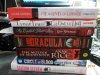
To add to this thread, below are the books I've received this week, with a Halloween slant. You might be interested (the image is bigger if you click on it, btw):

DSCN0097 small.jpg

For me I'm about two-thirds through the Morris, as I said above (and yes, now the horror has started!), but others I'm really looking forward to are the Kim Newman's and the Phil Rickman, which I gather is also a standalone ghost story. Station Eleven is more post-apocalyptical, I gather, but I have heard good things about. And its always interesting to see something from the Hammer Books.

Many thanks to the publishers concerned, of course. Now.. back to reading!!

M.
 
So glad to see this starting again. I look forward to it every year!

Just started reading the 'Drowning Girl' by Caitlin R. Kiernan. Heard a lot of good things about it.


Pat
 
I loved Anno Dracula by Kim Newman. Are the sequels as good?

I'm going to be watching Only Lovers Left Alive tonight. Heard a lot of good things about it.
 
I've read The Drowning Girl in September, and I think it is an excellent choice for a disturbing Halloween read, especially if you like deranged, double personality narrators who can't distinguish between reality and fantasy.
 
I've read The Drowning Girl in September, and I think it is an excellent choice for a disturbing Halloween read, especially if you like deranged, double personality narrators who can't distinguish between reality and fantasy.


Sounds perfect!


Pat
 
I loved Anno Dracula by Kim Newman. Are the sequels as good?
They are a very similar style. Must admit I didn't enjoy The Bloody Red Baron (LINK) quite as much as Anno Dracula, (LINK) but I did like Dracula Cha Cha Cha set in the 1950's and 60's (LINK). Johnny Alucard is set in the 1970's, on the set of Francis Ford Coppola's production of Dracula (see the alternate twist there?) so I'm really looking forward to it.


M.
 
Hi, all.

Thanks for the kind words.

Mark, I hope you like my follow up on both The Lodger and Holmes/Watson: I'll post a discussion of the movie Murder by Decree presently.

I didn't see a book in the stack by Phil Rickman. Which one will you be reading? Just to note, near the end of the month I'll be discussing Curfew (a.k.a. Crybbe). In short, I enjoyed it.

Nechtan, I only heard about that just recently. Please let us know what you think.

Pat, like Algernoninc I enjoyed The Drowning Girl though maybe not as much as I did Kiernan's previous novel, The Red Tree. I look forward to hearing what you have to say about it.

Lastly, read Anno Dracula years ago, enjoyed it greatly (on a par with Alan Moore's graphic novels about The League of Extraordinary Gentlemen) and plan on rereading it before going on to the others.


Randy M.
 
Terror in Film

MURDER BY DECREE (1979; Dir.Bob Clark; starring Christopher Plummer, James Mason, David Hemmings, Susan Clark, Genevieve Bujold, John Gielgud, Anthony Quayle, Donald Sutherland, and Frank Finlay as Lestrade)

Fade in the skyline of night time London, 1888. Shift to the streets: tongues of fog drifting, gas lamps fluttering, Bobbies patrolling, a Hansom cab slowly trawling, clip-clop, clip-clop loud on the cobblestones. One woman rushes along a narrow alley and ducks quickly through a door. Another street, another woman not so quick, that door resisting her efforts as hands stretch out of the dark and grasp her throat, stopping a scream. Cut to: Daylight and Inspectors Lestrade and Foxborough survey a corpse which is shielded from our view, Foxborough composed and serious studying the body, Lestrade distressed and almost ill, looking away.

It’s probable that the Whitechapel murders of 1888 played on Sir Arthur Conan Doyle’s imagination, but to my knowledge Doyle did not directly engage Jack the Ripper in his fiction. Perhaps that is a result of Victorian decorum guiding him away from an unseemly subject or perhaps a result of not wishing his stories to reignite the fear and anxiety caused by murders so close in time to their publication; later artists have been less reticent.

Murder by Decree boasts an excellent cast and an intricate plot concerning the decadence of royalty, conspiracy by members of a (somewhat) secret society, radical insurrectionists using the Ripper murders for their own aims, and Holmes and Watson caught between factions.

Holmes and Watson, aware of the murders, both wonder why the authorities have not asked him to consult. Merchants local to Whitechapel enlist Holmes’ aid, ostensibly concerned for East End women while also complaining that the murders have chased away business, respectable Londoners avoiding the area. Other motives emerge later.

When Holmes arrives at the scene of the murder described above, he is welcomed by the inspectors until the head of Scotland Yard, Sir Charles Warren (Anthony Quayle) appears. Warren calls Holmes an interfering amateur and tries bullying him into ending his investigation, later even going so far as to threaten arrest. Warren was a real historical personage, not well-loved by the working class and poor Londoners for his handling of riots the year previous and eventually forced out of office by the ineffectuality of the Ripper investigation.

When Holmes uncovers a connection between the dead prostitutes and tracks down two who still survive, he learns the reasons behind the murders and the peculiar significance of the wounds inflicted on the dead women, and his findings threaten powerful men high in the government. The movie’s action is capped by the search for Mary Kelly (Marie Kelly in other sources) before the killer can find her and is well-handled but anyone knowing the history will recognize it as the Ripper’s last and most brutal murder which subsumes the terror of what might happen in the horror of what did; Clarke handles this discreetly, implying the viciousness of the attack through sound, dim outlines seen through dirty, fire-lit windows and a brief glimpse into the room in which Kelly meets the Ripper.


Murder by Decree was not the first film to pit Holmes against Jack the Ripper. Besides one silent film, there is A Study in Terror (1966) directed by James Hill and starring John Neville and Donald Huston as Holmes and Watson (the cast also including Anthony Quayle and Frank Finlay’s first foray as Lestrade – typecasting, perhaps?). While not a Hammer Studios production, I recall it as having some of the same feel and atmosphere as the better Hammer movies, and John Neville as a measured and mellow Holmes compared to the energy of previous actors like Basil Rathbone and Peter Cushing. Though it has been several years since I last saw it, I remember enjoying A Study in Terror and thinking it underappreciated. Tangentially, a novel based on the movie, written by Ellery Queen (or one of the writers Frederic Danay and Manifred B. Lee often hired to write their later novels) featured a document by Dr. John Watson (according to queen.spaceports.com, apparently written by Paul Fairman) wrapped within an Ellery Queen case.

A few years after directing Murder by Decree its director, Bob Clark, became famous for producing and directing two movies, Porky’s and A Christmas Story.

Yes. Porky’s, the success of which financed A Christmas Story.

Anyway, Clarke had already made two well-regarded horror movies on the cheap, Children Shouldn’t Play with Dead Things (1972) and Black Christmas (1975; proto-slasher movie that pre-dates and is said to influence John Carpenter’s Halloween), so he came to the material with experience handling horror elements. The question was, could he handle Holmes and Watson? The casting of Christopher Plummer as Holmes and James Mason as Watson was a masterstroke. Plummer, like John Neville, gives a less stagy performance than most previous actors, his Holmes quick to observe and energized by his observations. Mason imbues Watson with the decency one would expect, but also a dignity few previous film Watsons muster and which he sustains even as comic relief. Plummer avoids the moments of condescension that appear in some Holmes movies, and both actors emphasize Holmes and Watson’s regard for and trust in each other, making this movie a harbinger of the BBC Sherlock Holmes series (which ran approximately 1984-1994), and of more recent adaptations from House to Sherlock and Elementary in which the complexities of the Holmes/Watson relationship assume an importance equal or nearly so to that of the adventures.

What could have devolved into a bloody horror movie treads carefully between depicting a friendship, real-life horror and speculating about power and corruption, using Holmes and Watson as the pick and shovel for unearthing it all. The film also acknowledges the Whitechapel murders as a point of engagement in England’s class struggles, yet I think it reasonable to say that Holmes’ meetings with the radical element and in particular his final confrontation with those in power who wish to suppress the full story, stamp this as a post-Watergate film.

As mentioned in the entry on The Lodger, Jack the Ripper is the one monster we inherited from the 19th century based on a historical figure. While inspiring some serious researchers he has also drawn many who spin theories that frequently serve no purpose except aggrandizing themselves. It’s hard to say which group the following fits in: In the 1970s the theory of government conspiracy and Free Mason involvement behind the murders became popular. The theory gained currency though the evidence was circumstantial at best, but that’s no reason for creators of fiction like Clarke and his script writer, John Hopkins not to tap into it. The end credits state that the movie is based on (then) recent theories, its main source The Ripper File by John Lloyd and Elwin Jones. According to the appendices of From Hell, a graphic novel by Alan Moore, the Lloyd and Jones was one of a deluge of books that appeared in the late 1970s and early 1980s, probably anticipating the hundred year anniversary of the murders (in “Appendix II . The Dance of the Gulls” Moore skeptically and often gleefully recounts the macabre history of “Ripperology”).

I haven’t read The Ripper File, but shortly after publication and largely because of respectful reviews in several national periodicals, I did read former police sergeant Donald Rumbelow’s The Complete Jack the Ripper (which Moore cites as a source in his endnotes). For most of its length, The Complete Jack the Ripper is a matter-of-fact and well-researched recounting of the murders, placing them in the context of the society and the times, and includes information not widely available previously because Rumbelow had access to Scotland Yard’s case files. What stays with me, in spite of Rumbelow’s non-sensational approach, is the chapter in which he recapitulates the murder of Mary (Marie) Kelly; this remains one of a handful of readings to leave me shaken for some time after closing the covers, and has made me wary of fiction downplaying the viciousness of the murders: It is easy to romanticize the Ripper when ignoring or glossing over the details of his crimes.

That said, the focus of Murder By Decree is on the Holmes and Watson relationship, their investigation, and the skein of possible motives behind the murders. For me that somewhat mitigates shying away from the ferocity of the crimes; in this fictional world the viciousness of the Ripper unveils an equivalent disregard for life in the callousness of those seeking to suppress the story or to use the murders for their own ends. Further, Plummer’s portrayal conveys much of the horror of the events, humanizing the thinking-machine through showing a gradual evolution of Holmes’ good-humor and excitement in the puzzle into near incredulousness and open anger as he perceives the extent of what he has uncovered, and indignation and sorrow over the final events. These elements lend the movie a seriousness most Holmes and Watson movies lack.

I commend Murder by Decree to anyone who enjoys Holmes and Watson, and to those interested in a fictional use of the Ripper murders that does not dwell long on the gory details. For readers with stronger stomachs, I recommend Rubelow’s history; and, too, Alan Moore’s From Hell (not the diluted movie version) for its use of speculations similar to those in Murder by Decree but in a more expansive story that includes endnotes citing sources and detailing what is fact, what is extrapolated from fact and what is fictional fancy. But I warn you, for all that this is comic book art, the murders are viewed with unflinching directness and the section portraying Mary Kelly’s murder does not skimp on detail and is all the more disturbing for explicating the murderer’s (speculative) reasoning behind the assault.

Of interest featuring Jack the Ripper:
A Night in the Lonesome October by Roger Zelazny
[An enjoyable, charming fantasy in spite of my resistance to its portrayal of Jack. I noticed a new edition of this in a local bookstore just this morning.]​

Of broader interest:
Thomas Burke: “The Hands of Mr. Ottermole” (from The Best of Thomas Burke; The Golden Gong and Other Stories)
Ray Russell: “Sagittarius” (from Haunted Castles
Harlan Ellison: “The Whimper of Whipped Dogs” (from Deathbird Stories)
Vincent Bugliosi: Helter Skelter [non-fiction]
Robert Bloch: Psycho & American Gothic


Wednesday: Shadow of a Doubt
 
Last edited:
They are a very similar style. Must admit I didn't enjoy The Bloody Red Baron (LINK) quite as much as Anno Dracula, (LINK) but I did like Dracula Cha Cha Cha set in the 1950's and 60's (LINK). Johnny Alucard is set in the 1970's, on the set of Francis Ford Coppola's production of Dracula (see the alternate twist there?) so I'm really looking forward to it.


M.

Cheers Mark. I'll definitely be adding them to the ever expanding wish list.
 
No problem, Nechtan: hope you enjoy them!

Randy: I didn't realise that the director of the original Black Christmas was also the director of Porkys.... I've learned something.

I've also just bought a copy of the Zelazny, which I've wanted for AGES but has been sadly out of print for a long while. Secondhand copies also were horrendously expensive. Thanks for the heads up. (Knew it wouldn't be long before I bought stuff..... :) )

And Christopher Plummer and James Mason.... I do remember it vaguely from UK TV in the 1980's, but little else. Looks like it's worth a rewatch!

The Phil Rickman is called Night after Night. It's a standalone, involving strange goings on and reality TV, evidently. (Sounds a bit like Stephen Volk's GhostWatch, if anyone remembers that.) Due out October 30th. I did like Crybbe when I read it in the 1990's. Might have even been my first Phil Rickman, actually. It isn't in that photo, sadly, except for at the very bottom: my haphazard photo skills missed it off the bottom of the picture. *embarrassment*

M.
 
Last edited:
Hi Randy. You asked me about Only Lovers Left Alive. I did type up an answer but then I lost it when I previewed my reply. Not sure if it's a problem at my end or a glitch at SFF world. I'll get you a better answer tomorrow. I really got to sleep just now!
 
Hi Randy. You asked me about Only Lovers Left Alive. I did type up an answer but then I lost it when I previewed my reply. Not sure if it's a problem at my end or a glitch at SFF world. I'll get you a better answer tomorrow. I really got to sleep just now!

Look forward to it, Nechtan. Hope the sleep helped.

Mark: Yeah, Clark had a weird, varied career. It's odd that Porky's and A Christmas Story were two of the high-lights. Glad to hear you got the Zelazny. Every time I try to describe it the best word I can come us with is, charming.

Murder by Decree is a favorite of mine. At a time when Holmes/Watson were somewhat in eclipse, relatively few pastiches/adaptations in the pipeline, it was good example of what can be done with the duo.

I also look forward to what you have to say about the Rickman. Curfew is the first thing I've read by him and I'd like to read some more.


Randy M.
 

Sponsors


We try to keep the forum as free of ads as possible, please consider supporting SFFWorld on Patreon


Your ad here.

Latest posts

Back
Top