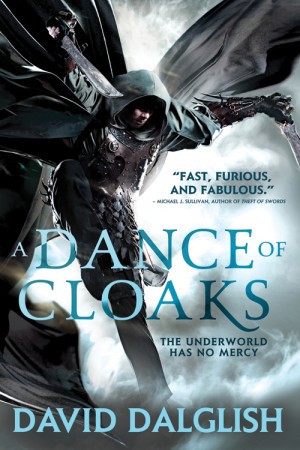
 A Dance of Cloaks by David Dalglish
Published by Orbit, October 2013
ISBN: 978 0 356 50278 6
452 pages plus extras
Review by Mark Yon
In Veldaren we have different guild factions of tradesmen and women: the Ash, the Spiders, the Serpents, the Wolves, the Hawks and the Mantis Guild. Currently the person holding an uneasy truce between the underworld Guilds, King Vaelor and the three families that make up the city’s Trifect is Thren Felhorn, the leader of the Spider Guild of assassins and generally recognised as the greatest assassin of his time.
In this tale of underworld assassins, rooftop chases, secret passages, devious schemes and counter-schemes, young clandestine heroes, hissable villains and anti-heroes we are pitched at a pretty fast pace from the start.
As a debut book in the series, A Dance of Cloaks is a ‘setting-out-the-stall’ kind of book, where the reader is introduced to characters and places that it is clear will all be developed later, and undoubtedly with paths that will cross at some point. There are quite a few different characters to follow here, some major, others minor, but who may become more important later. Of the families, much of the plot deals with the life-changing events around two main characters. In the Trifect group, Alyssa Gemcroft, is the main heroine, the heir to the Gemcroft family fortune, used as a political device by her father Maynard, available for marriage to the right suitor. As you might expect, she rejects this.
Similarly, in the Guilds, the main plot revolves around Thren’s young son, Aaron, who is being trained to contribute to the family business, but who dislikes his father’s methods of teaching, and rebels against it also.
Thren himself has issued a challenge: in an attempt to secure his position and end the long-lasting battle between the guilds and the city, at the upcoming gathering in the city of merchants, family members, and servants, the Kensgold, he will kill the three heads of the Trifect.
Behind it all we have a religion: the priests of Karak in the religion of Ashur, with a renegade group of ‘disgraced’ women, the faceless, who become involved in protecting Alyssa against the priest’s wishes.
As with a lot of Fantasy novels, the core of the book seems to be the numerous ethical dilemmas that drive the plot. It is a tale where moral consequences are at the forefront. Characters pick impossible choices in difficult situations, sometimes correctly, sometimes otherwise.
It’s all rather reminiscent of Old-School Fantasy. A little less ‘grimdark’ than many recent novels (although there is a fair degree of throat cutting and stabbing, it must be said), it rather reminded me more of Jon Sprunk’s Shadow series than, say, Joe Abercrombie’s First Law novels.
Whilst the characters are nothing really new, and the plot admittedly rather generic, this is a book that revels in, and can be enjoyed for, its familiarity. With such a book, a reader does not need to spend time wrestling with deep concepts or revelatory stylistic touches. Readers can be assured that what they expect is what they get, to enjoy the plot developments as they happen, feel engaged with a story that uses straightforward language and enjoy a tale that basically is done well. Its purpose is to entertain.
Where the book scores particularly well is in its pace, which is energetic from the get go, and in the battle scenes, which are surprisingly fluid and well written and add to the already mentioned frenetic pace. David’s script reads as if he’s been writing this stuff for a long time (this is not his first series), and the pages turn quickly as a consequence. (His pleasingly honest Afterword suggests that the writing may not have been as effortless as it reads.)
By the end, it’s an engrossing read that will leave the reader wanting to read the next one very soon. It’s probably a good thing that the next book in this proposed series of six (A Dance of Blades) will be published a month after this one: not much longer after this review appears. I suspect many readers will want the next one as soon as possible.
Mark Yon, October 2013