 After four crime novels Rod Duncan switched to fantasy, and is currently writing a series of alternate history books, called ‘The Fall of the Gas-Lit Empire’.
First of all for those not familiar with The Fall of the Gas-Lit Empire series, can you tell us a bit about the world you’ve created?
The Fall of the Gas-Lit Empire follows the adventures of private investigator Elizabeth Barnabus as she ekes out a living in what appears to be Victorian England. But this is an alternate history in which the country has been divided long ago by a revolutionary war. Something has stalled the industrial revolution. The year is 2009 but technology has not progressed beyond the age of steam. This is the Gas-Lit Empire. But as the series title suggests, the tide of history is about to turn.
Unseemly Science is the second book in the series, what can your fans expect?
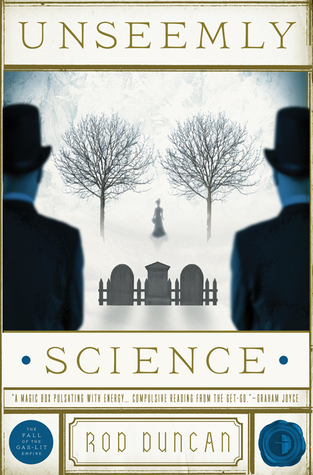
Unseemly Science continues where The Bullet Catcher’s Daughter left off. I can promise the return of some characters from the first book. And the introduction of new ones. Look out for Yan Romero, the lawyer. I had fun writing him. But this story will take Elizabeth into colder, darker places. There will be lots of ice and there will be some deeply macabre scenes.
Elizabeth Barnabus, a private detective living a double life. Can you give us some insight into your main characters?
Elizabeth was born in a travelling show. Her father was a master conjurer. From him she learned a deal of trickery, which she puts to good use in her adventures. Among the illusions he taught her was the art of appearing to be her own twin brother. Thus, in the restrictive world of the Gas-Lit Empire, she is able to travel to places usually barred to women. The corset and the binding cloth each focus different aspects of who she is and project them to the world.
How do you feel your characters have evolved since the first book?
All characters develop as you write them. I am particularly aware of this with some of the secondary figures in the book. For example, we see far more of Elizabeth’s student, Julia Swain in this novel. In truth, she is now more of a friend than a student. She plays a part in Elizabeth’s investigation and we learn more of her character. We will also get to see a new side of Mrs Simmonds, the lock keeper’s wife, and Mary who lives on the coal boat.
What is it with Steampunk you find fascinating?
The high Victorian aesthetic and its technology definitely appeal to me. It is also a fascinating period because so many of the ideas and social movements which would later come to be familiar (for good or ill) can trace their roots back to that time. Writing this kind of fiction gives me the chance to play with history. What would happen if I made this little change a couple of hundred years ago? How would things play out? That kind of thought experiment is one of the joys of alternate history.
How do you develop your plots and characters? Do you use any set formula?
Place suggests character. Character suggests plot. Plot and place inform the development of the characters. It all feeds around a circle again and again. But underlying the process is an understanding of the norms of traditional story structure. Descriptions such as the Hero’s Journey, three act structure and Freytag’s Triangle all contribute to the way I look at plot.
Have you ever struggled between what you would like to happen to a character and what you considered more sensible to occur? Can you tell us when and what did you do at last?
Writers sometimes plan the things that they want to happen for the benefit of the plot but then discover that the characters won’t cooperate. For example, you get your characters to a haunted house and want them to say ‘Let’s split up.’ That way you can have them picked off one-by-one. But something in the back of your mind tells you they wouldn’t really behave that way. So you find you can’t write it.
That kind of thing has happened to me before. But not recently. I’d like to think I’m getting to know my characters better. But they’re probably just lulling me into a false sense of security.
How did you start writing? Was there a particular book or moment in your life that spurned you on?
I always told myself stories. But I couldn’t write them down. Writing was a problem for me because of my dyslexia. The big change came when I learned to type. That, combined with the development of the word processor, removed the barrier. It was as simple as that. I started writing in 1992 and haven’t stopped since.
Who or what has influenced your writing, and in what way?
I couldn’t read well enough to pick up a book for pleasure until I was in my teens. But before that, my father read stories to me. Looking back, that was my biggest influence. He was into science fiction, fantasy and Sherlock Holmes. So those were the stories I got to hear. I think it probably shows in what I write now.
What sort of challenges, as a writer, might you have faced over the years? Any insights you would be able to share for those aspiring writers seeking advice?
Anyone who’s tried will know that writing a novel is a long journey. I wrote several before I’d developed my craft enough to secure a publishing deal. So I guess some combination of irrational degrees of determination and enjoying the process are fairly important. One thing that helps with both those is the company of other writers; giving and taking feedback, sharing the journey, taking pride and enjoyment from each other’s successes. If you can find friendly writers who share those goals, hold on to them.
For your own reading, do you prefer ebooks or traditional paper/hard back books?
I prefer physical books. But eBooks are really useful. I would not like to be without either.
What kind of books do you read, any favourite authors?
I avoid reading anything close to what I’m writing at the time. That’s because I don’t want to have to worry about where my ideas came from. I also find my narrative voice can be influenced by immersing myself in similar work. That would be a problem because my style would drift.
Reading is still hard work for me, so I don’t usually attempt doorstep books. For the same reason, there are a lot of books I’ve started but not finished. Other than that, I read an eclectic mix. It might be Dylan Thomas one day and Martin Cruz Smith the next.
What do you do when you’re not writing, any hobbies?
I love to walk in the hills when I’m not writing. And I watch movies to relax. If I can round up some volunteers I enjoy playing board games. Oh, and my camera – I am on a black and white photography binge at present.
What’s next, what are you working on now?
Right now I’m working on book three in the Fall of the Gas-Lit Empire. That is called The Custodian of Marvels. There are also a couple of collaborative writing projects bubbling away in the background. They are both screenplays – which means they might never get an audience. But I get a creative kick out of working with other writers. I also learn a huge amount from them. In the last analysis, nothing you write is ever wasted.
* * * * * * *
Interview by Dag Rambraut – SFFWorld.com © 2015