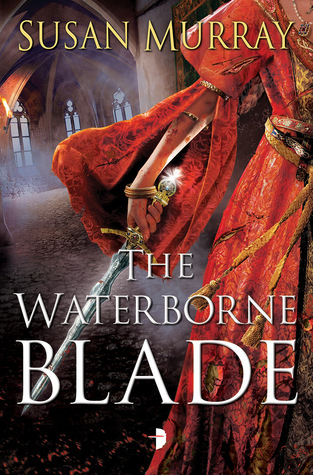
 Susan Murray has just released The Waterborne Blade, the first book in her new epic fantasy series, Waterborne.
First of all can you tell us a bit about your new novel, The Waterborne Blade?
The Waterborne Blade centres on a pampered queen who’s been uprooted from her privileged world and her struggles to adapt to this situation while coming to terms with growing telepathic powers.
Can you give us some insight into your main character, Queen Alwenna?
At the beginning of the novel, Alwenna is a fairly uptight character. She’s learned a lot about putting duty before her own inclinations – this is the flip side to the comparative ease of her upbringing in a royal household. She’s very self-controlled, which is both a strength and a weakness in her character. It might have made my job a lot easier if I’d made her loud and opinionated, but I wanted to explore a character who was ‘strong’, without that strength necessarily being exhibited in an overt, obvious way.
How did you come up with the idea for this series?
The initial spark for the story came from a short writing exercise during a creative writing module taken as part of my Open University degree. I developed the exercise for a short story intended for a student anthology which didn’t get off the ground. By then I was pretty sure it had the potential to be a novel so I set out to test that theory.
What goals might you have set for yourself when writing The Waterborne Blade and how do you feel about the end result?
I studied two creative writing courses as part of my degree. After the first course I realised I was playing it safe by reworking old material for assignments – decades-old in some cases – rather than venturing out into unfamiliar territory. By the end of the second course I was pushing myself to create and develop all-new material, which proved far more satisfying – the first of those short stories is available at present in the Holdfast Anthology 2013-14. With The Waterborne Blade, I wanted to apply that learning to completing and polishing a novel-length piece of work, largely to see if I could. The resulting novel has secured me representation by a literary agent and a publishing contract, far exceeding my expectations.
What is it with Fantasy you find fascinating?
As a reader I’ve always enjoyed exploring other worlds – worlds that are demonstrably not the one we inhabit, whether through the introduction of fantastical elements or future technology. Fantasy lets the story occupy a broad canvas, where the stakes are high and the consequences of an individual’s actions can be far-reaching. At the same time it lets us explore human nature and our own world through a magnifying lens, permitting an often intimate focus without the distractions of modern technology and mega-corporations.
How did you start writing? Was there a particular book or moment in your life that spurred you on?
The pivotal moment for me was completing my Open University degree in my late forties. I’d been scribbling away for ever, intending to work at it properly one day and I realised if I hoped to achieve anything with my writing I needed to make it happen. I started submitting short fiction for publication and began working in earnest on The Waterborne Blade.
What sort of challenges, as a writer, might you have faced before your first book was published? Any insights you would be able to share for those aspiring writers seeking advice?
There seems to be a consensus that once one novel’s out of the door it’s time to start on the next. With the benefit of hindsight, I would agree this is excellent advice. I initially hung back to have the benefit of editorial feedback before drafting the sequel. This was a mistake – I could have completed the first draft with time to spare. As it was, my publishers went into a brief hiatus shortly after acquiring my novel as the holding company put the imprint up for sale. It was difficult working on a novel which possibly no longer had a home but even more difficult finishing that novel later while editorial notes and copy edits flew back and forth for the previous book. Financial considerations aside, you learn from every piece of work you complete, so it’s worth pushing forward on those grounds alone.
What is the hardest thing about writing?
For me, it’s keeping the self-doubt at bay long enough to get the words onto the page. Once a first draft is complete, it can be edited with the overall story shape in mind. It’s so tempting to go over the previous day’s output and start tinkering with language and minor details – that’s how I have folders stuffed with opening chapters of unfinished work. It takes an odd combination of stubbornness and blind faith to get a project back in motion when it stalls, but an unfinished story is no use to anybody.
How do you develop your plots and characters? Do you use any set formula?
I don’t work to a set formula, although I do find it useful to think in terms of a 5-act structure overall (I found Yorke’s Into the Woods illuminating for this). When developing new characters I often find it useful to freewrite from their point of view, to get an idea of what makes them tick and what matters to them. I tend to brainstorm plot ideas and use mind maps to keep track of them, but I don’t create a rigid outline, preferring to let events develop organically once characters are set in motion.
Can you tell us a bit about the process that led to The Waterborne Blade being published?
I met both my commissioning editor and my agent during one-to-one sessions at the Festival of Writing in York – a year apart, as preparing the synopsis for the early draft convinced me a substantial rewrite was needed. Knowing this, the editor asked to see a partial when it was completed. A year later with the novel complete I spoke to three agents at the festival, one of whom was enthusiastic about the project and requested the full manuscript. After he’d had the full for a few weeks I assumed the worst, sent off the partial to the editor and started researching other agents. When Angry Robot requested the full I sent the agent an update, then everything seemed to happen at once after that. Some people are cynical about one-to-one sessions, but you can learn far more from a brief chat with industry professionals at such events than you can from a form rejection.
For your own reading, do you prefer ebooks or traditional paper/hard back books?
Traditional paperback books, all the way. I like the element of spatial awareness they allow – you know how far through the book you are, and it’s easy to flick back a few pages to check something in the previous chapter, or see how close you are to the end of a chapter. And they’re so tactile – pages were made to be riffled.
What kind of books do you read, any favourite authors?
These days I read far more fantasy than science fiction. Perennial favourites are Robin Hobb and John Wyndham. Of late I’ve been branching out into other genres and discovering authors who are new to me but have become must-reads, such as Lauren Beukes, Sarah Lotz and Sarah Pinborough.
What do you do when you’re not writing, any hobbies?
In recent years hobbies have taken second place to house renovation and writing, but I enjoy reading (essential for a writer), gardening (in a lazy way), walking with our dog, and sewing, particularly cross-stitch and needlepoint. I can’t knit.
What’s next, what are you working on now?
I’ve just handed in the sequel, Waterborne Exile, to my publishers. Having taken a few days to catch up with real life – and attempting to follow my own advice – I’ll shortly be starting work on the third title in the trilogy. After that there’s a shiny new idea for another fantasy novel demanding attention and I’d like to work on a few short stories as a refresher.
* * * * * * *
Interview by Dag Rambraut – SFFWorld.com © 2015