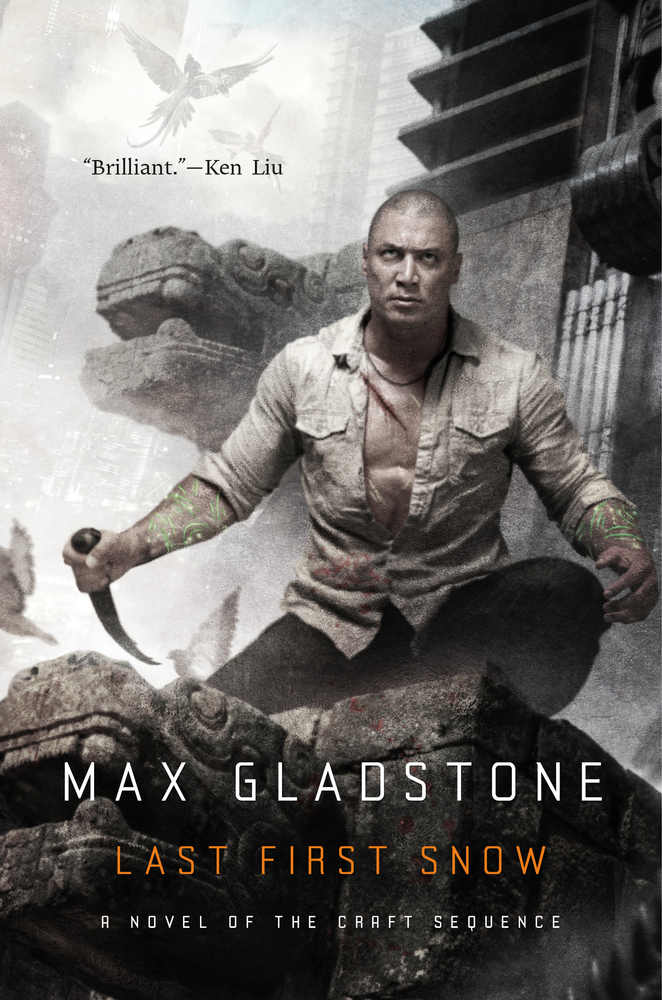
Last First Snow is sequentially first and publicationally fourth. Why are you trying to confuse you readers, Max with such a chronology?
Because I am a wicked, wicked man. Also because readers are smart! They know that you’re probably “supposed” to read books as they come out. I tend to assume my readers are brilliant, and it’s worked out okay for me so far.
One thing I noticed in both Last First Snow and Three Parts Dead is that early in the novel, one of the main characters falls to the earth. Was this a conscious mirroring or did the plot just demand this?
I hadn’t noticed the parallel, because the contexts are so different—but falling is a great entry point into a story, isn’t it? The character, like the reader, tumbles toward a strange new world, in crisis and confusion, and slams into some context she then has to deal with. The Satanic Verses starts with a fall, and so does Paradise Lost after a fashion, so there’s precedent. (Speaking of historic falls—Planet of the Apes!)
Four published books into this series, has anything changed about the world you initially revealed in Three Parts Dead?
The world’s grown subtler and more complicated. The initial structure I laid out in Three Parts Dead was big, bold-colored, accessible—painting a universe in broad strokes. Later books developed, broke open, and inverted structures I introduced in Three Parts Dead. Nothing’s changed, but few things quite mean what we thought they did in that first book.
What would the Max Gladstone who is set to see Last First Snow publish say to the Max Gladstone who was still writing Three Parts Dead?
Enjoy this. You’re in for a wild ride.
Does reverse or non-linear chronology allow you more freedom in terms of world and character backstory, or does writing the stories out of order make it more difficult for details you hinted at in the first published (Three Parts Dead) book match with the second chronological book (Two Serpents Rise)?
A bit of both. Since the books aren’t causally connected—that is, they’re not direct sequels or prequels to one another for the most part—I have a lot of freedom to explore new corners of the world and strike out in weird directions. Still, I want readers to feel continuity from book to book, so I have to bring in characters and situations from other stories—which means working to make sure I don’t contradict myself.
Your world is quite complex, in terms of depth, flavors, and influences that went into and continue to go into it. Did the world form first in your mind or did the characters force the world-building?
Thank you! In this case, the world came first—when I started Three Parts Dead I didn’t exactly have an encyclopedia of the Craft Sequence to hand, but I had spent the previous few years grinding my first intimations of this world into a conceptual lens on bankruptcy and necromancy, law as magic, the death and life of organizations and human communities, the breaking and renewal of the world. The first Craft Sequence characters emerged out of those conflicts. As the story progressed, they grew deeper and more complicated, and fed back into the world. At this point the circle’s complete: world leads to character leads to plot leads to world leads to character and so on.

You’ve been lucky with the covers Chris McGrath has provided for your books; not only are they striking images, but there’s no whitewashing and each cover manages to provide insight to the diversity and wonder of your books. How important do you think cover art is in general and do you think McGrath’s imagery has helped your books?
Cover art is life. Art and design—and all the other sub-arts people talk about as “book packaging”—bring the reader into the story. They prime reader expectations, and present the particular book and the genre in general both to core readers and the wider public. (Think about deckled edges—yes, they’re sort of goofy and impractical, as Hank Green’s pointed out, but by evoking the bad old days when readers had to cut open the pages of their books themselves, they inspire a bit of subconscious awe even in readers who don’t know that history! This is a real book, they think as they struggle to turn the pages.) Whitewashing in cover design is such a big problem because of the message it sends about who is, and who is not, present, or welcome, in our weird conceptual playground.
I have been really fortunate in Chris McGrath’s covers. He has a great eye for character and expression; when I first talked through the cover for Three Parts Dead with Tor, I was really nervous about what we’d get—I had visions of bare midriffs if not skull bikinis—and Chris just knocked the Three Parts Dead cover out of the park. Combined with Irene Gallo’s amazing creative direction on the project, we ended up with a book—four books, now!—that I love holding in my hand.
One of the true signs that a SFF writer has arrived is that his or her work has its own TVTropes page. Do you take a look at anything of that nature of fan speculation about your world & work or is that too dangerous a path for a writer to walk?
I could tell you I haven’t read every subpage on that TV Tropes link, but I’d be lying. I love fan work—it’s the sincerest form of flattery. Fan art and TV Tropes and the like show people engaging creatively with my books. I came out of fanfic and roleplaying communities—especially the Electric Ferret forums and alt.starfleet.rpg—and I grew up with tabletop roleplaying, so I absolutely get the desire to immerse myself in another person’s world. A few friends have put together tabletop RPG adventures set in the Craft Sequence, which are a hell of a lot of fun to play. There are even, I’ve learned recently, a few piece of Craft Sequence fanfic on AO3; I haven’t read those yet, out of a sort of superstitious concern, but I don’t know if I’ll be able to resist forever.
Is it dangerous? I mean, yes, if you think fan work is about you in some way—it’s not, it’s about the fans—or if you feel compelled to respond and participate. But if you don’t work yourself into a tizzy, it can be enormously cool.
A couple of months ago it was announced that you would be writing a Pathfinder novel – how familiar are you with Golarion and how integral was playing RPGs to your development as a writer/storyteller?
I’ve been a tabletop roleplayer since way back—I devoured AD&D sourcebooks in Nashville’s Davis Kidd bookstore (of blessed memory) long before I had anything so quotidian as friends to play the game with. I still buy weird-shaped dice whenever I can, out of a fear they’ll stop making them. (I didn’t have a game store anywhere nearby when I grew up.) I read a decent chunk of game world fiction, too, especially the early Dark Sun books, which impressed the hell out of me with their Bad-Guys-Win postapocalypse fantasy aesthetic. I don’t play as much as I once did—I love game mastering, and I’m pretty damn good at it if I do say so myself, but it takes the same resources as writing—but I still have a damn respectable collection of sourcebooks.
I’m newer to the Pathfinder universe, but I’ve been steeping in its mythology, reading novels and worldbooks to catch up. Golarion walks a fun, fine line, reveling in the core tropes of the great old gaming worlds while expanding into new territory. For me, writing a Pathfinder novel is an opportunity to participate in a particular sort of epic fantasy conversation—I haven’t built a fantasy world that contains elves and dwarves and hereditary nobility and Vancean magic, for example, but I do have things to say and stories to tell about elves, dwarves, hereditary nobility, Vancean magic, and so on, and this is a perfect opportunity to play with those toys.
You’ve published some short fiction on Tor.com, as well as some very interesting and thought-provoking musings on popular culture both at Tor.com & on your blog. Will you be gathering these shorter pieces together in an anthology?
I’d love to! I don’t have any clear plans for that at the moment, since I’ve been buried in book drafting, but—watch this space!
How would you pair each of your books with a Beer, Wine or Meal?
Three Parts Dead – A brisk, refreshing Czech pilsner.
Two Serpents Rise – Jack’s Abby Smoke and Dagger, mostly for the name.
Full Fathom Five – I had a homebrew rice wine in China that tasted roughly like 7-Up and I discovered, several pints in, was actually about 40 proof. That made for an interesting evening. That’s Full Fathom Five.
Last First Snow – Goose Island Bourbon County Stout—bourbon barrel aged imperial stout, 14.2% abv. Do not step to this beer. It will end you.