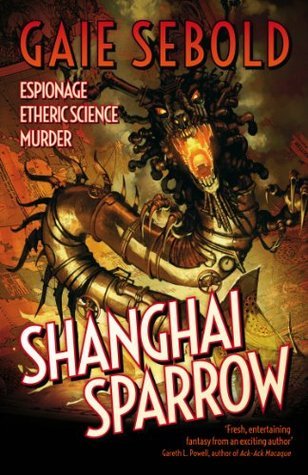
We have talked to Gaie Sebold, author of the Steampunk novel Shanghai Sparrow.
First of all can you tell us a bit about your book, Shanghai Sparrow?
It’s my first attempt at Steampunk. It’s on the grimy end – fewer pretty clothes and more grinding poverty, but it does have high adventure, magical creatures, and, of course, airships. Indiana Jones meets Mayhew, if you like.
Can you give us some insight into your main character, Eveline? She seems like a very strong character even when the odds are against her.
The central character of my other series, Babylon Steel, is very physically strong – it was interesting to write someone who is young, undernourished and has to rely entirely on wits and quickness rather than strength and training. Eveline went from a stable, loving childhood home to life on the streets, and although she’s a survivor, she’s got emotional scars and quirks as a result of that experience which are now an essential part of her personality.
I feel there are two important parts that sets your story apart from others, and that’s Etheric Science and The Folk. Can you tell us a bit about both?
My take on Etheric Science was inspired by The Ethocentric Museum, an odd and delightful performance/installation by Ray Lee that was on at the Battersea Arts Centre in 2012. I’ve just rewritten two paragraphs about eight times trying to describe it, so suffice it to say – it incorporated the idea of sounds that could inspire emotions, and if he does it again, go. It’s fabulous. And sort of dieselpunky. And very weird.
As to Faery – I’ve always been fascinated by the idea that the world of Faery lies just across the stream or under the hill, close enough to touch. To some extent I’m drawing on the original British Isles mythology, which is often pretty dark. The inhabitants of the other world may sometimes be charming – but Hannibal Lecter could be charming, too. And I’ve added twists of my own because that’s half the pleasure of writing fantasy.
What is it with the Steampunk genre you find fascinating?
I like the opportunity to reimagine this particular era. I know some people see Steampunk as glorifying the British Empire and all that goes with it, and perhaps in some cases that’s true, but there’s also Steampunk which has nothing to do with the British Empire (there’s plenty of excellent American steampunk, not to mention Russian) or which comes at the idea from a completely different direction. For me, the genre allows one to mess about with the crossover of science and magic in a way that seems to work particularly well in that setting.
What inspired you to write this story?
My publisher was interested in doing another series, and I was tossing some ideas about, and had been reading steampunk on and off for the last few years. And of course there’s our current government, who seem to be doing their damnedest to return us to some of the worst aspects of the Victorian age, demonising the poor and sick and anyone they decide is morally questionable, while behind the shields of power and money they’re some of the biggest thieves and liars going. Part of the inspiration was undoubtedly a chance to talk about that in a fictional setting.
Can you tell us a bit about your other series, Babylon Steel?
Babylon Steel’s eponymous heroine is a former sellsword and servant/avatar of a goddess, now working as a courtesan in the city of Scalentine. In the first book in the series she is trying to track down a serial killer when her past catches up with her, in the second she is working as bodyguard to a controversial government figure in a country on the verge of civil war. The books have (I hope) quite a lot of humour in them, but they deal with serious subjects – sex-positivity, sexual self-definition and the misuse of power among them.
How did you start writing? Was there a particular book or moment in your life that spurned you on?
I couldn’t narrow it down to a particular moment – I’ve been writing almost since I could read, so that’s getting on for half a century. Ouch. The much-mourned Terry Pratchett was definitely a huge influence, though, among others. He really opened me to the idea that you could write about serious things and have fun while you did it. Even if you know you can never match up, I think it’s hugely important to have a standard like his to aspire to.
What sort of challenges, as a writer, might you have faced over the years? Any insights you would be able to share for those aspiring writers seeking advice?
I suppose I have had some challenges, but no more than most writers and a lot less than some. I was lucky enough to be born into a family of readers, and got a decent education and access to as many books as I wanted. Writing wasn’t really seen as a viable career, and that wasn’t dreadfully helpful, but then, I’m stubborn. I’ve been fortunate enough to only have minor health issues.
I lived alone for a long time, and writing isn’t the most social of activities, so I did spend some time feeling pretty isolated. Friends who support you are a lifeline, whether they write or not – but writing friends understand just why we’re having furious arguments with the voices in our heads. I’m very lucky in that my partner also writes so we can have a good old moan to each other when things aren’t working and a mutual cheering section when they are.
I guess that would be one of my main pieces of advice to aspiring writers – seek out support. A good critique group can be pivotal – as well as improving your writing it could introduce you to friends for life. Be prepared to go for a group that will actually be honest with you, because that’s what it’s for – but if you don’t get on with their style, look for another or start your own if you can.
Other advice would certainly include read a lot, and write a lot. Get critique from a group or other people you trust – and whom you trust to be honest, even if it hurts. (Yes, I’m saying this twice – it’s that important!) Be prepared to rewrite, and edit, and rewrite, and edit some more. Be prepared not to sell your beloved first novel, or second, or third – as soon as you’ve finished polishing and submitted one, I’d strongly suggest working on another. Apart from anything else it gives you something to take your mind off waiting.
I could go on but there’s a huge amount of good advice out there – the Absolutewrite.com forums are an excellent resource. If you like your advice with a large heaping of inventive rudery, try Chuck Wendig (terribleminds.com). Good books include Writing the Breakout Novel (Donald Maas) and Techniques of the Selling Writer (an oldie but a goodie, by Dwight Swain).
Have you ever struggled between what you would like to happen to a character and what you considered more sensible to occur? Can you tell us when and what did you do at last?
Oh, yes. More than once. I’ve ended up killing characters I really liked because the plot demanded it, and having to excise characters who simply didn’t fit into the eventual story. I have at least one character who turned up for the Babylon Steel series who I adored, but haven’t yet found a place for.
What are your thoughts on good/bad reviews?
Good ones are always a nice ego-stroke, but reviews are for readers, not for authors. I think the whole Amazon situation has complicated things, because more people can comment on books in a very public way than ever before, but I think eventually it will remain up to the reader to find reviewers they like and trust (or alternatively whose tastes they know are so completely opposite to their own that they can use them as a kind of anti-recommendation).
How do you define success as an author?
Earning a living at it would be great, but that’s, sadly, increasingly rare for authors. Personally I feel at my most successful when someone comes up to me at a convention and says, ‘I really liked your book,’ and tells me something they enjoyed about it. I never get tired of that. But I never get tired of being paid, either!
For your own reading, do you prefer ebooks or traditional paper/hard back books?
I’ve only recently started reading many ebooks, and I don’t find much difference in the experience. Ebooks have the advantage that I can carry a lot around with me without breaking my shoulder, and since I may finish a book halfway through a train journey or a holiday, that’s a definite advantage. But I can’t read ebooks in the bath, and they don’t hold memories of the first time you read them the way a physical book does.
What kind of books do you read, any favourite authors?
*Grin* How long have you got? I read fantasy, some sf, crime, romance, contemporary fiction, non-fiction (some for research, some for fun) occasional poetry. Favourite authors include Angela Carter, Stephen King, Robin Hobb, Marion Keyes, Terry Pratchett…
What do you do when you’re not writing, any hobbies?
I garden. I also garden when I am writing (it can be very useful for letting my mind freewheel while I work stuff out) not to mention when I, er, should be writing instead. We grow quite a lot of our own vegetables, and I love to cook and experiment with new recipes. I occasionally do Live Action Role Play (very occasionally, these days).
What’s next, what are you working on now?
I’m working on the edits for Sparrow Falling, the sequel to Shanghai Sparrow. That’s due out in summer next year. I’ve also got a new fantasy series in the works, a steampunk novel in collaboration with my partner, writer David Gullen, and a poetry project. Other things are waiting in the wings. I always feel happier if I’m a few ideas ahead of myself.
* * * * * * *
Interview by Dag Rambraut – SFFWorld.com © 2015