

 Davis Ashura is the author of the Castes and the OutCastes series and a member of our forum. We’ve talked to him about the series and sneaked in a few questions about how he discovered the SFFWorld Forums.
First of all can you tell us a bit about The Castes and the OutCastes series?
Sure. At its heart, The Castes and the OutCastes is a hero’s journey. We have a young warrior, Rukh Shektan, who was raised with a certain moral code, and finds himself forced to confront the truth of his teachings. He lives in a world of seven, segregated castes, all of whom have different physical appearances and magical abilities and cannot inter-marry. Even touching between members of two different castes of the opposite sex is frowned upon. However, the world is slowly dying. For two thousand years, Suwraith, a goddess or demon depending on your viewpoint, has worked tirelessly to see Humanity’s extinction. The only reason she hasn’t yet succeeded is because she’s insane (she has paranoid schizophrenia and all the attendant deficits of such a condition). Nevertheless, she has succeeded to a certain extent. Humanity teeters on the edge with only a few scattered city-states left in the world. The world is in shadow, and the future is in doubt.
In some ways you have mirrored parts of our own world with social divide based on such things as ethnicity and caste. Can you explain a bit why you chose to do this?
The caste system and casteism is as distinct a problem for India as America’s own history with racism. However, casteism has existed for far longer and it could even be argued to be more odious since, in some sense, there might even be a religious basis for casteism. But what if the castes were happy with their status? What if there weren’t lower castes but just castes of different types, with everyone thinking they were equal and everyone believed that their position in the world was just as good as anyone else’s? What if people were moral in the way they were taught. They are genuinely good and generous in many ways, but casteism is the unseen mote in their eyes. Nevertheless, the cities they created are absolutely beautiful; lush oases of culture, music, art, and knowledge? That was what I wanted for my world. Plus, as an Asian Indian, I really wanted to write a story with world building inspired by India. I even pulled words from the language of my birth-Telugu-for words like nanna (father), amma (mother), or ammamma (grandmother but specifically one’s mother’s mother).
How did you come up with the magic system?
Hmm. Tough question. I could admit that I was a bit lazy and just wanted something natural and intuitive, which is true, but over time, it just worked. I didn’t want a select few that could do magic, either through luck of birth or finding some special something. It’s available to everyone. Upon their birth, they have it. The magic, or Jivatma (soul in Hinduism) is inherent to who they are. It would be very democratic, which is why the cities themselves are democratic. But if someone wants to master their talents, which vary based on their caste, then they do have to work. They do have to study. It becomes no different than any other skill.
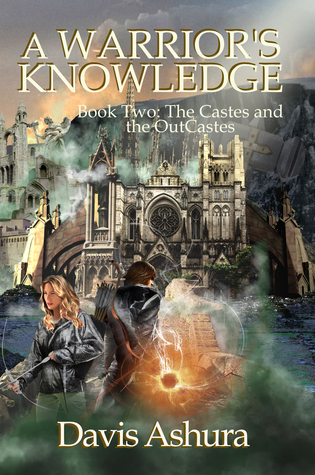
You have earlier this year released the second book in which I believe is going to be a trilogy. How do you feel you as an author have you grown in the process?
I certainly hope I’ve become a better writer. I’m better at plotting and hopefully at other aspects of writing, like narrative flow and prose. At least I’m not just flinging words at the screen like a monkey hitting the keyboard…or at least as much as I used to.
When do you plan to release the final book and can you give us a sneak peek of what to expect?
The final book, A Warrior’s Penance, will hopefully (fingers crossed) be done by early next year. And really the three books aren’t three separate stories. What I wrote was really just a single long story separated into three volumes. That was intentional but it also means that volumes 1 and 2 end on cliffhangers. However, have no fear. All will be made apparent with volume 3. I could simply quote Robert Jordan about a sneak peak. He used say rafo (read and find out), but alas, I’m not popular enough to give that kind of answer. The final book takes place in the bejeweled city of Ashoka with a slow build. However, the final 2/3 of the novel is meant to be non-stop with action, dread, horror, and tension, but I’ll fit time enough for some romance. At least, that’s the intention.
How did you start writing? Was there a particular book or moment in your life that spurned you on?
I’ve wanted to be a writer since I was fifteen. It was an idea that came to me while reading The Belgariad by David Eddings. Don’t ask me why, but Eddings’ homey advice, author’s notes, and interviews about how he became a writer convinced me that maybe I could do it to. It’s why Eddings will always have a special place in my heart. Of course, early on, and by this, I mean many, many years, I never actually finished anything. I started-abandoned more stories than I can remember. Then came the decade of no fun. I had med school, residency, and fellowship to contend with. But after fellowship-with a 2 year old and a 2 week old at home; a new job in a practice I had to build from scratch; a city where we knew no one and had no family-I had time to write (thanks to my awesome wife). I wrote an awful book. It was so bad that it should have been burned. I re-wrote it. And re-wrote it. And re-wrote it. Now it’s just an very bad book, but hey, that’s an improvement over what it started from! Then came a couple of fanfics, a Nanowrimo novel, and by then, I figured I sorta, kinda could take another crack at writing a book and (gulp) ask someone to pay for it.
How do you develop your plots and characters? Do you use any set formula?
I wish I had a formula. Is there one? Please keep me in mind if you find out. Anyway, for me, the basic plot just kinda percolates in my head. It happens while I’m driving, watching TV, or even writing or reading. I’ll write down snippets of scenes, phrases, and even the ending. Then I outline some, fill it in; outline more; fill it in. I keep that process going until I reach the ending. As for characters, they begin on a blank sheet of paper-for whatever reason, I find that world building/character building is easiest with pen and paper-but they often twist themselves, changing until they find their proper niche.
 Can you tell us a bit about the process that led up to the first books being published? How has your experience with self-publishing been?
I was lazy (sounds like a common flaw on my part) about traditional publishing. It seemed like a lot of work, so I made a half-hearted attempt at finding an agent or publisher. And when I was correctly turned down, I turned to self-publishing-or as us cool kids call it: independent publishing. As for my experience, it’s been gratifying and yet also frustrating. First, I never expected the success I’ve had. I haven’t sold enough to afford me to quit my day job, but one of my happiest days was when A Warrior’s Path had sold 100 copies and was listed above both Way of Kings and A Memory of Light in terms of sales for several days in a row on Amazon. And it’s absolutely electric when someone lets me know they like my books, either with a review or a letter.
But here’s the frustration. Because Amazon is so dominant in ebooks, I sell at least 200 times as much on Amazon as I do on other distribution channels. I hate being obligated to one company for sales. Marketing is also a challenge, and something I loathe. I imagine most authors who aren’t already a household name find this to be a slog as well. It’s difficult convincing a skeptical reader to take a chance and give your book a try, but I’m sure it’s a bit harder to have that pitch go over for those of us who are self-published…I mean, independently published.
..and since you are a member of our community here at SFFWorld we also have to talk a bit about that (Nila would probably kill me if we didn’t).
How did you discover SFFWorld.com and why did you decide to join and what keeps you coming back?
I discovered SFFWorld while in fellowship. I was covering the floor and had already seen my patients. My attending was stuck in clinic, so before rounds, I had nothing to do for a few hours. I typed in science fiction forums and SFFWorld popped up. And boy was it wild back in those days ten years ago or more. Gary Wassner, ChrisW, FungKoo, and whole slew of others would argue all the time about what qualified as good fiction, especially fantasy. Gary even started a thread asking if the Bible (and all religious texts) couldn’t be read as fantasy. That set off an ignition. Scott Bakker would sometimes chime in as well, but he was utterly intimidating because even in something like a forum, his intellect was obvious, especially in matters of religion, dogma, and determinism. And I keep coming back here because of the community and the deep knowledge so many here have and are willing to share. Plus, who can turn down a chance to read KaG’s pithy posts?
What is your favourite authors and where’s your favorite place to read?
My favorite authors change with the years of my life. Back when I was young, it was Robert Heinlein, Arthur C. Clarke, and Isaac Asimov (I was much more into sci-fi at one time). Then came Tolkien, and everything changed. He was followed by Stephen R. Donaldson, Terry Brooks, David Eddings, Anne McCaffrey, and PC Hodgell. Then came my “Robert Jordan is the Creator” mode, where everything was measured (and found lacking) against The Wheel of Time. For more modern authors, I really love Martha Wells’ Raksura series. Fantastic non-human characters and a bizarre but irresistible world. Robert V.S. Reddick’s Voyage of the Chathrand reminded me of why I fell in love with fantasy in the first place. Those four books are sorely under-appreciated. And Patrick Rothfuss showed me how lyrical writing should be done.
What do you do when you don’t write, any hobbies?
Other than read? Binge watch shows on Netflix or watch sports. Any sport will do. But if I really had time for another hobby, it would be to build furniture. I love the feel and smell of wood and making a misshapen lump into something beautiful (or at least trying to).
Finally, what are you working on now? Any plans for your next project after The Castes and the OutCastes series are finished?
Right now, I’m hip-deep in book 3, and for awhile, even in book 1 since Nick Podehl, the narrator for The Name of the Wind, just finished the narration on A Warrior’s Path. That just came out, but after The Castes and the OutCastes, I going to pick up that story I’ve re-written five times-the one that should have been burned-only this time, I think I know what to do with it. It’ll be fun, like Chuck (the TV show) meets The Chronicles of Amber.
* * * * * * *
Interview by Dag Rambraut – SFFWorld.com © 2015





Great interview! I look forward to reading A Warrior’s Knowledge.
Awesome. I’m so looking forward to book 3.
I mean, honestly, at some point most of us above a certain age have had a “Robert Jordan is the Creator” phase. I was fully aware of the flaws of WoT when I was reading them, but despite those flaws, STILL nothing compared to that series. And, to be completely honest, not even GRRM broke that for me, but I am absolutely loving Davis’ connected worlds and series of Castes and Outcastes, William Wilde, Instrument of Omens. I love how he spins out characters and how they inevitably find each other life after life. He’s coming closer and closer to that Jordan level for me with each book that he puts out.