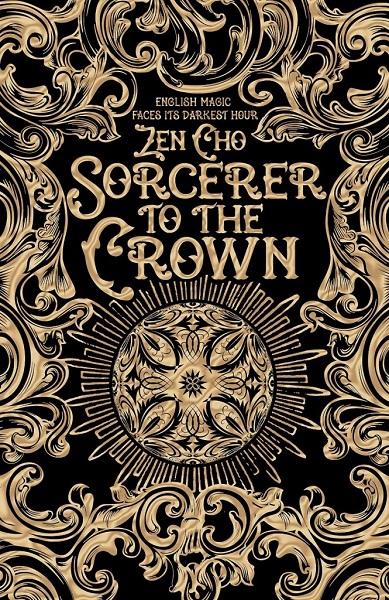
 From the Back Cover:
THE FATE OF ENGLISH MAGIC LIES IN THEIR HANDS
In Regency London, Zacharias Wythe is England’s first African Sorcerer Royal. He leads the eminent Royal Society of Unnatural Philosophers, but a malicious faction seeks to remove him by fair means or foul. Meanwhile, the Society is failing its vital duty – to keep stable the levels of magic within His Majesty’s lands. The Fairy Court is blocking its supply, straining England’s dangerously declining magical stores. And now the government is demanding to use this scarce resource in its war with France.
Ambitious orphan Prunella Gentleman is desperate to escape the school where she’s drudged all her life, and a visit by the beleaguered Sorcerer Royal seems the perfect opportunity. For Prunella has just stumbled upon English magic’s greatest discovery in centuries – and she intends to make the most of it.
At his wits’ end, the last thing Zacharias needs is a female magical prodigy! But together, they might just change the nature of sorcery, in Britain and beyond.
The reason for me putting the publisher’s blurb at the beginning is unusual, but important: if you don’t like the sound of what you’ve read there in that description, then I suspect you are not going to like the book.
Combining a Regency setting with the use of magic is a brave thing to do, especially when such content can easily lead to comparisons being made between it and the relatively recent Jonathan Strange and Mr. Norrell by Susanna Clarke. It could be seen, fairly or unfairly, that this is a case of Jonathan Strange and Mr. Norrell –lite. My overall feeling is that whilst the setting is the same time period, the book is not in the same league as Strange and Norrell in terms of style, depth and complexity, although I could perhaps accept the point that it doesn’t try to. On a scale of such things, it is perhaps more to the liking of Gail Carriger fans than those of Susanna Clarke.
Whilst the author attempts to create such a similar scenario to that of Strange and Norrell, the tone is less realistic and in many places rings rather falsely in comparison with its counterpart. Situations occur which jarred me out of the world it was trying to create, for example, referring at one point to a character as a ‘gorgeous’ man takes us into the realm of Ab Fab rather than Sense and Sensibility. Merely throwing in obscure words into dialogue does not necessarily a period piece make.
I have said before that the use of humour is an extremely tricky and highly subjective issue in books. Clearly some styles work for me, others less so. Where some see fun, others see farce. In the same way, attempting to take on the wit and charm of a PG Wodehouse or a Terry Pratchett (as some quotes suggest this does) is a near-impossible task to do without using a great deal of intelligent thought and subtlety. This is not something we get too much of in Sorcerer to the Crown. Even names like ‘Prunella Gentleman’ feel like a bad joke, which, even if so intentioned, after a while tire easily. The book seems uneven, never quite sure whether to take its matter seriously or thumb a gesture at its characters. The grip on the historical setting seems somewhat patchy or at least inconsistent, with characters glibly interchanging between ‘England’ and ‘Britain’ throughout the text.
This unevenness further applies to the book’s purpose. If Sorcerer to the Crown is meant to be a comment on society, it is a less refined one than it wants to think it is. Rather than perhaps subtly highlighting the limits of Regency society (prejudice, low status of people of colour, limited status of women) and letting the reader deduce it for themselves, the points are instead rammed home, in more of a “Oh look, what are women doing now? How dare they!” kind of way. Repeatedly. The reader feels bludgeoned by the point rather than being gently persuaded, to the point where it becomes more ‘Carry On’ than Jeeves and Wooster.
It is possible that I may be reading too much into this, and you may not be as picky as myself – as a reviewer I am here to praise, as well as criticise, after all. If you can get around such issues, then there are elements that you may find enjoyable. The plot is serviceable and at a basic level does what it is trying to do – tell an entertaining tale. Some may feel that the basic idea of a hero and heroine taking on challenges and beating the odds within the restrictions of a less permissive society are good enough for them. Good will out, as they say. But it would be wrong to suggest that there is much more. Jane Austen, despite what some have said, it is not.
In summary, Sorcerer to the Crown is clearly the work of a debut author (or at least one fairly young in their career). It’s fast paced, there’s a lot of fun in it, it’s pleasantly romantic, and it can be entertaining, but in my opinion often overreaches itself and tries too hard, to the point where the whole implausibility of it all at times nearly comes crashing down on itself. If you can read it without thinking about it too deeply or comparing it with other books of a similar nature, then you may enjoy this book enormously, but for me it is more of a limited success than I had hoped for, to the point where I struggled to read it.