After graduating with an MA in Creative Writing in the 1990s, Matthew De Abaitua served as amanuensis — a role occupying a grey area somewhere between personal assistant and volunteer slave — for the unconventional British novelist/journalist/political commentator Will Self in a remote cottage in Suffolk. Having survived, he went on to become an author himself and currently lectures on Creative Writing at Brunel University and Writing Science Fiction at the University of Essex. He tweets on Twitter @MDeAbaitua, and a wealth of interesting info can be found on his website, www.harrybravado.com.
His short story ‘Inbetween’ was included in the bestselling anthology Disco Biscuits and adapted as a short film by Channel 4, while his first novel, The Red Men, was shortlisted for the Arthur C. Clarke Award. It has since been followed by two others, If Then and now The Destructives, and to begin with it is this most recent title in particular that I was keen to hear more about.
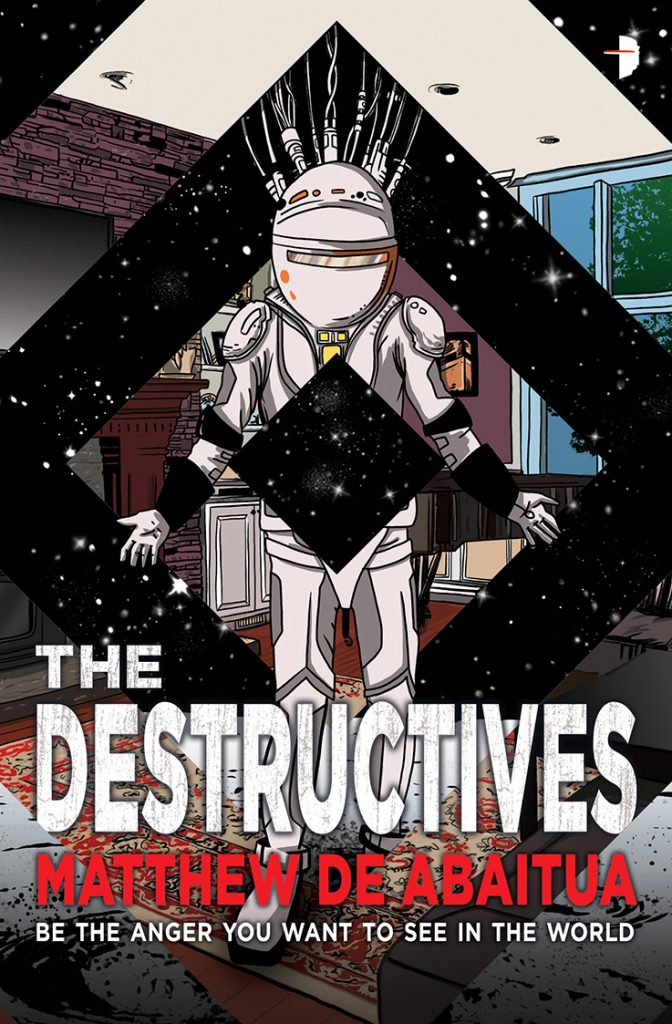 Thanks for giving us your time, Matthew. Your latest novel, The Destructives, is fresh out from Angry Robot — please, set the scene for us.
The world economy is disrupted by artificial intelligences, or emergences as they call themselves. After a few years of turmoil, the emergences decamp to a superstructure around the sun. One remains on Earth to study a single human life from beginning to end, the life of our protagonist Theodore Drown. Theodore is damaged from his addiction to a drug called Weirdcore and recovering as a lecturer on the University of the Moon. He is asked to investigate an archive of data from before the emergence and within that archive he uncovers a secret that will take him on an adventure through the asylum malls of Earth and to a remote off-world colony – there he will be faced with a choice that could create a new future for mankind, or destroy it.
I like the evocative labels you’ve created for what feel like semi-familiar social concepts, be they places (like asylum malls and corporate bloodrooms) or people — the idea of a “freelance executive” struck me first as ridiculous, but then after I thought about it as something that, damningly, already exists. Are these things what they sound like?
Extrapolating new cultures is key to my science fiction, particularly in The Destructives. I rub our existing culture against modish concepts from technology, neuroscience and theories of consciousness to map out how the self might change. Philip K Dick and JG Ballard remain relevant because their fiction predicts the psychopathy of the future; not the toys – the flying cars or jetpacks – but the states of mind induced by 21st century life.
The bloodroom is a corporate meeting room made from the cloned biomaterial of a CEO. It serves the dual purpose of augmenting the lifespan of the CEO and functioning as an intimidating environment in which to motivate or discipline staff. The bloodroom extrapolates a practical utility and a cultural role at the same time. The asylum malls are a mistake made by the artificial intelligences who realise that humanity requires treatment but we also likes shopping so they merge the two environments into one misunderstanding of the phrase “retail therapy”. Both technologies speak of a future that is not progressive but is rather an intensification or acceleration of the way things are now.
Having spent sixteen years in the twenty first century, I believe the key motif of our time is the loop. Consumerism loops us around and around but we no longer draw a sense of progress from pop culture and politics. In The Destructives, humanity is stuck in a loop while the artificial intelligences go off and explore the solar system and beyond.
Your own label, De Abaitua, is a reclaimed family name from your father’s side, done so partly at his request — not a dull tale in itself, and in recounting the events leading up to your embrace of it you described yourself as “obsessed with alternate selves”. What provoked this interest, and how does it move you creatively?
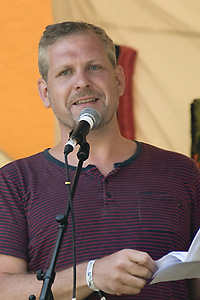 A childish reluctance to be defined, that is characteristic of being young or youngish in contemporary Western culture. There are various people that you may or may not become, and you want to give them all a chance. Particularly if your life experience involves moving from one class to another – in my case – or moving out of an ethnic or gender role into another. Those kind of migrations are accompanied by a degree of self-creation. Self-mythologising.
Also, I like strangeness and the uncanny. Your doppleganger differs from you by a couple of degrees, just enough to make you shiver with apprehension. There is the possibility that you are Mr Hyde and your good self, Dr Jekyll, is locked away somewhere, trying to track you down and bring you under control.
I remember that when The Red Men came out it boasted cover praise from Will Self — and, despite his skill for writing the weird, he’s not the first person I think of when it comes to science fiction as such. I felt the book had a “literary” air (and, although that’s not a label I generally like for the connotation of superiority, it is one I associate with Self’s work) alongside its obvious speculative themes, but some authors sniff at accusations of genre. Where do you see yourself on the spectrum?
Two of Will Self’s novels, The Book of Dave and Great Apes, are powered by science fiction conceits: the post-collapse world of The Book of Dave is influenced by Riddley Walker, and Great Apes is a satirical work that moves Planet of the Apes into an alternative contemporary setting. Ballard and Stanislaw Lem are powerful influences on Will Self’s work, as is William Burroughs, who was originally published in the UK as a way-out SF writer.
There is no way on God’s holy earth that Will Self would describe himself or his novels as science fiction because they are not generic; that is, they do not serve up a standard mix of storytelling elements to scratch a recurring itch for the reader. I’d have to embark upon a more detailed discussion with him about it rather than inferring or extrapolating his opinions about the matter: for me, I identify myself as a writer of science fiction. I follow Ursula Le Guin’s thoughts on this matter (aired in her review of Margaret Atwood’s work as a way of questioning Atwood’s position on speculative fiction).
 The Red Men uses characters and a voice from contemporary literary fiction mixed with science fiction technology. The novel has been embraced by the tech start-up community: its stylistic hybridity speaks to the ethical dilemmas that come with the technology and corporate lunacy demanded by their profession. It’s science fiction not as escapism but as something closer to memoir.
If Then comes out of an alternate tradition of science fiction that is identified as particularly British; writers of what used to be termed“scientific romance”, a term that predates science fiction, and encompasses writers such as Olaf Stapledon, HG Wells, and the odd foray into the genre from Kipling and Conan Doyle. In the 1960s, writers of New Wave science fiction, reacting against the Vietnam War, wanted to use science fiction tropes in a way that distanced their work from American military-industrial activity. So If Then is entirely science fiction but my definition of science fiction may differ from a consensus.
My novels are powered by science fiction ideas and I spend time refining my style – in a way that can be codified as literary, but which I just think of as writing – so that the reader’s experience of my fiction is more immersive, involving, disturbing. I’m stealing from the techniques of literary realism so that my science fiction is more believable.
I found The Red Men to be both unlike and reminiscent of William Gibson — the chief difference being a less stripped-down prose style, and the chief similarity being a very strong sense of place in your rendering of London. To what degree do you consider location an important factor in your story-telling?
Yes, Gibson’s early style is noir. I am a massive fan of The Peripheral. I loved that novel, and his style now takes in more shades than noir. Whereas The Red Men was more abundant in its voice. A bit over-abundant, so I cut out about thirty thousand words when it was reissued as an ebook by Gollancz.
A sense of place is crucial to me. I could only set the opening of The Destructives on the moon by studying maps, high-definition photography, and accounts of the people who’ve been there. When I realised that the moon is a landscape shaped entirely by destruction – through the erosion caused by millions of meteorite strikes – then I could imagine what it would be like to hike across its terrain. Likewise, If Then is a combination of two places; one, the Sussex Downs, which I know well, and secondly the battleground of Suvla Bay in the First World War; again, I could only write scenes set on Suvla Bay once I had researched the place so thoroughly that I could draw a freehand map of its various hills, patches of vegetation and salt lake.
The underlying structure of my novels is a shift from place to place, and each fictive place is made out of a mix of experience and research; the keen attention to place is to make the novel “scarily immersive”, as a person on Twitter described The Destructives.
Are there particular writers, sf or otherwise, whom you seek to emulate in one way or another?
I try to steal something from every good novel that I read. So I’m more influenced by individual works than authors.
I’m reading Christopher Priest’s forthcoming novel The Gradual at the moment and I admire the deliberate pace, and how he actively resists a florid style as that would distract from the patient layering of the dream of the fiction. Equally, I’ve been in thrall to the highly-wrought, Nobel Prize-winning style of Saul Bellow to the point of carrying his short stories around with me everywhere and studying the structure of his paragraphs. Ursula Le Guin’s The Dispossessed continues to provoke me because it throws down the challenge of devising a workable utopia. I never want to lose sight of the excitement in the storytelling of Alfred Bester’s The Stars My Destination or the charged mystery of Arkady and Boris Strugavsky’s Roadside Picnic. More recently, I’ve been responding to Jeff Vandermeer’s use of swampland in Annihilation. There’s more to be done in mixing the literatures of the wilderness with science fiction – getting away from the futuristic city and into the evolving wild.
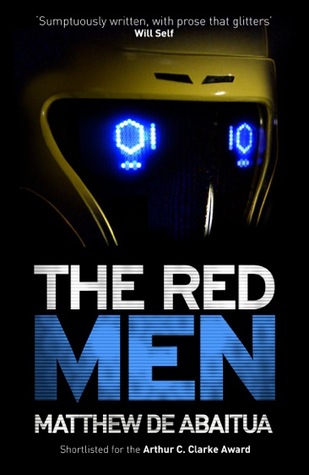 The Red Men’s release enjoyed an unusual perk: it provided the inspiration for the striking short film DR. EASY (which can be seen here — very much recommended). Can you tell us how this came about, and are there still plans for a larger film project based on the novel?
Dr Easy was written and directed by Shynola and produced by Warp Films. They continue to hold the option for a feature film of The Red Men and I believe they have secured funding for a scriptwriter to work on it. Shynola came across The Red Men via a mutual friend; I gave him the then-unpublished manuscript and asked him to pass it onto Shynola. They work in Hackney and know the area well, and being big fans of SF were keen to make it. Their online mood board for the adaptation can be seen at http://www.theredmenmovie.com.
The Red Men, If Then (which we spoke to you about before) and The Destructives represent a loosely connected trilogy, and I’m interested to know if they were planned as such in advance. Is there an escalation of a particular central concept that is shared by them all, or are they more complementary equals?
Complimentary equals. Not sequels or prequels. Each novel stands alone dramatically but shares themes and a world with the others. The central concept is: can we be translated into data? In The Red Men, the self is turned into a data set that powers a simulation of an individual. In If Then, there is an attempt to organise a society according to metrics and administered by algorithm. In The Destructives, we discover how the emergence of artificial intelligence is partially influenced by attempts to quantify the self. We run our societies by translating them into metrics and data, which we then analyse and attempt to alter. Our conception of what it means to be human is challenged by these dominant methods of social influence. We have exchanged ideology for analytics – creating a new ideology that is one remove from the human.
The novels weren’t planned in advance. That would have required the mind map of a madman.
Do you have any regrets regarding the trilogy, now you are able to look back on it as finished? Is it finished, even, or will you expand on this world in the future?
I’m done with the theme of quantified self but there are more stories to tell in that world. All three novels riff on digital culture and we’re coming to the end of that now – Google and Apple are holding onto our imagining of the future by their fingernails. They have hit a wall of useful innovation, and are reduced to cooking up self-driving cars and wearable tech in an attempt to keep futurism as part of their brand. But digital tech has failed significantly to deliver substantial benefits to our societies; an unexpected consequence of the network effect has been the establishment of supra-national monopolies that are inimical to nation states, and lower the price of labour, and are therefore disruptive of democratic freedoms. All that remains is for the tech billionaires to play out their science fiction fantasies of agency by dying on Mars. As a writer, I have to look elsewhere for my futures.
What new projects do you have on the horizon?
Nothing on the boards yet. Nothing official. I’m planning something. Dreaming it up. Researching it. We’ll see.
Interview by Andrew Leon Hudson – SFFWorld.com © 2016